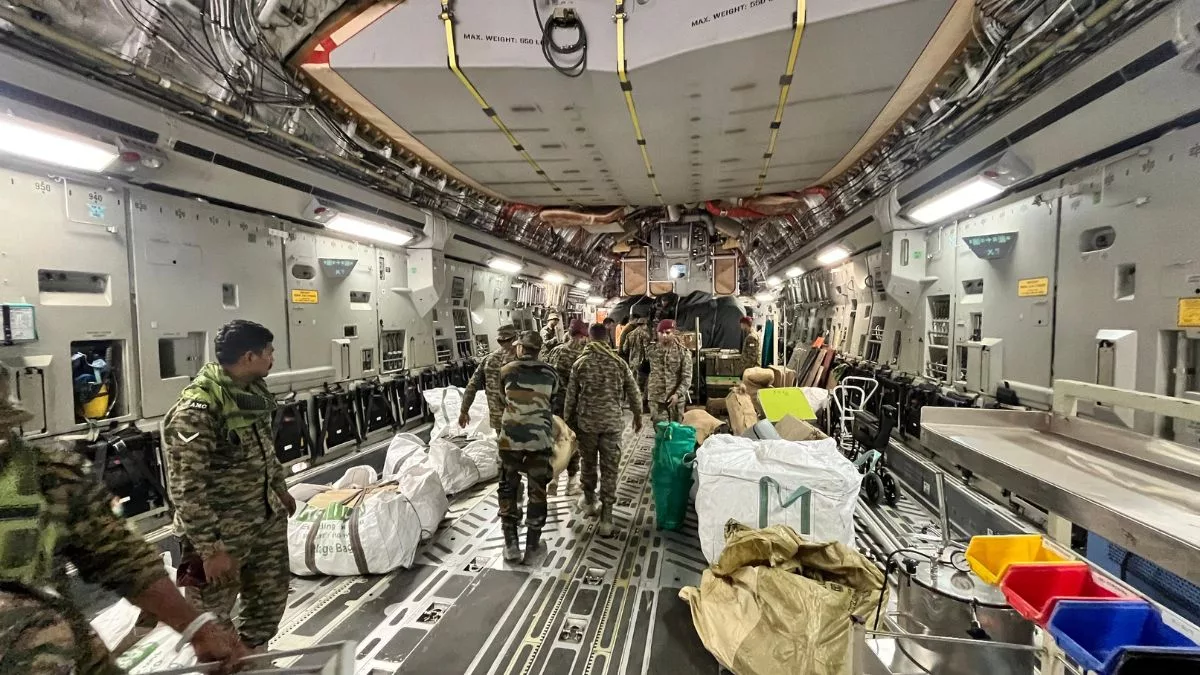
Amidst multiple reports of an Indian Air Force plane carrying relief material to quake hit Myanmar, coming under cyber-attack mid-air, the Indian Air Force has issued a clarification categorically stating that its crew were capable of handling such situations while ensuring the safety of flights.
Notably following the devastating 7.7 Richter scale earthquake in Myanmar, India used C-130J Super Hercules, and C-17 Globemaster heavy-lift transport aircraft to carry relief materials and rescue teams.
Advertisement
The first consignment was sent on March 29, a day after the quake, using a C-130 J aircraft. As per the reports, a total of six aircrafts were used under the relief operations, termed Operation Bramha.
While five planes landed in Yangon and Nay-Pyi-Daw on March 29-30, one was dispatched to Mandalay on April 1. As per media reports, the GPS signal of a plane was tampered mid-air while it entered Myanmar’s airspace.
Fuelling the speculations further, Air Marshal Sanjeev Kapoor (rtd), an IAF veteran, in a post on X (formerly known as Twitter) said that plane carrying relief material was placed under cyber attacks and GPS spoofing.
Dubbing it as the ‘untold story’ Kapoor wrote, “As Indian aircraft entered Myanmar’s airspace with aid, something unusual happened, GPS glitches, Navigation anomalies, Comm sys slowed down. This wasn’t random. It was electronic interference possibly hostile & highly calculated. GPS spoofing a tactic increasingly seen in grey zone warfare was in play.
The crew of C- 130 & C-17 reported, Altitude mismatches, Aircraft location ‘jumps’, Drop zones disappearing In remote, post quake zones, this is more than a glitch.
Simultaneously, cyber intrusions targeted rear end mission systems, malware in planning terminals, phishing, attempted data corruption. Objective may have been to disrupt India’s aid tempo.”
“But the @IAF_MCC crew countered by, switching to INS & TACAN, used terrain following radar & encrypted SATCOM. The EMCON protocols kept emissions discreet & secure. In my opinion, why does this matter? Because humanitarian ops are the new battlefield. Grey zone actors exploit crisis to test digital resilience, probing not just borders, but bandwidths.
“The crew finally relief drops at makeshift airstrips, made evacuations from unstable terrain, executed medical logistics under degraded GPS #OperationBrahma wasn’t just about #HADR, it was a real time test of airpower, cyber preparedness & leadership under pressure,” the post read.
Deemed to be a type of cyber attack, GPS (Global Positioning System) spoofing includes generating false GPS signals which misleads navigation equipment posing a serious threat to the aircraft and its crew.
As per reports as soon as the pilots of the aircraft under threat became of aware of the “GPS interference and spoofing” by unknown sources, the pilots activated the backup system called ‘inertial navigation system.’
Even though the IAF did not confirm the GPS Spoofing, it issued a statement on Monday night.
“The possibility of degraded GPS availability was published by Mandalay International Airport as NOTAM (Notice to Airmen), and all due precautions were put in place to cater for such conditions,” the IAF said in a social media post. “IAF crew are well capable to handle such unavailability, while ensuring safety of flight and achievement of the designated task or mission. Accordingly, every mission was achieved as planned,” it added.