‘They attacked us twice mid-talks’: Iran arrives in Islamabad with photographs, red lines, and little faith
Tehran’s tough preconditions, Hormuz tensions and Pakistan’s mediation set the stage for crucial US-Iran talks that could shape the next phase of the West Asia conflict.
Statesman News Service | New Delhi | April 11, 2026 10:14 am
Photo source: X/@mb_ghalibaf
The United States and Iran are heading into crucial ceasefire talks in Islamabad, but the mood is tense, with both sides carrying visible mistrust and very different expectations from the negotiations.
The talks come at a sensitive moment in the West Asia conflict. A ceasefire is technically holding, but the situation on the ground is still tense, with unease on both sides and fears that things could flare up again.
Advertisement
According to reports in The Washington Post, both countries appear to be united only in their urgency to find a way out of the conflict, even as their negotiating positions remain far apart.
Advertisement
Arrival of the delegation of the Islamic Republic of Iran for Islamabad Talks pic.twitter.com/aJYU9cx5t2
— Ministry of Foreign Affairs – Pakistan (@ForeignOfficePk) April 10, 2026
Pre-conditions, pressure points define talks
Ahead of the discussions, Washington and Tehran exchanged accusations, each questioning the other’s intent. US President Donald Trump described Iran’s proposals as “a hoax” and criticised Tehran’s restrictions on tanker movement through the Strait of Hormuz, calling the move “dishonourable,” The Washington Post reported.
Iran, on the other hand, has drawn clear red lines. Parliamentary Speaker Mohammad Bagher Ghalibaf insisted that issues such as the release of “blocked assets” must be resolved before any formal negotiations begin, according to The Washington Post and The New York Times.
Reiterating Tehran’s position after reaching Islamabad, Ghalibaf said, “Our experience of negotiations with the Americans has always been met with failure and breach of promise. They attacked us twice in the middle of the negotiations. We have goodwill but no trust.”
He added that previous engagements had repeatedly collapsed, warning that Iran would not accept talks lacking sincerity.
The Iranian delegation, which arrived in Islamabad late on Friday, includes representatives from key sectors such as security, political, military, economic and legal domains, underlining the wide scope of the talks, according to Iranian state media reports.
It is led by Foreign Minister Seyed Abbas Araghchi, along with Ali Akbar Ahmadian, Secretary of Iran’s Defence Council, and Abdolnaser Hemmati, Governor of the Central Bank of Iran. Several members of the Iranian parliament are also part of the delegation.
Iranian Parliament Speaker Mohammad Bagher Ghalibaf arrives in Islamabad with a high-level delegation ahead of ceasefire talks with the United States on April 11, 2026. (Photo: Xinhua via IANS)
Symbolism and signalling on way to talks
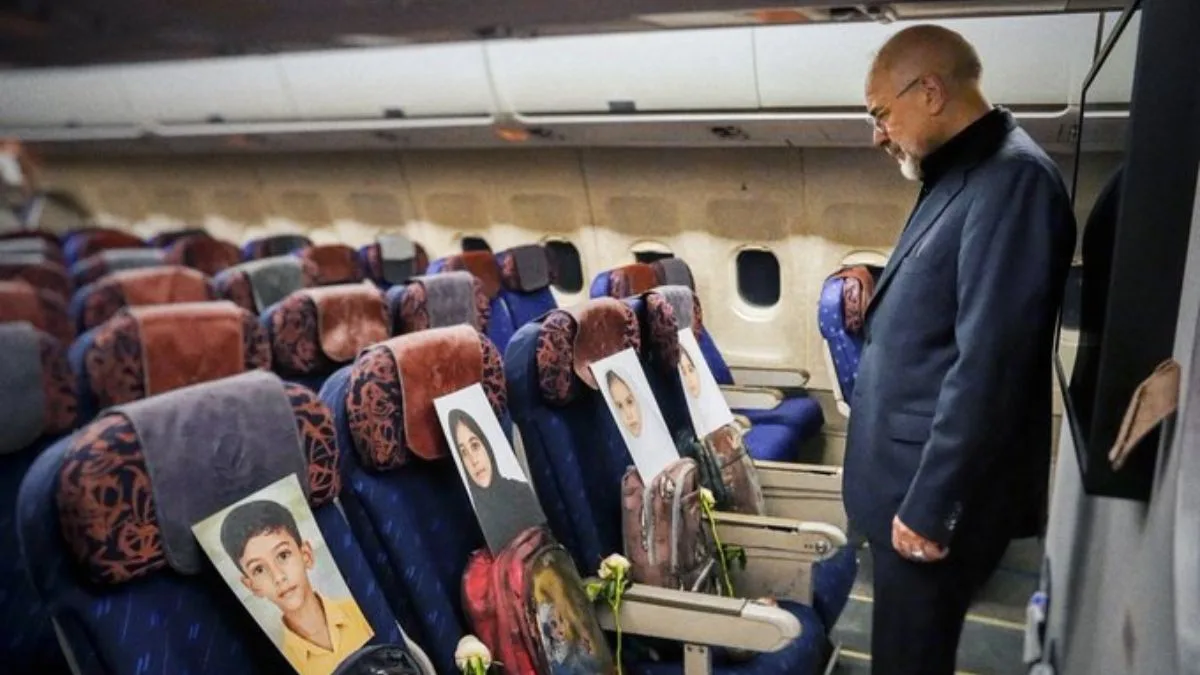
In a striking visual message ahead of the negotiations, Ghalibaf carried photographs of victims of the Minab school attack on his flight to Pakistan. The images, placed on empty aircraft seats alongside backpacks and roses, referenced the February 28 strike that Iran says killed children and staff.
Sharing the moment on X, he wrote, “My companions on this flight, Minab 168.”
The incident, which reportedly caused at least 165 deaths and over 100 injuries, has become central to Iran’s diplomatic narrative ahead of the talks.
Tehran has also reiterated that its preconditions remain non-negotiable. In a post on X, Ghalibaf said two agreed measures were yet to be fulfilled, including a ceasefire in Lebanon and the release of Iran’s blocked assets.
“Two of the measures mutually agreed upon between the parties have yet to be implemented: a ceasefire in Lebanon and the release of Iran’s blocked assets prior to the commencement of negotiations. These two matters must be fulfilled before negotiations begin,” he said.
— Embassy of IR Iran Pakistan (@IraninIslamabad) April 10, 2026
US signals openness, but draws lines
Leading the American delegation, Vice President JD Vance struck a cautious but optimistic tone. “I think it’s going to be positive,” he said, adding, “If the Iranians are willing to negotiate in good faith, we are certainly willing to extend the open hand.”
However, he also issued a warning: “If they’re going to try to play us, they’re going to find that the negotiating team is not that receptive.”
Trump, meanwhile, indicated that Iran may be overstating its leverage, particularly in the context of tensions around the Strait of Hormuz.
Vance, who departed for Islamabad earlier in the day, is leading the US delegation. According to the White House, US Special Envoy Steve Witkoff and Jared Kushner are also part of the team.
The first round of talks is expected to take place on Saturday morning, local time.
Strait of Hormuz, sanctions key sticking points
One of the most contentious issues remains Iran’s actions in the Strait of Hormuz, a vital global energy corridor. Tehran has imposed new controls requiring tankers to seek permission and has begun collecting tolls, a move US officials have termed “illegal” and “unacceptable,” according to The Washington Post.
The disruption has already impacted global markets, pushing oil prices higher and raising concerns about energy supply stability.
Washington is pushing for the Strait to reopen fully, but Iran doesn’t seem ready to let go of a key advantage it holds in the current standoff.
Differences extend to broader demands as well. Iran has rejected calls to halt uranium enrichment and scale back its missile programme, while the US has made it clear that sanctions relief would come only after a formal agreement is reached.
Pakistan steps in as mediator
Pakistan is hosting the talks and has positioned itself as a key intermediary between the two sides. Prime Minister Shehbaz Sharif described the negotiations as a “make or break” moment, The Wall Street Journal reported.
Islamabad has been actively involved in earlier diplomatic efforts, including helping facilitate the current ceasefire, even as it manages its own economic and security challenges, according to The New York Times.
It remains uncertain whether the talks will be held directly or through mediation, with reports suggesting that both delegations may remain in separate rooms while Pakistan carries messages between them.
A key point of contention also remains the scope of the ceasefire. While Iran maintains that the truce includes a halt to Israeli military operations in Lebanon, both Washington and Israel have said it does not extend to Hezbollah targets, adding another layer of complexity to the negotiations.
Ceasefire holds, but future uncertain
The current conflict, which escalated earlier this year, has already drawn in multiple regional actors and disrupted global energy flows.
Although a temporary ceasefire was reached this week, its durability is in question as both sides continue to test each other’s intentions.
The talks are aimed at ending the over month-long conflict in West Asia and building on a two-week ceasefire agreement reached earlier this week, though its future remains uncertain.
The row escalated after New York City Mayor Zohran Mamdani said his administration was exploring the legal powers available if the Israeli Prime Minister visited the city, drawing a sharp response from both Washington and Jerusalem.
The new duties, announced under Section 338 of the Tariff Act of 1930, will apply to hundreds of Canadian products in 30 days, with exemptions for energy, potash, critical minerals and several other categories.
Explosions were reported across southern and central Iran after the US announced a new military offensive, while Kuwait activated air defences and regional tensions continued to spread.