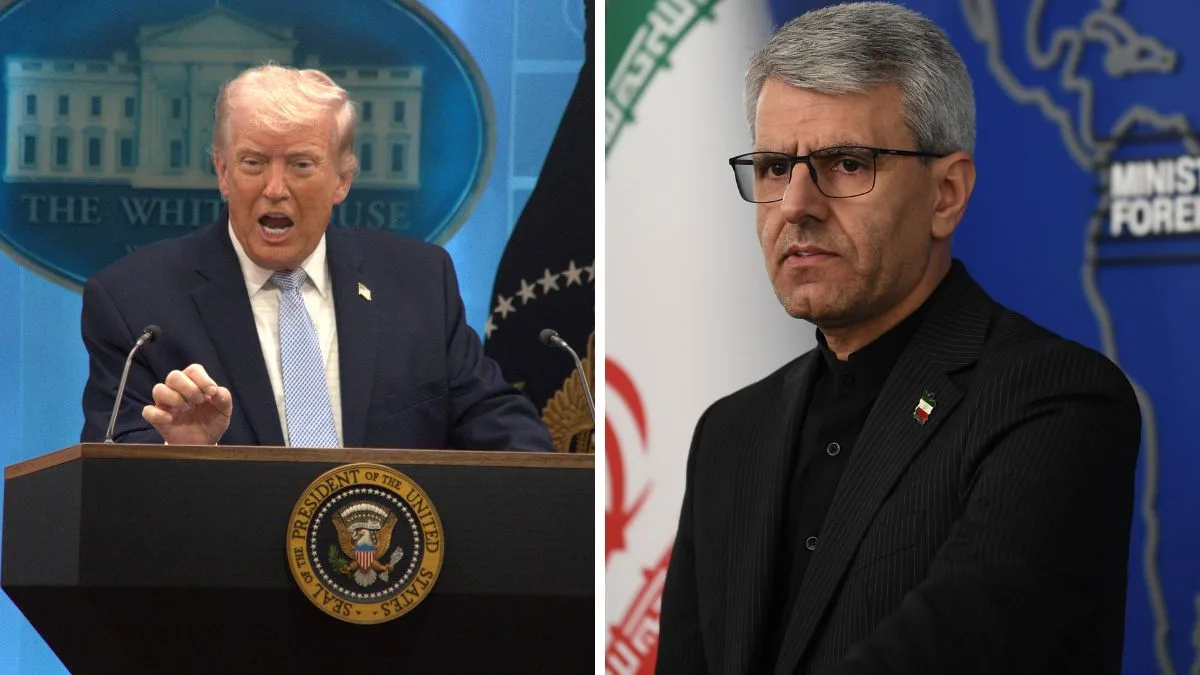
The United States and Iran appear to be inching towards another crucial diplomatic moment, with President Donald Trump claiming negotiations are in their “final stages” even as Tehran confirmed that fresh messages from Washington are under review.
Iranian Foreign Ministry spokesman Esmaeil Baghaei said Tehran was examining the latest American position conveyed through mediation channels, while stressing that Iran remained deeply distrustful of Washington because of its recent record. The renewed diplomatic push comes weeks after a fragile ceasefire halted 40 days of direct conflict involving Iran, the US and Israel, raising hopes that both sides may still avoid another military escalation.
Advertisement
Speaking to state-run IRIB TV, Baghaei said communication between Tehran and Washington had continued through Pakistan’s mediation efforts. According to him, Iran entered the talks “with goodwill and seriousness” but remained cautious due to what he described as hostile US actions over the past 18 months.
He said Iran’s demands included the release of frozen Iranian assets, an end to what Tehran called “maritime piracy”, and the lifting of restrictions affecting Iranian shipping routes.
Baghaei also said Iran, in coordination with Oman, was exploring a mechanism to ensure “lasting security” in the Strait of Hormuz. He added that Tehran was prepared to work with regional coastal states to create protocols for safe maritime movement in the strategically vital waterway.
According to Iran’s semi-official Tasnim news agency, Washington recently sent a revised draft proposal after Tehran submitted its own 14-point framework earlier this week. A source close to Iran’s negotiating team said the mediator was currently in Tehran attempting to narrow differences between the two sides, though no agreement had yet been reached.
Why the Strait of Hormuz remains central to US-Iran talks
The Strait of Hormuz has emerged as one of the biggest flashpoints in the ongoing tensions. Following the outbreak of the conflict earlier this year, Iran tightened control over the route and blocked vessels linked to the US and Israel.
After peace talks in Islamabad failed in April, the US imposed a naval blockade affecting ships travelling to and from Iranian ports through the Strait.
The waterway remains critical for global energy shipments, and any disruption there has triggered international concern over oil supply and regional stability.
Iranian President Masoud Pezeshkian, in a post on X on Wednesday, said Tehran had consistently tried to prevent further conflict.
“All paths remain open from our side. Forcing Iran to surrender through coercion is nothing but an illusion,” Pezeshkian wrote.
Trump says US willing to wait for ‘right answer’
At the White House, Trump indicated that Washington was prepared to give diplomacy one final opportunity before considering tougher action.
“We’re in the final stages of Iran. We’ll see what happens,” Trump told reporters.
“We’ll either have a deal, or we’re going to do some things that are a little bit nasty. But hopefully that won’t happen,” he added.
The US President also said he was “in no hurry” to secure what he described as a limited arrangement focused only on reopening the Strait of Hormuz.
“We’re going to give this one shot,” Trump said, ruling out the possibility of a partial compromise.
Trump further revealed that he had held a “very good” phone call with Turkish President Recep Tayyip Erdogan, whose government is seen as one of the key facilitators in the ongoing diplomatic efforts.
Even as talks continue, both sides have kept up sharp rhetoric.
Iran’s Islamic Revolution Guard Corps warned on Wednesday that any repeat of US-Israeli military action would expand the conflict beyond West Asia. Iranian Foreign Minister Seyed Abbas Araghchi also warned Washington against returning to war, referring to reports of US aircraft losses during the recent conflict.
The latest diplomatic activity follows the ceasefire reached on April 8 after weeks of fighting triggered by joint US-Israeli strikes on Tehran and other Iranian cities on February 28. One round of negotiations held in Islamabad on April 11 and 12 failed to produce a breakthrough.
In recent days, Trump has repeatedly warned of possible military action if no agreement is reached, while also insisting that Iran’s leadership was eager to strike a deal.