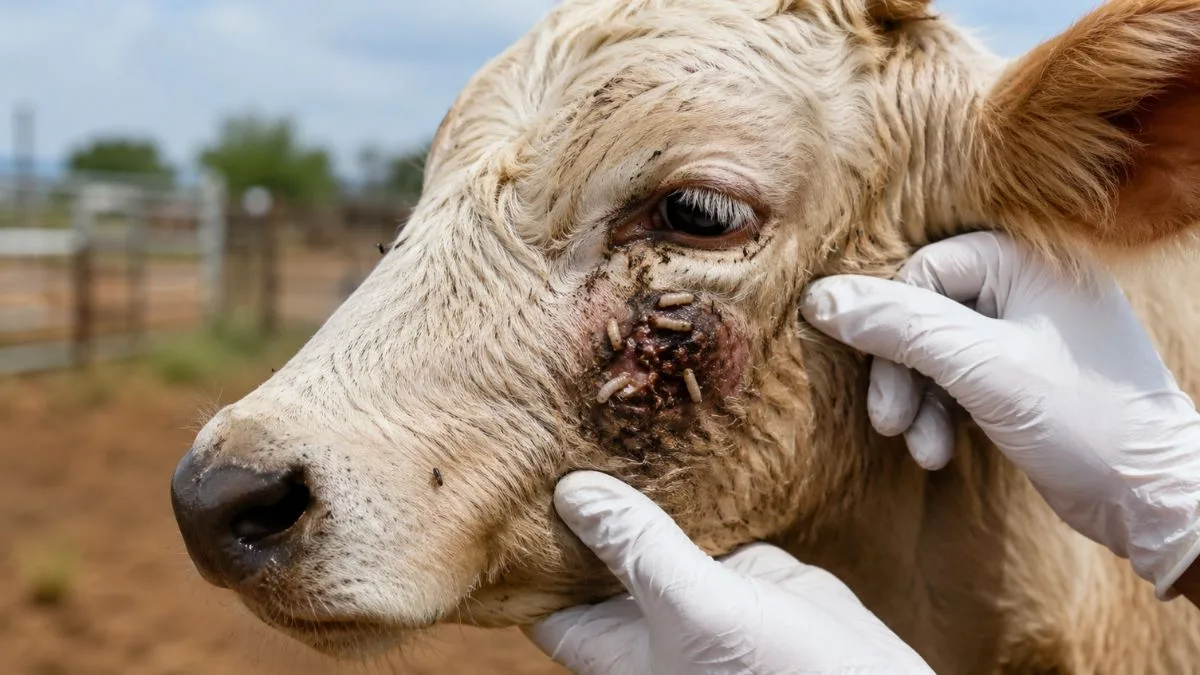
A parasite that sounds like it belongs in a horror film has put American agriculture on high alert.
The discovery of a New World screwworm infestation in a calf in Texas has triggered an emergency response from federal and state authorities, marking the first such case in the state since 1966. While officials insist the outbreak can be contained, the detection has rattled ranchers, traders and livestock producers who fear the pest could spread through the country’s already strained cattle industry.
Advertisement
The concern is not just about a single infected animal. The screwworm is a parasitic fly whose larvae feed on the living flesh of warm-blooded animals. Female flies lay eggs in open wounds or soft tissue, and once hatched, hundreds of larvae burrow into the host’s body. Untreated infestations can prove fatal.
Authorities have moved quickly to stop the parasite from gaining a foothold. Animal movement has been restricted in a 20-km radius around the affected area in La Pryor, Texas. Checkpoints have been set up on major roads, with livestock being inspected for signs of infection before being allowed to move.
US Agriculture Secretary Brooke Rollins said no additional cases have been detected so far and expressed confidence that the outbreak can be contained if movement restrictions and treatment protocols are followed.
Why cattle producers are nervous
The timing could hardly be worse for the US livestock sector.
America’s cattle herd is already at its lowest level in 75 years after years of drought forced ranchers to reduce herd sizes. Meat processors have struggled with limited supplies, and a widespread screwworm outbreak could add another layer of pressure.
Experts warn that if the parasite spreads across Texas, economic losses could run into billions of dollars. The state is one of the largest cattle-producing regions in the country, making it particularly vulnerable.
The discovery also briefly rattled cattle markets, with traders initially worried that consumers could become wary of beef products, although officials have stressed that screwworm does not pose a food safety risk.
The battle plan
The United States successfully eliminated screwworm decades ago using an unusual but highly effective strategy: releasing sterilised male flies into the wild. When female screwworm flies mate with them, they produce no offspring, gradually collapsing the population.
Officials are once again turning to that method. Sterile flies are being released both on the ground and from aircraft near the affected zone. The USDA is also building a new sterile-fly production facility, though it is not expected to be operational until 2027.
The case has reignited concerns that the pest, which had been advancing northward through Mexico, may be harder to keep out than previously thought. For now, the focus is on stopping a single infestation from becoming a much larger agricultural crisis.