At the time of writing this, a small bell symbol is quietly echoing across Nepal’s election map.
In Kathmandu, one seat has already fallen to the Rastriya Swatantra Party (RSP). In several other constituencies, the party is leading. For a political force that did not even exist a few years ago, the moment feels dramatic.
Advertisement
Supporters are excited. Critics are cautious. Political veterans are watching nervously.
Because the RSP, officially called Rastriya Swatantra Party, has become one of the most unusual experiments in Nepal’s modern politics. The party, often abbreviated as RaSwaPa, positions itself in the political center. It claims to represent a new generation frustrated with corruption, unemployment and slow governance.
But its story is not simple.
The party rose quickly. It entered government quickly. It faced scandal quickly. And now, in the middle of another election season, it is again testing whether its promise of “new politics” can survive controversy and internal turmoil.
To understand why the RSP still attracts attention, one must look closely at its short but dramatic history.
A party born out of anger
Nepal’s traditional political system had been facing deep frustration for years.
Large parties dominated parliament. Governments changed frequently. Corruption allegations were common. Many young Nepalis felt the political class had become disconnected from ordinary people.
Into this environment stepped Rabi Lamichhane.
On 16 June 2022, Lamichhane shocked many observers by resigning as managing director of Galaxy 4K Television, where he had built a strong reputation as a television personality.
Five days later, on 21 June 2022, he announced something bigger: the formation of a new political party.
That party was the Rastriya Swatantra Party.
The announcement included a 21-member central committee and a bold promise: politics would be different.
The party was formally registered with the Election Commission of Nepal on 1 July 2022, just months before the national elections.
Its election symbol was simple but memorable: a bell inside a circle.
For many supporters, the symbol carried a message: a wake-up call for Nepal’s political establishment.
The television star who jumped into politics
Lamichhane himself was not a typical politician.
Born in Kathmandu in 1975, he spent much of his early career in journalism and television.
He gained international attention in 2013, when he hosted a 60-hour talk show marathon, setting a Guinness World Record. The event brought him global publicity.
His programs often had sensational content. For instance, in one episode shot in Lalitpur’s Tikathali, he tried to drive away a ‘ghost’ in front of the camera. People laughed.
He did political content. For many viewers, he sounded like someone who was finally saying what ordinary citizens had been thinking for years.
After spending several years in the United States, Lamichhane returned to Nepal during the mid-2010s and eventually became the managing director of Galaxy 4K Television.
But journalism, it turned out, was not enough.
By 2022, he was ready to enter politics directly.
The shock of the 2022 election
Few political observers expected the RSP to make a big impact in the 2022 general election.
The party was new. It had little organisational structure. It lacked the long networks that traditional parties had built over decades.
Yet the result surprised almost everyone.
The RSP fielded candidates in 131 constituencies for the House of Representatives election. It did not contest provincial elections, choosing to focus on the federal level.
When the votes were counted, the party had secured 7 direct and 13 proportional representation seats.
In the party list vote, the RSP received 10.70 percent of the total ballots; roughly 1.1 million votes.
This result made the party the fourth-largest national party in Nepal.
Entering government
After the election, the RSP joined the coalition government led by Pushpa Kamal Dahal, widely known as Prachanda.
The party did not join as a minor observer. Lamichhane himself became Deputy Prime Minister. He also served as Home Minister, one of the most powerful positions in the cabinet.
Another RSP figure also gained a significant post. Indira Rana Magar, a member of the party, was elected Deputy Speaker of the House of Representatives.
For supporters, it seemed the party’s promise of generational change was finally taking shape.
But the celebration did not last long.
The citizenship crisis
In January 2023, Nepal’s Supreme Court delivered a major blow.
The court ruled that Lamichhane had not properly regained his Nepali citizenship after renouncing his United States passport.
Because of this technical but serious legal issue, both his parliamentary seat and ministerial position were declared invalid.
The decision forced him to step down.
For a leader who had just entered government with enormous momentum, the moment was deeply embarrassing.
The RSP quickly withdrew from the cabinet in response to the ruling, although it continued to support the government from outside.
Inside the party, Dol Prasad Aryal became acting president.
Lamichhane later reacquired Nepali citizenship and returned to politics. But the controversy left a shadow that would follow him for years.
Internal discipline and early scandals
The party also faced its first internal scandal.
One of its proportional representation lawmakers, Dhaka Kumar Shrestha, was accused of corruption. The RSP responded strongly.
Shrestha was replaced as a list MP and expelled from the party.
The decision was meant to demonstrate the party’s claim that it would not tolerate corruption within its ranks.
By-election comeback
Despite controversy, Lamichhane remained popular with many voters.
In 2023 by-elections, he contested from Chitwan-2 and won again, this time with an even stronger mandate.
At the same time, the RSP also captured Tanahun-1, expanding its presence in parliament.
Despite legal disputes and criticism, the party’s support base remained strong.
Back to government, briefly
The RSP rejoined the Prachanda-led coalition government again in March 2024.
This time the party received four cabinet ministries.
But the alliance proved fragile.
By 12 July 2024, political disagreements caused the coalition arrangement to collapse, and the cabinet was dissolved.
For the RSP, the second entry into government ended almost as quickly as the first.
Leadership turbulence
The party also experienced internal leadership tensions.
In one notable incident, general secretary Mukul Dhakal was expelled from the party for violating party rules.
Leadership reshuffling continued.
In June 2025, Kabindra Burlakoti was appointed general secretary. Manish Jha became party spokesperson.
The changes suggested that the party was still trying to stabilise its internal structure.
The cooperative fraud case
The biggest challenge came in October 2024.
Lamichhane was arrested over allegations related to cooperative fraud. The accusations triggered a major political storm.
He was later placed in judicial custody in Bhairahawa as investigations continued.
Once again, Dol Prasad Aryal stepped in as acting president.
For critics, the arrest raised serious questions about Lamichhane’s image. For supporters, it looked like a politically motivated attempt to destroy a rising outsider.
The legal case remains one of the biggest factors shaping the party’s future.
The famous ‘12 bhai’ controversy
Lamichhane’s relationship with Nepal’s media also became controversial.
After losing his ministerial post in early 2023, he held a press conference where he harshly criticised journalists.
During the event, he accused a group of editors of plotting against him and referred to them as the ‘12 bhai’, a supposed group conspiring to damage his reputation.
His comments included personal attacks and warnings that he might reveal journalists’ private lives.
The remarks triggered strong backlash.
Journalists’ organisations accused him of threatening press freedom. Civil society groups warned that such rhetoric could encourage harassment of reporters.
Lamichhane later apologised and admitted he had spoken emotionally.
But the phrase ‘12 bhai’ quickly became political shorthand for his confrontational relationship with the media.
The clash between populist politics and institutional oversight has now become part of the RSP’s identity.
The paradox of ‘new politics’
The RSP was built on frustration with traditional parties.
Its core promise was simple: politics would be transparent, youthful and accountable.
Yet some observers see a contradiction.
Lamichhane’s aggressive criticism of journalists reminded critics of the same intolerance often displayed by older political leaders.
At the same time, the cooperative fraud allegations created tension with his anti-corruption message.
This contradiction raises an uncomfortable question. Can a movement built on anger against old politics succeed if its leaders start behaving like the politicians they once criticised? The answer is still unclear.
Is RSP the new alternative? That’s unclear, too.
The Gen Z protest
Nepal’s Gen Z protest movement in 2025 also affected the RSP.
The demonstrations, driven largely by younger citizens frustrated with the political system, reshaped political discussions across the country.
Within the RSP, the protests triggered some departures.
Former MP Sumana Shrestha resigned from the party. Chief whip Santosh Pariyar left and later joined the Pragatisheel Loktantrik Party.
The exits raised questions about internal unity.
However, the party also experienced expansion at the same time.
A major merger attempt
In December 2025, the Bibeksheel Sajha Party merged into the RSP.
Bibeksheel Sajha had long promoted urban reform agendas. Its merger with RSP suggested a possible consolidation of Nepal’s reform-oriented political forces.
Another ambitious plan was also discussed.
The RSP signed an agreement to merge with the Ujyaalo Nepal Party and to bring Kathmandu Mayor Balen Shah into the party.
The idea attracted national attention. But the plan did not survive.
The agreement with Ujyaalo Nepal eventually collapsed, and the merger never happened.
An unusual party structure
From the beginning, the RSP tried to present itself differently from traditional political parties.
One of its most unusual decisions was organisational. The party declared that it would not create sister organisations, such as student unions or youth wings.
Instead, it said the party would have members rather than cadres.
This language was meant to distance the RSP from the hierarchical structures that dominate many South Asian political parties.
The party also promised something rarely seen in Nepali politics: primary elections.
Candidates for the 2022 general election were selected through internal primaries, allowing members to vote on who would represent the party.
Election moment again
And now, another election has taken place.
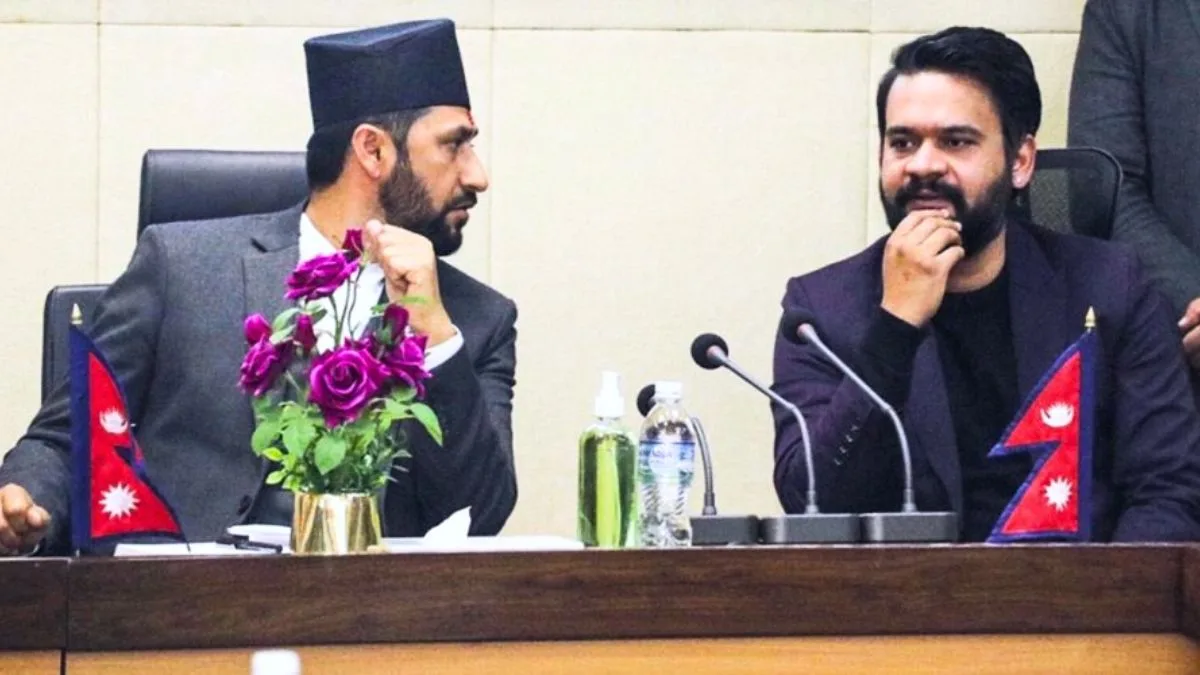
At the moment of writing, the RSP has already won one seat in Kathmandu and is leading in several other constituencies. Balen Shah, the party’s pick for PM, is fighting against former PM KP Sharma Oli in Jhapa. Lamichhane and Shah joined hands for this election.
Now there are questions. Is the RSP becoming a stable political force? Or is it still dependent on the personality of one controversial leader (now two)?
Nepal’s democracy is still relatively young. Since the country became a republic in 2008, politics has remained fluid, with alliances shifting and new parties emerging.
The RSP represents one of the most dramatic attempts to reshape that landscape.