Bangladesh President Mohammed Shahabuddin resigns nearly 2 years before completing his tenure
In accordance with the Constitution of Bangladesh, the speaker shall perform the duties of the president until the office is occupied by a new president.
The broadcast declaring independence from what was dubbed as the Swadhin Bangla Betar Kendra, claimed that those battling for Bangladesh’s independence had surrounded West Pakistani troops in the cities of Sylhet, Jessore, Barisal and Khulna as well as in Chittagong and Comilla.




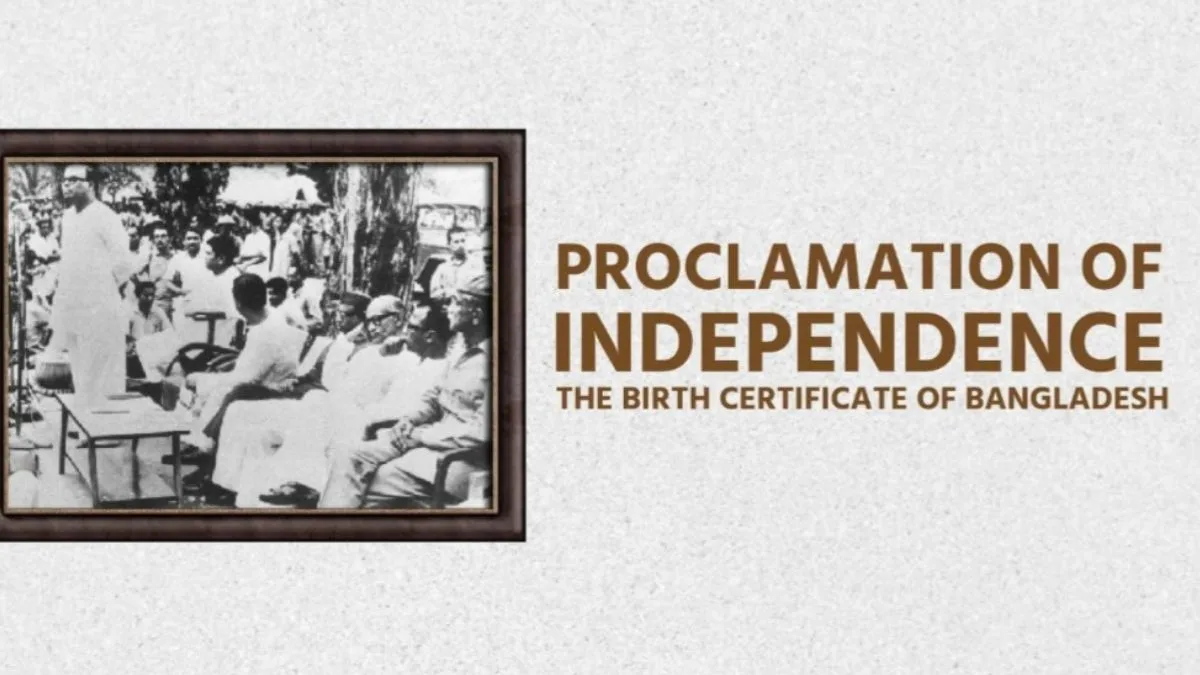
Some 55 years ago, on this day, an independent republic of Bangladesh was proclaimed.
As Pakistan’s military ruler Gen Yahya Khan banned all political activities in the nation’s eastern wing and began a brutal crackdown on political leaders and civilian population, Awami League’s leader Sheikh Mujibur Rahman who had long been campaigning for autonomy of his riverine land, declared independence.
Advertisement
The proclamation was read out the next day from a radio station at Kalurghat, near the Indian border with Tripura, by the then Major Zia Ur Rahman, whose son Tarique Zia, was elected the Prime Minister of Bangladesh in polls held recently.
Advertisement
Indian news agency dispatches of that time said that fighting broke out on this day itself between regular military troops from West Pakistan on one side and East Pakistani policemen and the paramilitary East Pakistani Rifles on the other, at many areas including Chittagong, Comilla and Rangpur, as well as at the capital city of Dhaka.
Despatches said that at least 10,000 soldiers from West Pakistan had been transported to the East, raising the total there to about 70,000 regular troops, who armed with tanks, artillery, mortars, besides the usual rifles and machine guns, attacked their East Pakistani uniformed counterparts and civilian citizenry.
The attacks came after “a serious deadlock” in the talks between President Yahya Khan, Sheik Mujib and Zulfikar All Bhutto, chairman of the West Pakistani dominant party, the Pakistan People’s party.
The broadcast declaring independence from what was dubbed as the Swadhin Bangla Betar Kendra, claimed that those battling for Bangladesh’s independence had surrounded West Pakistani troops in the cities of Sylhet, Jessore, Barisal and Khulna as well as in Chittagong and Comilla.
“Sheikh Mujibur Rahman is the only leader of the people of independent Bangla Desh and his commands should be obeyed by all sections of people to save the country from the ruthless dictatorship of West Pakistanis, the broadcast said.
It reiterated the Awami League’s decision to organise a strike, throughout the eastern wing to protest army attacks in the last few days that reportedly had resulted in the death of more than 100 civilians.
Before this happened, in the early hours of 26th of March 1971 itself, Mujib himself was picked up by an army coloumn from his home at Dhanmandi in Dhaka and flow down to be jailed in West Pakistan in a swoop nicknamed ‘Big Bird’.
Elsewhere in the city, troop carriers and jeeps fitted with wireless sets rumbled through the streets late that night, their engines breaking a tense and watchful calm.
Near a place called Farmgate, about a kilometre from the military cantonment on the outskirts of Dhaka, the first of the advancing Pakistani columns met an unexpected obstacle– a makeshift barricade of felled tree trunks, broken down cars and even a stranded steamroller, hastily assembled hastily by students.
Behind it stood several hundred ordinary people, chanting in defiance. The shooting started soon after, killing people indiscriminately.
Army coloumns then attacked civilian houses in Old Dhaka, killing thousands. Flamethrowers were used to torch houses and force people to rush out, only to be mowed down. At Dhaka University, the violence took on a more deliberate character. Miliatry personnel stormed into student dormitories. Residents were pulled from their rooms; some were shot where they stood, others after being assembled outside. Faculty members were sought out in their quarters and killed. The Shaheed Minar, a symbol of cultural identity, was reduced to rubble. In Jagannath Hall, students were lined up and executed. Among those killed were the philosopher Govinda Chandra Dev and well-known academic, Jyotirmoy Guhathakurta.
On the eve of his arrest by the Pakistani army, Sheikh Mujibur Rahman, however, moved decisively to set the course for a break with Islamabad.
Late on the night of March 25, as military operations began in East Pakistan, he issued instructions urging his followers to resist and sent out the declaration of independence.
Reports carried in leading international newspapers, including The Times, cited clandestine radio broadcasts asserting that the Sheikh had declared the tens of millions of people in East Pakistan to be citizens of a sovereign, independent Bangladesh.
Gen Yahya Khan in a separate broadcast to his people warned that the situation in East Pakistan “had taken a very serious turn” and added “I have ordered the armed forces to do their job and fully restore the authority of the Government.” Intellectuals – academics, journalists ; Awami league leaders and Hindus were specifically targeted in the army crackdown codenamed ‘Operation Searchlight’, which rapidly wound its way throughout the countryside, sending millions streaming for safety across the border to India.
In time, as pro-independence fighters and Awami League cadres streamed into India along with the refugees, a Mukti Bahini was formed as also a provisional government of Bangladesh, which set up base in central Kolkata, besides a clandestine radio station which worked out of a rented house in Ballygunge Circular Road.
Refugee camps and rebel training bases sprung up along the border and the war for liberating East Pakistan started. The rest as they say, is shared history for both the new republic and its neighbour India.
Advertisement