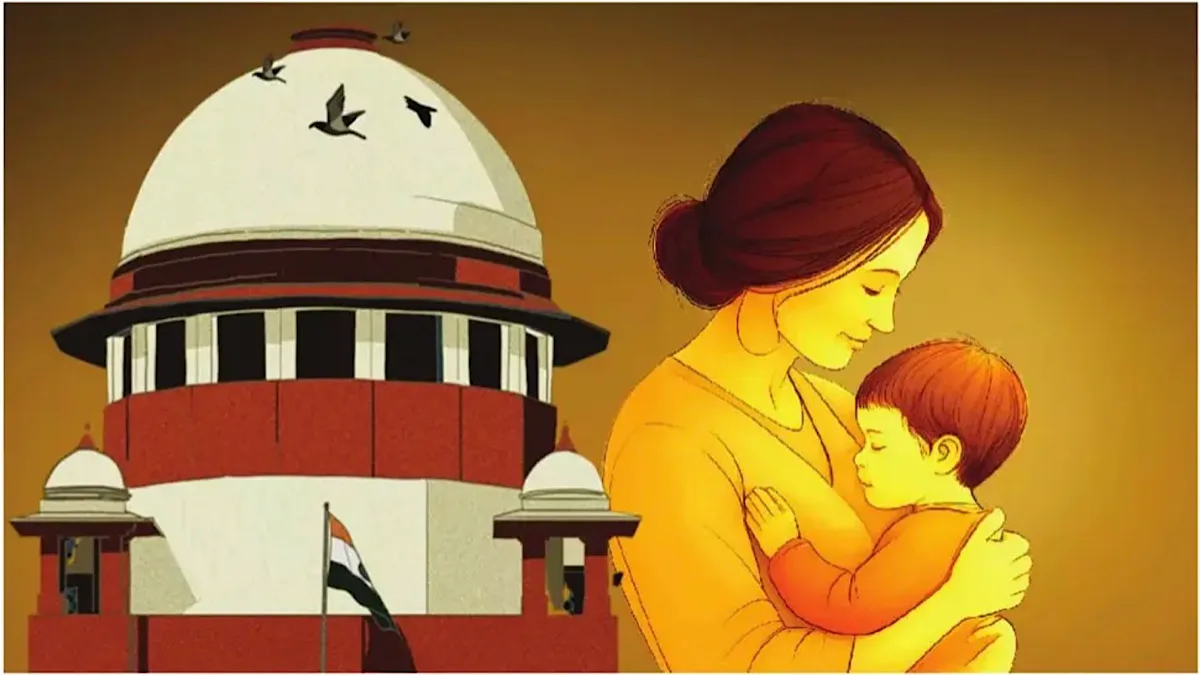
The Bombay High Court’s recent decision in ABC versus State of Maharashtra has recognized a long-denied truth: a single mother is a complete parent. The case involved a mother who sought to have her child’s surname and caste in school records changed to her own, as she was the child’s natural guardian and had been solely responsible for the child’s upbringing. The father, accused of impregnating the woman by sexual assault, had renounced any relationship, responsibility, or role in the upbringing of the child through a recorded settlement.
In granting relief, the court questioned the deeply embedded assumption in Hindu law that lineage belongs to the male line and that a child’s identity must flow through the father, even though the burden of care is on the mother. The court recognized that this burden is even greater in cases of single motherhood, where the child’s custody is with the mother. Beyond the matter of documentation, the court affirmed that children cannot be made to bear the consequences of adult conduct or the burden of social stigma and outdated family norms, and the state cannot preserve these assumptions merely because they are old. A mother might be a complete parent for a child’s civic identity, but the Hindu inheritance law still does not treat her as a source of legal continuity.
Advertisement
The transmission of property within families still revolves around family membership and paternal lineage, and courts remain less willing to apply the same equality-based reasoning in inheritance cases. Far-reaching reforms have been made to the customary Hindu law through the Hindu Succession Act, 1956, especially by the 2005 amendment, which made daughters coparceners by giving them rights by birth in their father’s joint family property. Yet these reforms have not entirely unsettled the deeper patrilineal structure of coparcenary and the rights that flow from it. On the one hand, the Delhi High Court in Manu Gupta v Sujata Sharma has given a broader interpretation to the amending law, holding that daughters must enjoy the same rights as sons in all aspects of the Hindu joint family, including the right to act as Karta of the family.
Conversely, the Bombay High Court in Vishwambhar v. Sunanda has taken a narrower view by denying birth rights of children in the joint family property coming from their maternal line. Relying on an old 1937 ruling, the court restricted the meaning of this property to flow only through the male line, refusing to treat females as sources of such lineage, despite them having received the statutory rights of coparceners. So, a mother might be an equal, but her lineage is not. The continuing emphasis on the male line as the only recognized source of joint family property shows how the family’s identity under inheritance laws is still linked to the outdated assumptions of lineage being paternal and heavily dependent on the marital status of the parents.
Such an interpretation is out of step with the social reality where various new forms of families have developed over the last few decades. This includes single mothers with sole custody, or unmarried women who have legally adopted a child. In these cases, a child is raised solely by the mother and her family, but when it comes to the birth rights in the property, the law will be on the lookout for the father, who could be absent, untraceable, unbothered, or non-existent. This rigid imagination also adversely affects the rights of children who are born outside of marriage or in relationships that are not in the nature of a marriage. The inheritance laws have left these children in a vulnerable position where they are not even considered related to the father or his family and can only inherit from the mother, not even the rest of the maternal line.
If the child’s mother dies, this child could be left destitute, having no rights to the properties held by the paternal or maternal lines, depending entirely on wills or gifts for financial security. The Bombay High Court’s recognition that the state cannot insist on paternal identity must also extend to property and inheritance rights. By continuing to tie birthrights to paternal lineage, the law unfairly burdens children born into non-traditional families, leaving them financially and legally vulnerable. However, this is as much a legislative concern as a judicial one.
The 2018 Law Commission Consultation Paper’s recommendations to abolish the coparcenary system and reform the inheritance rights of children under the Hindu Succession Act deserve urgent reconsideration to provide financial security and economic rights to children born outside of traditional marriages. It is time for the law to recognize that lineage, like care, must flow as clearly from the mother as from the father..
(THE WRITER IS ASSISTANT PROFESSOR OF LAW, O.P. JINDAL GLOBAL UNIVERSITY, SONIPAT.)