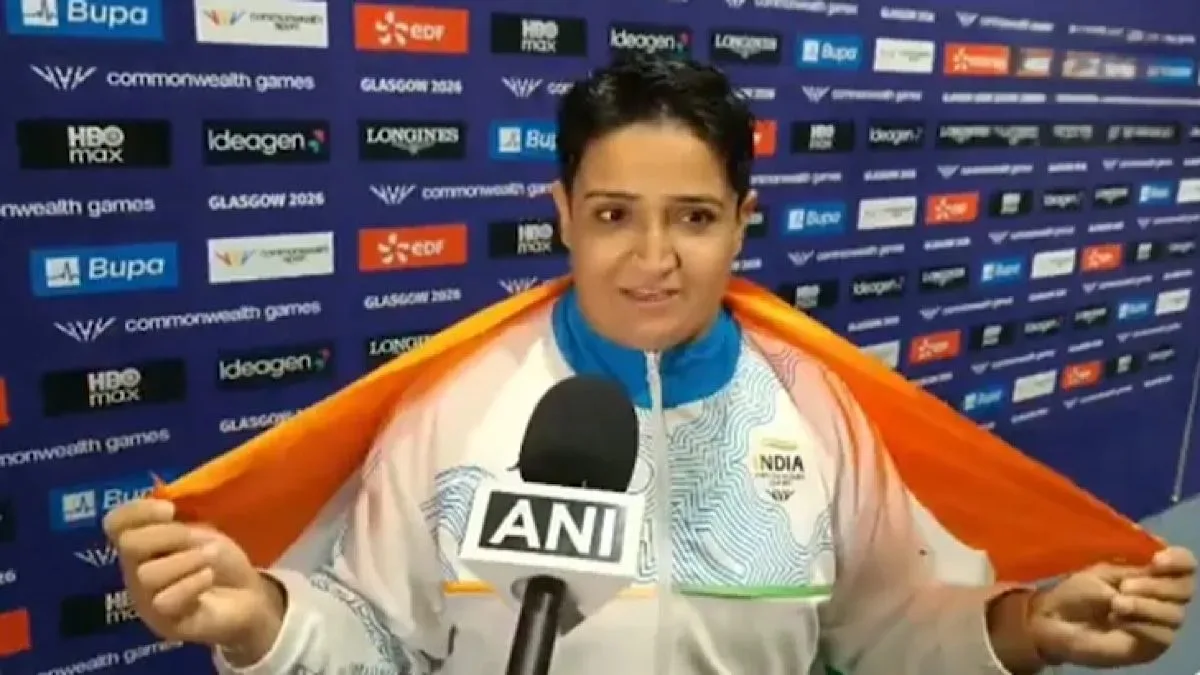
There was a time when Sharmila Dhankar did not know if life would ever give her another chance. Today, she stands as a Commonwealth Games champion.
On Monday night in Glasgow, the 40-year-old from Haryana scripted one of the most inspiring stories in Indian sport, winning the Women’s Shot Put F57 gold medal with a season-best throw of 9.81 metres. The victory was historic in every sense as it brought India its first-ever Commonwealth Games gold in para-athletics, ended a 20-year wait for a para-athletics medal at the Games, and made Sharmila the first Indian woman to reach the podium in the discipline.
Advertisement
Yet, the medal only tells part of the story.
Long before she became India’s newest Commonwealth champion, Sharmila was fighting a far more difficult battle away from the sporting arena.
As a child, polio left one of her legs permanently impaired. But the biggest challenges came later in life. She found herself trapped in an abusive marriage, where physical and emotional violence became a part of her everyday existence. She was eventually thrown out of her home by her former husband, left to rebuild her life while raising two children. The trauma pushed her to the edge, and there were times when she struggled with depression and suicidal thoughts.
For many, that could have been the end of the story. For Sharmila, it became the beginning.
A new chapter opened after she remarried. Her husband, Ajit Singh, saw an athlete where others saw limitations. He encouraged her to explore para sports, even though she was already 34 years old, an age when most elite athletes are thinking about retirement rather than taking their first steps into competitive sport.
She had never played any sport before. Because of her disability, even running was not an option. The idea of becoming an athlete sounded almost impossible. But Ajit persisted.
In 2020, the couple approached Asian Para Games medallist Tek Chand, who agreed to coach her. That decision transformed Sharmila’s life. Within a year, she became national champion. Every season that followed saw her throw farther than before, repeatedly breaking her own national record and establishing herself as India’s leading F57 shot putter.
International medals, however, remained frustratingly out of reach. She finished fourth at the 2022 Commonwealth Games despite producing a national record. Another fourth-place finish followed at the 2023 Asian Para Games before she ended fifth at the 2025 World Para Athletics Championships. She was always close, but never on the podium.
Glasgow finally changed everything. Competing in the seated shot put event, Sharmila found her best effort on her third attempt, launching the shot to 9.81 metres. Then came the anxious wait as Nigeria’s Eucharia Iyiazi, the strongest challenger on paper, prepared for her remaining throws.
The challenge never came.
Sharmila produced an astonishingly consistent series, with all six of her throws travelling beyond the nine-metre mark. None of her competitors managed to cross that distance, with the silver medal decided at just 8.65 metres. It was a victory built not on one exceptional throw but on complete dominance.
The gold medal also carries a deeply personal meaning. Before leaving for Glasgow, Sharmila had spoken about wanting to win a medal that could help secure a government job and provide financial stability. She had even sold her house to continue training, believing the sacrifice would one day pay off.
Now, the woman who once had no home to call her own has become a Commonwealth Games champion. Her triumph is not just about distance measured in metres. It is about the distance travelled through adversity.
Karnataka’s Shilpa K Shyla bags bronze
For years, Shilpa K. Shyla worked quietly towards her dream, away from the limelight. On Monday night, the Karnataka para-athlete found herself at the centre of one of the most dramatic moments of the 2026 Commonwealth Games, claiming a bronze medal in the women’s shot put F57 after a successful protest by the Indian contingent altered the final results.
While the medal came under unusual circumstances, Shilpa’s journey to the podium is one built on resilience, patience and unwavering determination. Shilpa’s life changed forever when she was just four years old. A road accident left her with a permanent disability in her left leg, but it did not diminish her ambition.
Growing up in Kanchugarakoppalu village in Karnataka’s Mysuru district, she completed her education, earned a postgraduate degree and a B.Ed., and worked as a teacher before deciding to pursue para sports full-time.
Interestingly, shot put was not her first sport. Shilpa initially represented Karnataka in sitting volleyball before discovering her talent for throwing events. She later joined the Sports Authority of India (SAI) training centre in Bengaluru under coach Eshan S. D., where she specialised in the F57 category for seated throwers.
Her progress was steady. A gold medal at the 2025 World Para Athletics Grand Prix in New Delhi announced her arrival on the international stage, and she followed it up with a bronze at the 2026 Fazza International Para Athletics Championships in Dubai to secure qualification for the Commonwealth Games.
Making her Commonwealth Games debut in Glasgow, Shilpa produced the best throw of her career, sending the shot to 7.26 metres. Initially, it appeared she had narrowly missed out on a medal after finishing fourth. However, India challenged one of Nigeria’s Eucharia Iyiazi’s attempts, and after a review, officials ruled the throw a foul. Since it had been Iyiazi’s only valid effort, she slipped out of the standings, promoting Shilpa to third place.