Pradhan’s resignation shifts focus to Harjot Bains as Congress raises pressure in Punjab
Leader of Opposition Partap Singh Bajwa said the resignation showed that sustained public pressure could force accountability.
Corporate-driven marathon races have gained popularity in the country, they have wasted crucial resources in terms of spending huge budgets on foreign runners, with virtually no steps taken to support Indian runners.




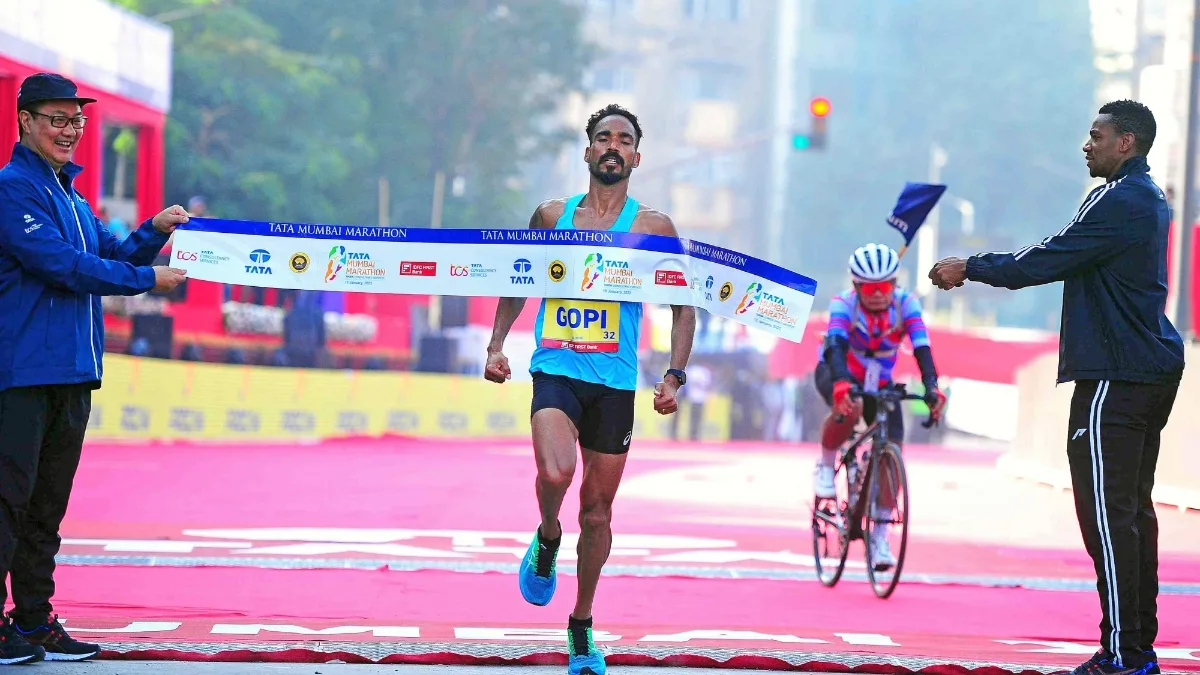
Gopi Thonakal completes his run during the 18 th TATA Mumbai Marathon in Mumbai on Sunday, January 15, 2023. (Photo: Nitin Lawate/IANS)
India is far from making a name for itself in track and field events, and long-distance running is a particularly neglected discipline.
There is a woeful lack of long-distance races in India, without which neither the talent pool increases nor do our athletes gain confidence to assert themselves in international competitions. Here, Indian long-distance runners should ensure that they compete in as many races abroad as possible.
Advertisement
While corporate-driven marathon races have gained popularity in the country, they have wasted crucial resources in terms of spending huge budgets on foreign runners, with virtually no steps taken to support Indian runners.
With such a state of affairs, it is no surprise that India’s marathon record was set in 1978 and has remained unbroken for 47 years.
Advertisement
Shivnath Singh set the national record in 1978 in Jalandhar, with the timing of 2:12:00. In the women’s category, the record was set by OP Jaisha at the 2015 World Championships; she clocked 2:34:43.
If you go through the list of national records from 5000 m onwards, all were set abroad. After spending a large part of their racing careers in the country, athletes realise that no one in India cares for them. If they wish to improve, they have to choose a good race abroad.
A recent example of this is Thonakal Gopi, who ran a phenomenal 2: 12: 23 in the Valencia marathon on December 7. T. Gopi is India’s second-fastest marathon runner after Shivnath Singh.
Shivnath did not have the luxury of competing abroad outside of his one marathon at the 1976 Montreal Olympics, where he clocked a credible 2: 16: 22 finishing in the eleventh position.
The responsibility for this state of stagnation lies not only with event organisers but also with the national federation, which has failed to create a structured domestic long-distance circuit. Countries that consistently produce world-class runners ensure their athletes compete frequently under high-quality conditions, with pace setters, scientific training support, and exposure to elite competition.
In India, however, long-distance runners are largely left to fend for themselves, with no clear pathway from national meets to international success.
Unless a deliberate policy shift is made, where Indian runners are financially supported to compete abroad, domestic races are upgraded to international standards, and performance rather than participation becomes the focus, Indian long-distance running will continue to lag behind.
Talent alone is not enough; it must be sharpened through competition. Without sustained exposure to fast races and world-class fields, India cannot realistically expect its runners to challenge global benchmarks.
However, will that advice be taken by the powers that be?
T. Gopi, for his part, having wasted his time running many marathons in India, at the end of his career was smart enough to choose one of the world’s fastest courses, on his own, in good weather conditions to get his best timings.
One hopes the young marathon runners follow suit and help themselves to better timings and raise India’s standards. If no one in India comes forward to help them, they have to do it for themselves.
Advertisement