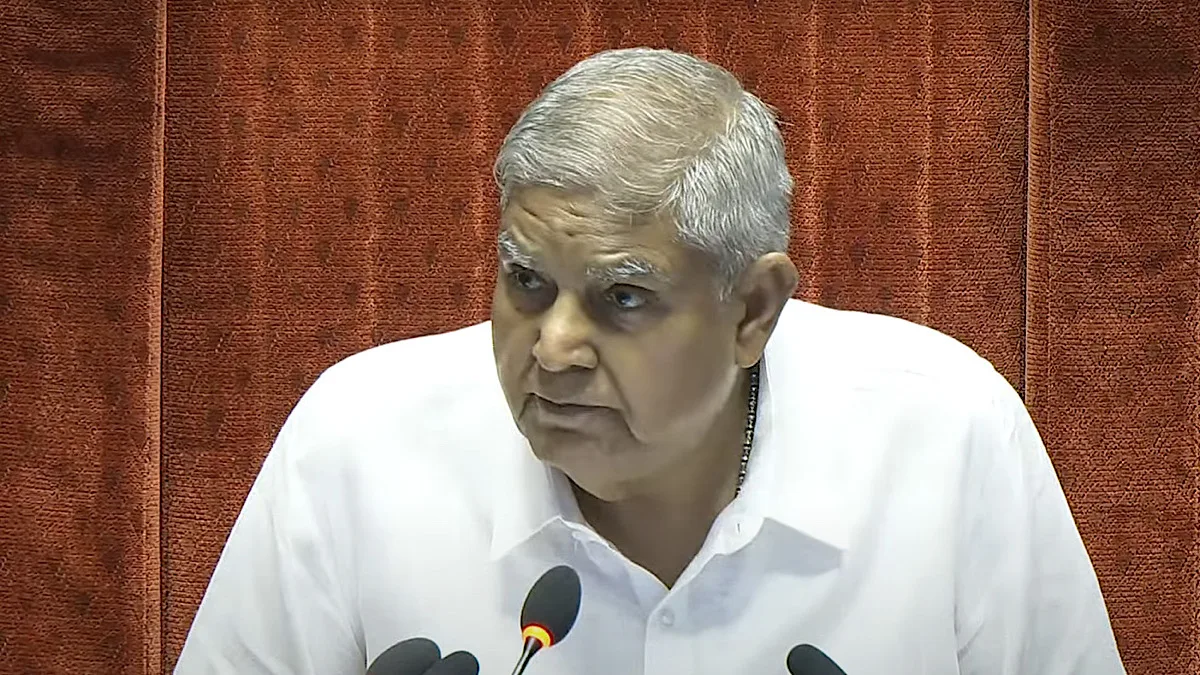
In India’s often-theatrical political landscape, it is not the noise but the silence that sometimes says the most. The resignation of Mr Jagdeep Dhankhar as Vice President has created precisely that kind of unsettling silence ~ one that grows more deafening with every evasive statement and conspicuous omission.
The official explanation, citing health reasons, barely holds up to scrutiny when weighed against the sequence of events leading to his departure. Until hours before his resignation, Mr Dhankhar was actively engaged in high-level parliamentary work. As Rajya Sabha Chairman, he convened two Business Advisory Committee meetings and scheduled another over lunch for the following day. This is not the behaviour of someone preparing to step down for health reasons.
Advertisement
The sudden cancellation of the second BAC meeting ~ reportedly because senior ministers failed to show up, without even the courtesy of informing him ~ raises questions about the exact nature of the friction at play. What followed was equally unusual: an impersonal farewell tweet from the Prime Minister almost 13 hours after the resignation. It offered merely a brief wish for “good health.” While not overtly dismissive, the message lacked the warmth typically extended to high constitutional office-bearers. It suggested a rupture ~ subtle but unmistakable. Mr Dhankhar’s recent remarks in the Upper House on impeachment motions against two controversial judges may have complicated matters further.
He upheld the procedural validity of the Opposition’s notice, even requesting updates from the Law Minister. Was this assertion of constitutional process perceived as a challenge to the executive’s desire to control the narrative? Adding to the friction may have been Mr Dhankhar’s pointed remarks at a recent public event, where he criticised Agriculture Minister Shivraj Singh Chouhan, who was present on stage, for not doing enough for India’s farmers. Mr Dhankhar, whose father was a farmer, spoke with visible emotion ~ perhaps too candidly for the comfort of some in the ruling dispensation.
The possibility that Mr Dhankhar’s institutional integrity and outspoken style clashed with prevailing political expectations cannot be discounted. His readiness to speak bluntly ~ even within his own circle ~ set him apart in an era when discretion often trumps dissent. Adding to the irony is the response from Opposition leaders. Several of them, including those who had previously moved an impeachment motion against Mr Dhan khar, are now praising his commitment to protocol and institutional balance.
That such gestures are emerging from across the aisle only highlights the awkwardness his departure has caused within the ruling establishment. That the Opposition ~ long critical of his partisan conduct, both as Vice President and ear li er as West Bengal Governor ~ is now offering praise adds an unexpected twist to an already puzzling exit. Mr Dha nkhar’s exit is not merely a resignation ~ it is a ru – pture. It reveals the narrowing space for institutional independence within India’s power structures. And in leaving without fanfare, Mr Dhankhar may have said more in silence than he ever could through words.