Export Illusion
China’s latest economic numbers expose a contradiction that has been building for years.
The situation worsened and in 1968 Nixon won the election with a promise to end the war in Vietnam. However, Nixon continued with the bombing including North Vietnam with the aim of bringing the Communists to the negotiating table.




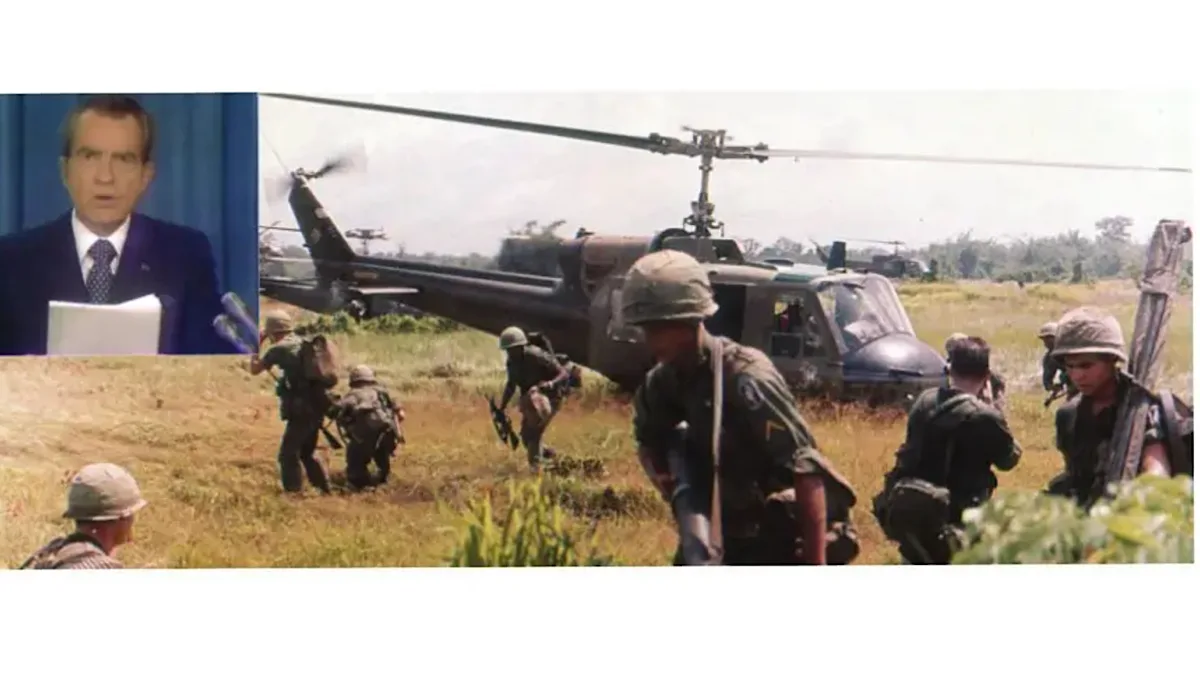
Photo:ANI
The situation worsened and in 1968 Nixon won the election with a promise to end the war in Vietnam. However, Nixon continued with the bombing including North Vietnam with the aim of bringing the Communists to the negotiating table. Ultimately a peace accord was signed between North Vietnam and the Americans which earned both Henry Kissinger and Le Duc Tho the Nobel Peace prize. But violations by both sides occurred frequently with the intensification of capturing control of rural areas between the North Vietnamese and South Vietnamese armies. The Accord was declared dead by South Vietnam in 1974. By the time Nixon signed the Accord it became clear that the war could not be won and a face-saving accord was the only option. When he assumed office in 1969, he was convinced about the need for a new approach as the US presence had become untenable.
Early in 1969, in South Vietnam, there were half a million US soldiers, 50,000 South Koreans and 75,000 South Vietnamese against 450,000 Vietcong and approximately 70,000 North Vietnamese troops. In this situation, Nixon introduced the new idea called ‘Vietnamization’, by which the US would re-arm and train the South Vietnamese army to take care of the defence of South Vietnam, allowing gradual withdrawal of US troops which led to the reduction of US troops to half by mid-1971. Nixon resumed heavy bombing of North Vietnam again along with the Ho Chi Minh trail through Laos and Kampuchea. But this did not change the ground reality and by the end of 1972, the Viet Cong effectively controlled the entire western half of the country. Nixon was under tremendous pressure both at home and abroad to withdraw. There were a number of reasons for building this huge pressure:
Advertisement
(1) the revulsion caused by the massive bombing of North Vietnam, Laos and Kampuchea;
Advertisement
(2) the extensive use of chemicals to destroy jungle foliage and of inflammable napalm jelly which burnt people alive;
(3) the deaths of thousands of innocent civilians and
(4) brutal killings of captured Viet Cong soldiers and civilians which were highlighted by the media throughout the world.
The last nail was the publication of the photograph of a girl running after being severely burned by napalm on the cover of Time magazine. There was a secret assurance by Nixon and Kissinger to the South Vietnam government that American troops would be stationed but that did not happen in view of resistance to it within South Vietnam and in the US Congress. The crisis became more acute with the OPEC decision to increase the price of crude oil four-fold in 1974 as South Vietnam found it extremely difficult to conduct air supported operations with the drying up of American financial assistance. Primarily an agrarian nation, South Vietnam could not replenish the losses suffered in the air operations.
The army was ill-equipped and ill-trained, unable to face the much more organized north Vietnamese forces and the South Vietnamese communists. By March 1975 the South Vietnam resistance collapsed and the fall of Saigon looked imminent. On 29 March, Da Nang, a city of 2 million people fell, leading to increasing desertions of the South Vietnamese army, which ironically stalled for a while the communists reaching Saigon. Adding to South Vietnamese woes, the American-backed Khmer Republic in Cambodia also collapsed. The attempt of the Americans and the South Vietnamese was to wipe out the communist bases which were an important link for the insurgents in South Vietnam. But the attempts never succeeded and the communists penetrated deeper into Cambodia. Also, the American bombing created thousands of refugees and simultaneously helped to build up a sizable number of communist combatants in Cambodia.
This was an ominous sign for the South Vietnamese leadership as thousands of Vietnamese worked with the Americans in the military operations in Cambodia. The Americans were caught in a dilemma as an immediate evacuation of the remaining Americans would erode the morale of the South Vietnamese army. The Americans wanted to maintain token control in South Vietnam and were preparing to fight the communists for a long time but with a hostile Congress, this plan could not be executed. The North Vietnamese strategically offered a negotiated settlement minus the present ruler Thieu. There was a lot of internal pressure on Thieu to resign but he tried to hold on. He was eventually forced to resign on 21 April 1975 when it became clear that the game was over. The new government’s call for a ceasefire was rejected by North Vietnam. Hanoi being in an invincible position could dictate its terms. An evacuation order was issued by the American Ambassador and a mass exodus followed from Saigon. But the magnitude of the problem led to a limited evacuation and many collaborators were left behind.
A total of 1,30,000 people were evacuated. Immediately the North Vietnamese Army captured Saigon and the remaining South Vietnamese units surrendered. Thousands of civilian employees and soldiers were sent to re-education camps and many such people were tortured, killed, and maimed but compared to Cambodia the Saigon take over was much less bloody. Saigon was renamed after the legendary Vietnamese nationalist leader Ho Chi Minh city. Outside the metropolitan area, many South Vietnamese generals committed suicide failing to reach American ships. The Laos capital, Vientiane had a better fate as the communists occupied it peacefully. The reasons for the US debacle were many. The Viet Cong and NLP had massive popular support; the Viet Cong were fighting in an area of which they had complete knowledge and intensive links with the hinterland and were experts in guerrilla warfare; the US military could not stop the supplies to North Vietnam and the moral plank of the South Vietnamese position was weak as it did not hold the promised elections fearing a Communist victory. The defeat was a heavy blow to US prestige leaving a deep impact on its society.
There was a growing feeling that the war was a blunder. This feeling coupled with the Watergate scandal led to Nixon’s resignation. Isolationist forces were strengthened domestically and the US government was cautioned about any such involvement in future. The victory of Ho chi Minh and his associates greatly boosted the morale of the communist world with the added strength of the Vietnamese army. However, both the Russian and the Chinese leadership were restrained in victory, with their desire to reduce international tension, which facilitated the process of détente, shifting the policy from containment. This became the cornerstone of US foreign policy from the 1970s till the collapse of communism in the 1990s. The entire Indo-China came under communist control but peace eluded the area when Cambodia under Pol Pot’s rule distanced itself from the Soviet-backed Vietnamese regime and Vietnam invaded Cambodia on Christmas Day, 1978 followed by an invasion of Vietnam by China in February 1979. The protracted war in Vietnam was one of the most defining events in the Cold War period. This was captured succinctly by Satyajit Ray in his film Pratidwandi (Adversary) which was made in 1970. In a job interview scene, a candidate was asked what he considered to be the most important event of the last decade? The candidate’s reply ‘the war in Vietnam’.
This was followed by a counter query, ‘not man reaching the moon’. The reply to this was “No, the progress in the field of science would have made that possible. The War in Vietnam brings to surface many new dimensions”. The interviewer then asked “Are you a communist”? The candidate replied, “one need not be a communist to admire Vietnam?” Ray immortalized the valour of the Vietnamese people in the same way as Sergei Eisenstein’s Battleship Potemkim portrayed the 1905 Russian rebellion.
The Vietnamese bravely fought the Japanese, the French, the US and China. They saw peace only from 1991. Since then, a peaceful Vietnam has become one of the fastest growing economies, transforming itself from an agrarian poor country to an industrial powerhouse with a per capita income of about USD 4900 in 2025.
(The writers are retired Professors of Political Science, University of Delhi)
Advertisement