‘Want to be on the winning side’: Shreyas Iyer ahead of India vs Zimbabwe 1st T20I
Shreyas Iyer says India are focused on adapting quickly to Harare conditions as they prepare to face Zimbabwe in the first T20I of the series.
Recently (on May 7 and 8), Swami Sandarshanananda of the Ramakrishna Mission Ashrama, Narendrapur, presented a beautifully modernized view of Hinduism in two succinct commentaries.




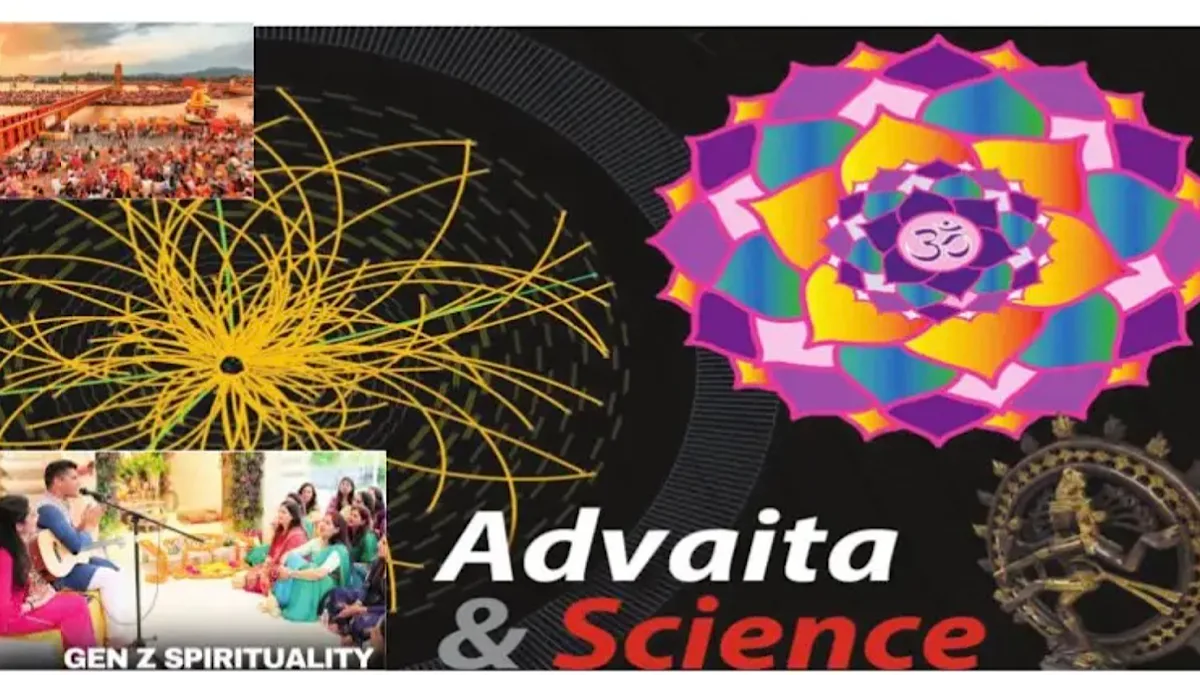
Photo:SNS
Recently (on May 7 and 8), Swami Sandarshanananda of the Ramakrishna Mission Ashrama, Narendrapur, presented a beautifully modernized view of Hinduism in two succinct commentaries. However, a large segment of the educated class in India, trained to view reality entirely through a Mill-Macaulay-Marxist framework, tends to dismiss traditional faith as backward and ancient knowledge as obsolete mythology.
This bias is particularly entrenched in our elite institutions, making one wonder how many readers actually engaged past the opening lines of those profound commentaries. It is with these sceptical readers in mind that the following exploration is offered. Written from the perspective of a non-expert with a scientific background and tailored for a contemporary Gen-Z audience, this is not a traditional religious discourse. Instead, it is a conceptual journey into the technical architecture of one of history’s most radical philosophies.
Advertisement
The modern vibe check is reaching a breaking point. Our generation is hyperconnected yet deeply fragmented, constantly toggling between the polished simulations of social media and the existential dread of a world that feels increasingly noisy. We look for a spiritual fix, but usually, that just leads us to expensive crystals or mindfulness apps that feel like putting a band-aid on a structural software error. If you are a humanities student obsessed with ontology (the study of being) or a physics nerd looking for the master equation of existence, it is time to move past the idea that ancient Indian thought is just a collection of peaceful platitudes.
Advertisement
Let us rebrand the conversation. We need to perform a hard reset on how we view Advaita Vedanta. It is not a religion; it is a high-level engineering manual for the human operating system. It is an intellectual tech stack designed to debug the code of the ego and reveal the singular server running the entire simulation. In humanities seminars, you are likely to encounter Western philosophy as a discursive, academic pursuit. From Plato to Postmodernism, the goal is often to build an intellectual map of reality through reason and language. It is essentially a theoretical simulation.
You can master the logic of Kierkegaard or Sartre while sipping an oat milk latte, and your internal state of consciousness remains exactly the same. The map is the end goal. Ancient Indian philosophy, however, is termed Darshana, which translates to vision or point of view. It is less about thinking and more about observing. If Western philosophy is a lecture on the optics of a lens, Darshana is the engineering calibration that allows the lens to actually focus. It is the difference between studying the theory of light and actually flipping the switch in a dark room.
To understand where Advaita fits, we need to look at the Shat-darshana, the six major orthodox schools of Indian thought. Think of these as different specialized engineering departments, each with a specific user manual for reality: Nyaya and Vaisheshika: The Logic and Material Science departments. They handle the rules of debate and the atomistic structure of the world. Samkhya and Yoga: The System Architecture and UI/UX departments. Samkhya enumerates the components of nature, while Yoga provides the practical interface to control the mind. Mimamsa: The Protocol and Procedure department, focused on the ritualistic data of the Vedas.
Vedanta: The Core Research and Development department based on the Upanishads. Within the Vedanta department, you find various sub-classes based on different system interpretations. There is Dvaita (Dualism ~ User and System are eternally separate) and Vishishtadvaita (Qualified Non-dualism ~ User is a component of the System). Then there is Advaita Vedanta (Non-dualism). This is the most radical subclass. It posits that the User, the System, and the Code are all one single, non-dual reality called Brahman.
The perception of multiplicity, of being separate from the person next to you or the phone in your hand, is just a rendering error known as Maya. If we treat Advaita Vedanta as an engineering textbook, we can strip away the mysticism and look at its functional specs through Ontology and Epistemology (the theory of knowledge). This is a structural Error 404. We superimpose the qualities of the Not-Self (the fluctuating data of our bodies, our thoughts, and our social media feeds) onto the Self (the constant, unchanging background of awareness).
You think you are your anxiety, rather than the screen upon which the anxiety is being projected. How do we know what is real? Advaita uses Jnana as its primary tool. This is not knowing a fact like a trivia answer; it is a cognitive recalibration. It is an epistemological shift where you learn to distinguish between the Signal (Atman/Consciousness) and the Noise (the world of objects). To achieve this, Advaita uses a systematic negation algorithm called Neti-Neti (“Not this, Not that”). You delete every false identification ~ “I am not this body, I am not this social status, I am not this memory” ~ until only the underlying, irreducible source code remains.
Here is the hard truth that most influencers get wrong: Advaita Vedanta itself is not spirituality. Studying Advaita is like reading a science textbook on the laws of thermodynamics. You can memorize the equations, pass the examination with flying colours, and explain the theory of entropy to your friends at a party, but you are not actually experiencing the heat. The text is a Pramana, a means of knowledge. It is the documentation for the software. You can spend your whole life reading the documentation without ever running the program. This is why we see dry scholars who know every Sanskrit verse but still operate from a place of ego and duality.
The book is just paper and ink; it is not the reality it describes. For the Gen-Z reader, this means you can be an “Advaitin” in an academic sense, mastering the logic and the ontology, without being spiritual in the sense of having a realized experience. Advaita is the technical framework, not the feeling. To make Advaita an effective practice, it must be integrated with spirituality. In engineering terms, you have to move from the design Phase to the implementation Phase. This is the core of the Reality Hack, handled through a three-step integration pipeline: Sravana (The Instruction): The Epistemology Phase.
You read the science textbook. You gather the technical data on why your ego is a construct and why duality is a rendering error. Manana (The Troubleshooting): The Testing Phase. You use your own logic to debug the theory. You ask the hard questions: “If I am not my thoughts, then what is observing them?” You stress-test the Ontology until your doubts are cleared. Nididhyasana (The Execution): The Engineering Phase. This is where spirituality enters the lab. You actually sit with the data until it becomes your lived reality. You move from thinking about non-duality to operating from it. Advaita Vedanta is arguably the most sophisticated ontological framework ever designed to solve the problem of human suffering.
It tells us that our unhappiness is not a moral failing; it is a technical error in how we perceive reality. But it remains a framework. Without the spirituality of direct application, it is just a dusty science textbook on the shelf of your mind. But when you interrelate the technical logic of the philosophy with the experiential practice of realization, you are not just becoming spiritual; you are successfully engineering your own liberation from the glitch of the ego. In the language of the digital age: Advaita is the documentation; spirituality is the deployment. You need both to go Live.
(The writer is Distinguished Professor, RKMVERI, Belur)
Advertisement