Supreme Court to hear pleas seeking court-monitored probe into alleged donation theft at Ram Temple
The pleas are listed for hearing before a bench headed by Chief Justice of India (CJI) Surya Kant.
Of all the water that blankets our planet, nearly every drop ~ 97.43 percent ~ is saline. Freshwater, the lifeblood of civilization, makes up a fragile 2.57 per cent, and of that, rivers ~ the veins that nourish cities, crops, and ecosystems ~ account for a vanishingly small 0.002 per cent.




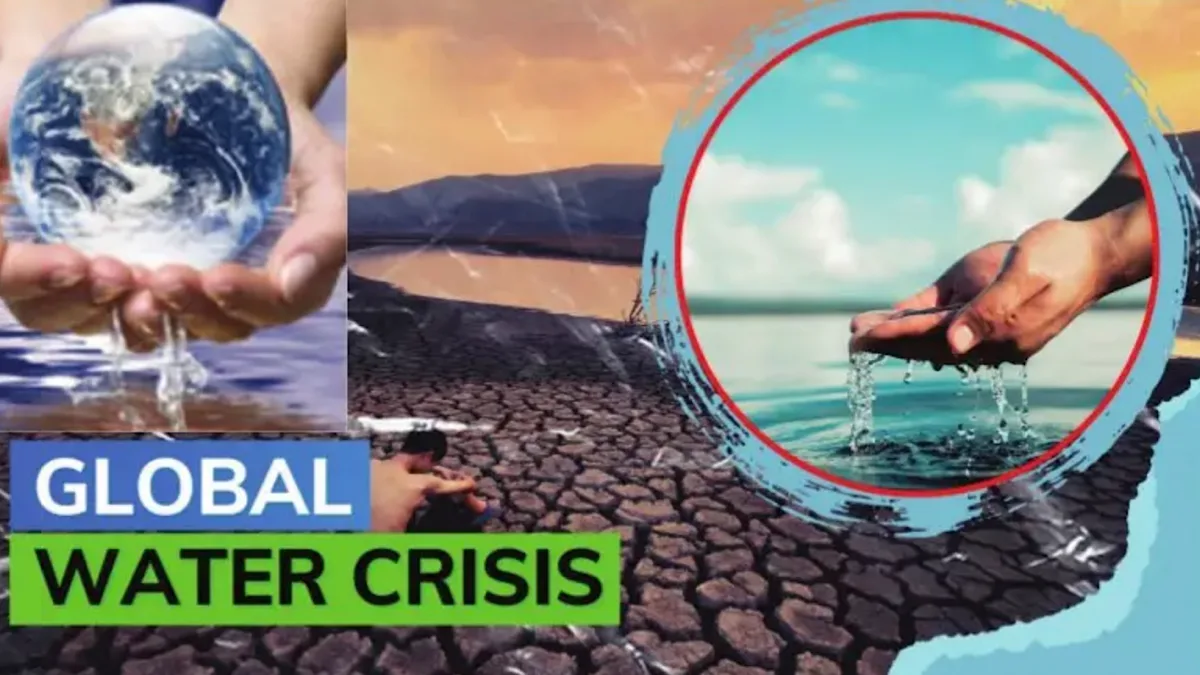
Photo:SNS
Of all the water that blankets our planet, nearly every drop ~ 97.43 percent ~ is saline. Freshwater, the lifeblood of civilization, makes up a fragile 2.57 per cent, and of that, rivers ~ the veins that nourish cities, crops, and ecosystems ~ account for a vanishingly small 0.002 per cent. It is this microscopic share, shimmering through our landscapes and sustaining every forest, farm, and life form, that humanity depends upon for its very survival. Despite humanity’s perilous dependence on this sliver of freshwater, the world’s response to deepening water crises remains astonishingly narrow.
From parched cities and vanishing aquifers to conflicts, collapsing canals, and climate-driven extremes, the planet’s mounting emergencies have done little to expand our gaze beyond this tiny, fraction of the Earth’s reserves. Consider this: as the global population surges from 8 billion today towards nearly 10 billion by 2050, the demand for food, energy, and water will soar to unprecedented heights. Groundwater reserves, the planet’s hidden lifelines, are in alarming retreat, while the strain on rivers, lakes, and reservoirs deepens by the day. UNICEF warns that half of humanity already lives under conditions of water stress. In India, the situation is especially dire: according to NITI Aayog, nearly 600 million people ~ about 45 per cent of the population ~ were grappling with severe water scarcity as early as 2020. By 2030, demand is expected to outstrip supply by nearly twofold. To make matters worse, the country’s aging dams and decaying infrastructure are further choking an already dwindling freshwater reserve.
Advertisement
One reason humanity remains trapped within the narrow confines of freshwater dependence lies in a deep-rooted perception: that saline water ~ with total dissolved solids above 1,000 milligrams per litre ~ is inherently unusable for drinking, farming, or industry. This belief, rarely questioned, has become a global blind spot. The result is a dangerous paradox ~ an escalating crisis born from humanity’s obsession with the finite, while ignoring the boundless potential of the saline. Even as the global water crisis deepens, the global collective response remains trapped in a silo ~ conserving, reallocating, and recycling the same tiny finite freshwater reserves.
Advertisement
Ambitious research that could liberate humanity from its dependence on freshwater remains scarce, confined largely to desalination plants or isolated trials in saline agriculture. The staggering reality that 98 per cent of Earth’s water is saline has not yet triggered the paradigm shift. Instead, humanity continues to chase dwindling freshwater reserves instead of learning to replace or even partially substitute them with saline sources. This inertia, more than hydrological limits, lies at the heart of the global freshwater crisis.
The freshwater crisis, therefore, is less a failure of hydrology and more a crisis of mindset. It is not a shortage of water, but of wisdom, a crisis born not from nature’s limits, but from humanity’s intellectual poverty. Paradoxically, global water discourse continues to attribute the crisis to a familiar catalogue of causes ~ population growth, urbanization, consumption patterns, poor governance, and climate change. Worse, the proposed remedies remain confined within the shrinking boundaries of freshwater: building larger dams, harvesting rain, and improving efficiency.
These are worthy efforts, but they all share the same flaw ~ they ignore the abundant 98 per cent of the planet’s water. Contrary to the widespread belief that saline water is inherently unusable, humanity has long been harnessing it. The world’s oceans have sustained human life for millennia, yielding seafood rich in more than 1,900 nutrients and forming a vital part of our diet. In doing so, they have quietly reduced the planet’s freshwater footprint. Seas nurture vast edible, nutrient-rich plants. Across the Pacific, species such as Porphyra, Monostroma, Enteromorpha, Laminaria japonica, kombu, and wakame have long formed the backbone of traditional diets ~ supplying essential inerals and proteins without tapping freshwater reserves.
Economically, many freshwater-dependent crops have saline-water counterparts. Mangrove species such as Rhizophora and Ceriops provide high-quality fuelwood, while salt-tolerant varieties of Prosopis offer durable timber. Halophytes are now emerging as powerful alternatives for the future of food, fuel, and industry. Thriving in saline water, they can produce grains, biofuels, and edible oils, offering sustainable substitutes for freshwater-guzzling crops like corn, sugarcane, and palm oil. Even saline-tolerant varieties in floriculture and horticulture are opening new economic frontiers.
To avert the looming water catastrophe, humanity must break its fixation on freshwater domain and embrace the vast saline reserves that envelop the planet. A conceptual tool to guide this transformation is the “saline water footprint” ~ the total volume of saline water employed in producing goods and services. With agriculture consuming 80 to 90 per cent of global freshwater, substituting freshwater-intensive crops with saline-tolerant analogues, advancing saline-based alternatives from staple crops to culinary delicacies and industrial products could dramatically expand the saline water footprint while conserving precious freshwater within its finite 2.5 per cent share.
Nearly 38 per cent of the world’s population ~ some 2.9 billion people ~ live within 100 kilometers of a coastline, and with the global shoreline stretching over 2.4 million kilometers (excluding Antarctica), the potential to harness saline water is immense. Climate change is further expanding salinity’s reach. So, clinging exclusively to freshwater is no longer a viable path for humanity. However, realizing this potential requires a fundamental paradigm shift ~ a collective reorientation of policymakers, governments, researchers, investors, and citizens alike to recognize saline water not as a limitation, but as a vast, untapped asset.
Global water policies must move beyond fragmented trials and integrate diverse strategies ~ desalination, seafood consumption, halophyte cultivation, saline-based agriculture into a unified saline water footprint framework. Such an approach would enhance, monitor, and scale saline water use while driving research and innovation. So, as long as humanity remains fixated on a narrow 2.5 per cent slice of freshwater while ignoring the oceans at its doorstep, the freshwater crisis will remain insolvable. With over 11,000 kilometers of coastline and confronting its own mounting water challenges, India has an opportunity to lead the world toward a “saline century,” setting an example for resolving freshwater scarcity once and for all.
(The writer is Director, Central Water Commission, Bengaluru. The views expressed are personal)
Advertisement