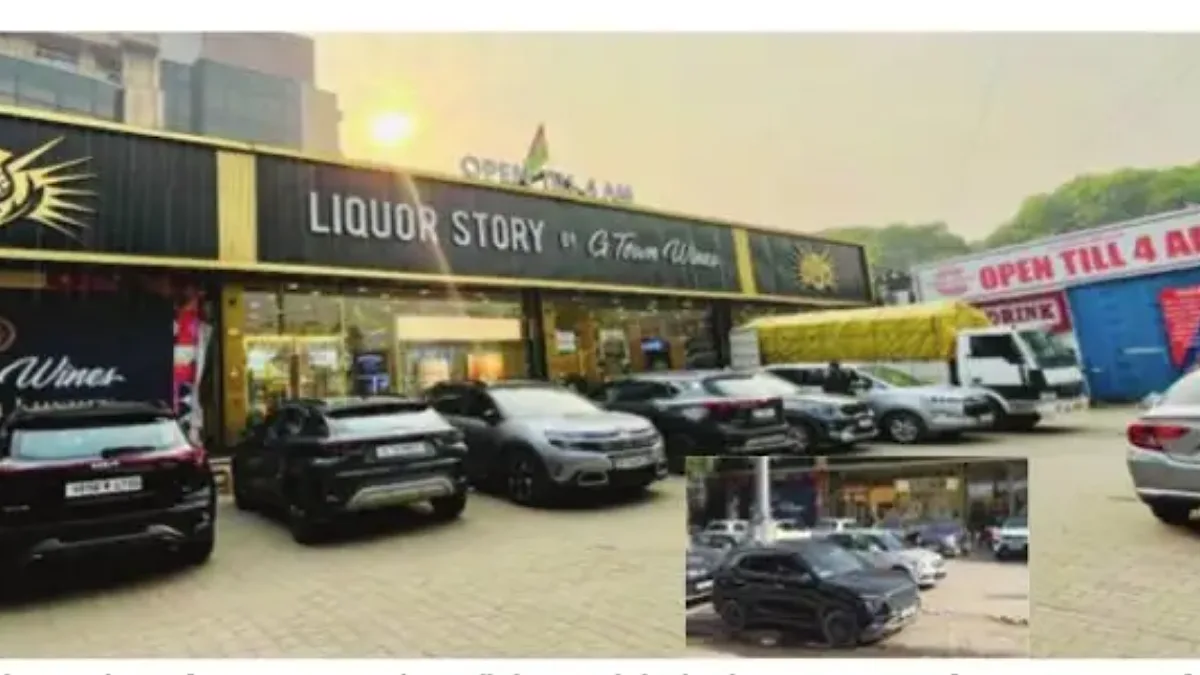
The sight has become routine in many Indian cities: rows of cars lined up outside liquor outlets, headlights flashing into service lanes, men drinking openly in full view of traffic, and crowds jostling at counters as if civic order has ceased to exist. In Greater Noida, across a busy Supertech Czar crossing leading to residential societies, one such outlet, placed in the open green land along the service lane, attracts thirty to forty cars every evening.
Bottles are purchased, corks are popped, cars and two wheelers get lined up and alcohol is consumed in public spaces without hesitation. The state police drive past, indifferent to the spectacle. Nothing happens day in and day out, and the silence of enforcement becomes complicity. This normalisation of public drinking is not a trivial nuisance; it is a marker of deeper disorder. Youth aggression is visible in the impatience of drivers, the foul language hurled at commuters, and the violent altercations that erupt over trivial provocations.
Advertisement
Alcohol fuels rash driving, turning roads into arenas of danger. India recorded 461,312 accidents and 168,491 deaths in 2022, with over-speeding and drunk driving among the leading causes. Behind each statistic lies a family shattered, a child orphaned, or a commuter injured simply for being sober on unsafe roads. The menace does not stop at traffic. Molestation and harassment of women become more likely when intoxication spills into public spaces. For sober commuters, especially women returning from work, the presence of drunken crowds near crossings or service lanes transforms routine travel into an ordeal. The promise of urban modernity collapses when safety cannot be guaranteed even on well-lit roads.
Public drinking is not merely a lifestyle choice; it is a civic violation that undermines dignity and security. The ill effects extend into homes. Drunken fathers beating wives is a tragedy repeated across households, often hidden behind closed doors but no less destructive. Children watching such violence suffer wounds that are not physical but psychological, scars that shape their understanding of family and society. To witness a parent intoxicated, violent, and abusive is to have innocence murdered. NFHS-4 data shows that 33 per cent of married women report spousal violence and women whose husbands drink are 3.1 times more likely to face abuse.
Nearly half of drinking husbands commit violence against their wives. For some women, the despair is unbearable: suicides linked to domestic violence and alcohol abuse are reported every year, each one a silent indictment of society’s failure to protect them. NCRB figures suggest that over 25,000 suicides annually are linked to family problems and domestic violence, with alcohol abuse often cited as a trigger. Health and well-being suffer in parallel. Alcohol consumption contributes to liver disease, cardiovascular problems, and mental health decline.
Hospitals already strained by infectious diseases and accidents must also bear the burden of alcohol related trauma. The World Health Organization estimates that harmful alcohol use accounts for 5.1 per cent of the global disease burden, and in India this translates into millions of hospital admissions each year. The economic cost is staggering: lost productivity, medical expenses, and law enforcement resources diverted to manage disorder. Yet the mushrooming of outlets continues, driven by revenue considerations and political patronage. The violence spills into public spaces as well.
Brawls after drinks are common, often escalating into fatal confrontations. Police records across states show hundreds of deaths annually from fights triggered by intoxication. What begins as a quarrel over a bottle or a parking space ends in bloodshed, adding to the grim statistics of alcohol related fatalities. NCRB data confirms over 22,000 deaths from spurious liquor between 2002 and 2022, with states like Uttar Pradesh, Punjab, and Tamil Nadu repeatedly reporting mass fatalities. The combination of aggression, impaired judgment, and easy access to weapons or vehicles makes intoxication a public hazard. Drunken driving adds another grim dimension.
Official data shows 1,503 deaths in 2022 due to drunk driving, down from 2,376 in 2019 but still alarmingly high. These numbers understate the true toll, as many accidents are recorded under over speeding or reckless driving without noting alcohol involvement. The reality is that intoxicated drivers endanger not only themselves but every commuter sharing the road. Each festive season brings spikes in fatalities, with families returning from celebrations only to face tragedy on highways. Comparative experience shows that regulation matters. In countries like Singapore, public drinking is prohibited after certain hours, and outlet density is strictly controlled.
In Scandinavian nations, state monopolies regulate alcohol sales, limiting access and reducing disorder. In contrast, India has allowed liquor outlets to proliferate near residential areas, highways, and crossings, often without adequate policing. The result is a landscape where alcohol is accessible, enforcement is absent, and civic behaviour collapses. The role of the police is central. When thirty to forty cars line up outside an outlet in Greater Noida every evening, the spectacle is not hidden. It is visible to commuters, residents, and law enforcement alike.
The absence of intervention signals that rules are optional, discipline is negotiable, and public safety is expendable. Policing is not merely about crime prevention; it is about setting norms. When norms are ignored in full view, society absorbs disorder as everyday behaviour. The psychological dimension is equally troubling. Youth exposed to public drinking learn impatience, aggression, and indiscipline as acceptable traits. The line between celebration and violation blurs. Studies in behavioural science show that repeated exposure to disorder breeds imitation.
When young men see crowds drinking openly, driving rashly, and harassing commuters without consequence, they internalise such behaviour as permissible. The erosion of civic values begins not in classrooms but on roadsides. The governance challenge is stark. Revenue from liquor sales is a significant source of state income, often exceeding thousands of crore rupees annually. This creates a conflict of interest: governments are reluctant to regulate outlets strictly because they depend on the revenue.
Yet the social cost far outweighs the fiscal gain. Road accidents, hospitalisation, domestic violence, brawls, suicides, and policing expenses drain resources and weaken social cohesion. The balance between revenue and responsibility has tilted dangerously. Public discourse must confront this reality. Civic order cannot be sacrificed at the altar of revenue. The proliferation of outlets near residential societies, highways, and crossings is a policy choice, not an inevitability. Regulation of outlet density, prohibition of public drinking, and strict enforcement of traffic laws are essential.
Awareness campaigns must highlight not just health risks but societal consequences: unsafe roads, molested commuters, broken families, murdered innocence, and lives lost in drunken brawls. The crisis also presents an opportunity for introspection. Just as tobacco regulation reduced public smoking, alcohol regulation can restore civic order. Community responsibility must complement policing. Residents’ associations, civil society groups, and educational institutions can play roles in awareness and monitoring. The narrative must shift from tolerance of disorder to insistence on discipline.
The incidents witnessed daily in Greater Noida are therefore more than local nuisances; they are symbols of national fragility. They force us to confront the silence of enforcement, the aggression of youth, the vulnerability of women, and the suffering of families. They remind us that public safety is not a privilege but a right, and that governance must prioritise dignity over revenue.
The voice of society now demands answers. Who ensures that roads are safe for sober commuters? Who protects women from harassment near liquor outlets? Who shields children from the violence of drunken fathers? Who prevents brawls from escalating into deaths? The answers lie not in silence but in reform. India must choose whether to continue with fragile enforcement or to embrace accountability and regulation. The future of its families, and the credibility of its civic order, depends on that choice.
(The writer is a retired Air Commodore, VSM, of the Indian Air Force)