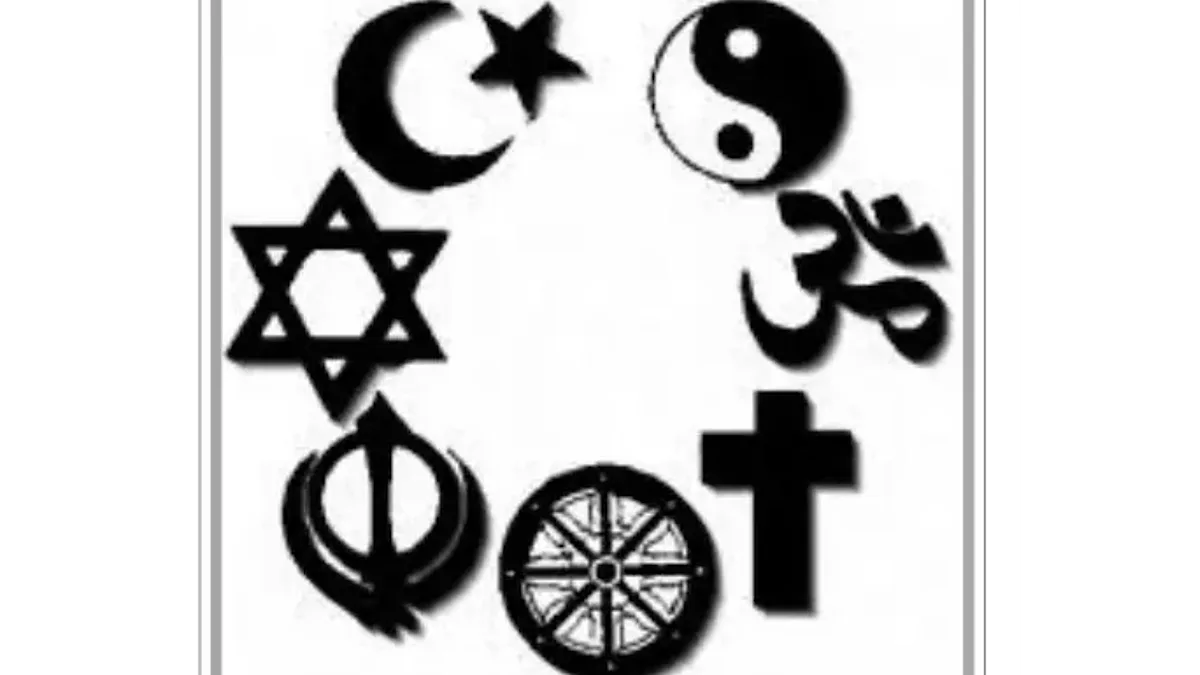
Religion is the enquiry into the beyond that marks the difference between the lives of human and animals. This is how Swami Vivekananda explained the essence of religion. He said: “So if man rests content with the present and gives up all search into the beyond, mankind will have to go back to the animal plane.” Religion is a complex human phenomenon encompassing various spiritual practices. It throws light into the inner world as well as engages in exploring answers to timeless, existential questions.
Religious feelings descend from one generation to the next. Swami Vivekananda held that the lowest stage of religion is the religion of fear when people turn to God and perform rituals and religious practices to protect themselves from harm. These are the external forms of devotion through which one has to pass. But according to Vivekananda “Temples or churches, books or forms are simply the kindergarten of religion, to make the spiritual child strong enough to take higher steps, and these first steps are necessary if he wants religion. “But if he is sincere, if he really wants to reach the truth, he goes higher than this, to a plane where forms are as nothing… External worship, material worship is the lowest stage; struggling to rise high, mental prayer, is the next stage; but the highest stage is when the Lord is realised…We have to analyse our own souls and find what is there…Only the man who has actually perceived God and the soul has religion…But if there is a God, He is in our own hearts.
Advertisement
Have you ever seen Him?” Religion is, therefore, realization. This was the assertion of Vivekananda about the highest stage of religion. He said: “This is one great idea to learn and to hold on to, this idea of realisation. This turmoil and fight and difference in religions will cease only when we understand that religion is not in books and temples.” Religion brings to man eternal life. It is the highest echelon of religion one must desire to reach. However, the vast majority of people today are more akin to perform only the basic rituals. People love to worship God, an external idea. It gives more reliance on external strength than on an eternal one.
Most people rely on external manifestation of faith often indulged in by institutions. Societal and Institutional impetus encourage people to congregate in large numbers at places of worship to perform religious practices. Therefore, a vast majority of people in India are at the preliminary stage of religion as propagated by Vivekananda. The desire to move to the higher stage of religion is visibly absent. “We often consider a man religious who can talk well. But this is not religion,” said Vivekananda. “Religion is a matter of growth, not a mass of foolish words.” Vivekananda added: “Wonderful methods of joining words, rhetorical powers, and explaining the texts of the books in various ways – these are only for the enjoyment of the learned, and are not religion.” These words of Vivekananda are still relevant today. Vivekananda lamented: “We are all atheists, and yet we try to fight the man who admits it. We are all in dark.
Religion is to us mere intellectual assent, mere talk, mere nothing.” The strong words of Vivekananda remind us – “We want everything but God. This is not religion that you see all around. … They have all sorts of things for enjoyment, and unless they add a little flavour of religion, life is not all right, because society would criticize them. Society expects it, so they must have some religion.” It is social compulsion that makes us religious if we recognize the words of Swami Vivekananda. However, a society does not literally force everyone to adhere to a specific religion but exerts significant pressures and influences that can promote specific religious beliefs and participation. Society is a stage of growth through which a man passes. Society is good at a certain stage, but it is not the ultimate aim, not the ideal.
One may argue that people act under irresistible compulsion because an individual is fully dependent upon the society in which he lives and must therefore accept its rules and dictums. But the formulation of this idea forces us to think what extent such a concept contradicts our sense of justice. The conscience of individuals must also work. An individual can think and create new ideas and values, set new standards for society. After all, the health of society depends upon the independence of its individuals. Society is in constant flux. The development of society is possible only when individuals composing it can think and judge independently. So, freedom of mind is extremely significant. Practical religion, according to Vivekananda, is to get the state of freedom, the attainment of freedom. It is the renunciation of the lower senses – all temptations – through which one can attain freedom and wisdom. Vivekananda said: “Renounce! Renounce all temptations to take your neighbour’s property, to put hands upon your neighbour, all the pleasures of tyrannizing over the weak, all the pleasures of cheating others by telling lies. Is not morality the foundation of society?” So, it is in daily practice. Life is the daily struggle for freedom. And one can attain freedom by reaching the highest level of religion. Society finds no end for its development. But the goal of human life is to attain wisdom. “Sense happiness is not the goal of humanity.” Religion is the source of getting the ‘highest wisdom’ which must be ‘spiritual knowledge’ according to Vivekananda. In his opinion what the world wants is the thought-power of individuals. He said: “We need to have three things: the heart to feel, the brain to conceive, and the hand to work. First, we must go out of the world and make ourselves fit instruments. Make yourself a dynamo. Feel first the world. At a time when all men are ready to work, where is the man of feeling?” Religion imparts a sense of purpose, a moral framework and coping mechanism that help an individual in life. Religion is not mere belief. The most fundamental aspect of religion is the personal and internal experience. Its collective aspect involves shared rituals, values and practices that help to build social cohesion. However collective religion does not always do good to human society; history shows this. For Vivekananda true religion was an individual and internal progression and did not relate to any external or social presentation. He advised: “If you want to be religious, enter not the gate of any organised religion. They do a hundred times more evil than good, because they stop the growth of each one’s individual development. Study everything, but keep your own seat firm.” Religion is the individual performance that one should practise. It is the direct communion between one individual and his God; no third person must come in between. (The writer, a Cost Accountant, worked for a public sector power utility.)