ADiRA workshop trains young journalists in AI tools at NSOU
More than 60 aspiring journalists attended a hands-on workshop on artificial intelligence at Netaji Subhas Open University.
There are men who write history, and there are those who quietly correct it. T.J.S. George belonged to the second kind – sharp, subtle, and serenely fearless.




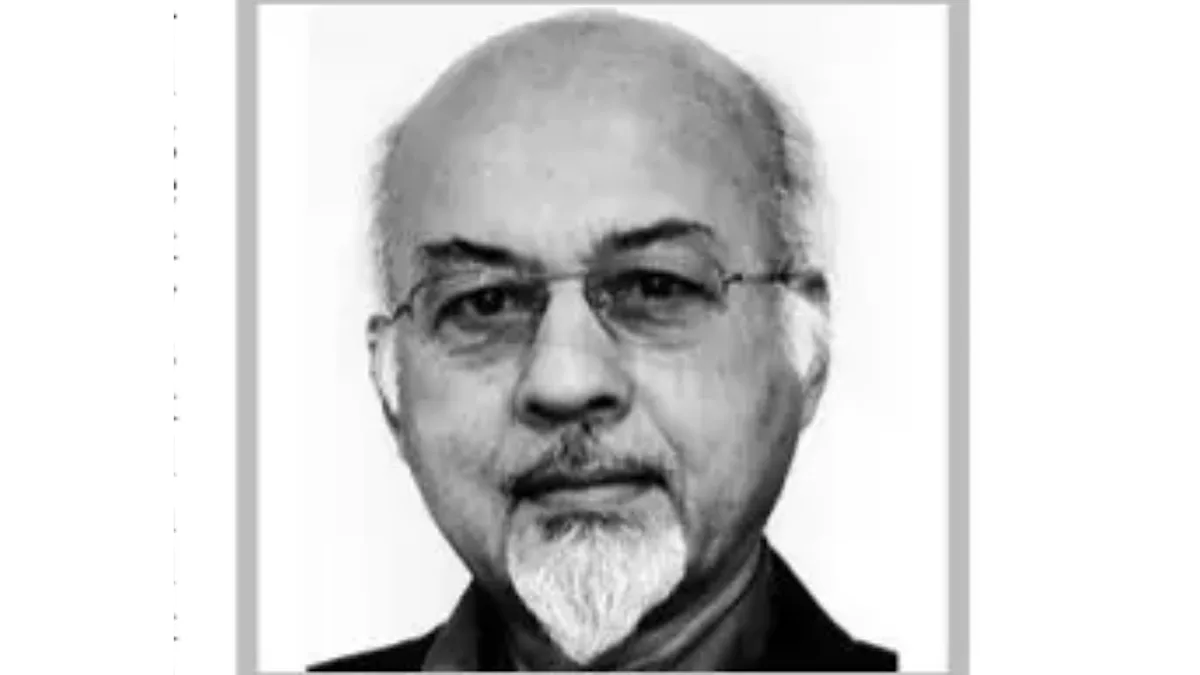
Photo:SNS
There are men who write history, and there are those who quietly correct it. T.J.S. George belonged to the second kind – sharp, subtle, and serenely fearless. His life was not just about journalism; it was about the joy of knowing, of thinking, and of telling stories that mattered. He wrote not for fame or fortune, but for the sheer love of truth dressed in elegance. T.J.S. George is not a name one can utter casually. It is a legacy, a school, a style. Every one of his books is a manual for young journalists; every column is a mirror held to power and pretence.
The biography of India’s most brilliant political journalist Pothen Joseph remains a monument to his craft, while his own Ghōshayātra stands as an autobiography without the self – peopled not by family but by friends, mentors, and unforgettable newsroom characters. The newsroom of The Free Press Journal in Bombay was his stage, and what a theatre it was! There, amid the clatter of typewriters and the smell of burnt cigarettes, George found his characters and his convictions. He once recalled a moment that still resonates across generations of journalists: a young, flamboyant reporter named Agnel struts back to the desk after tea, cigarette in hand, humming a tune. Someone behind him lets out a peculiar laugh.
Advertisement
When he turns around, a senior remarks, “You’re paid for the work you do. I’m paid for what I know.” George called it a timeless truth – and rightly so. For him, journalism was never about effort alone; it was about the mind behind the effort. A journalist without knowledge, he often said, is like a surgeon without anatomy. That blend of wit and wisdom also coloured the pages of The Story of Pothen Joseph. In one scene, the grand old editor looks at a trembling trainee and says with affectionate firmness: “I can teach you journalism, my boy, but I cannot teach you the alphabet.”
Advertisement
The lesson was simple: to work in this field, you must first be literate in more than letters – in curiosity, in honesty, in courage. George’s writings were never meant to be read in haste. They were to be experienced. He wrote like a musician plays a raga – measured, melodious, never loud, never lazy. His English was crystal, his Malayalam lyrical, his mind razor-sharp. Whether the subject was Nehruvian socialism, Basheer’s boyhood, Nargis’s lost love, or M.S. Subbulakshmi’s serene mornings with Venkatesa Suprabhatham, his sentences pulsed with life. And yet, for all his seriousness, George was a man of rare humour – often dry, often deadly.
He once narrated, with his signature straight-faced irony, an incident involving Jawaharlal Nehru and J.R.D. Tata. The two had gone together to inspect a new industrial site. At one point, Nehru felt the call of nature and walked toward a small shed marked “Urinals.” Tata followed him. After they emerged, Nehru reportedly said, “Jehangir, you could have come inside. There was space for five or six people.” To this, Tata replied with a mischievous grin, “Panditji, once you find anything working efficiently with five or six people, you might nationalize it!” George loved that story – not because it mocked Nehru, but because it revealed the power of wit to expose ideology.
In that single line, the absurdities of Nehruvian socialism stood naked – how a noble dream of equality was often betrayed by bureaucratic excess. For George, humour was not an escape; it was a scalpel. He never wrote a conventional autobiography. His Ghōshayātra was instead a parade of people – editors, writers, politicians, friends – who shaped his journey. His family appeared only as faint shadows in the background. It was left to his son, novelist Jeet Thayil, to fill those silences in his hauntingly beautiful novel Elsewhereans. Jeet’s book gives us the George we never saw in print – a man both disciplined and detached, romantic and rational.
The cover photo itself hides a story: a young Vietnamese woman named Nguyen Phuc Chau, whom George met while covering the Vietnam War. Years later, Jeet travelled to Vietnam, as his father had wished, and found her again – now a grandmother, still remembering the Indian journalist with gentle affection. George’s own love story had its own spark. When he decided to marry Ammu, a woman from Muvattupuzha, he placed one unusual condition: the wedding would not take place inside a church. It caused quite a stir until Ammu’s uncle, Dr. A.T. Marcos, found a diplomatic solution: “Let them marry outside, and no one shall compel them to enter again.”
It was a pact that both sides respected – typical of George, who believed institutions must bend to individual integrity, not the other way around. Money never mattered to him- perhaps to a fault. Jeet Thayil once described his father’s generation as “embarrassed by money and exalted by idealism.” After selling Asiaweek, George made sure he would never again work for money. Ammu managed all his finances; he managed everything else. For twenty-five years at the Indian Express, he earned a modest Rs 1001 a month – and seemed perfectly content.
He avoided discussing his personal struggles. He never sought advice. He simply read, wrote, and reflected. In his later years, though the typewriter lay silent, his mind never stopped writing. When Jeet once told him he was reading Russian poetry, George frowned and said, “Don’t waste your time – poetry doesn’t pay.” Then he handed him a list of books and added, “If you must write, write a novel.” That was T.J.S. George — practical, piercing, and always pushing the next generation toward thought that endures. In Elsewhereans, Jeet recalls that when his father could no longer write, he became “a distressing presence around whom the household adjusted itself.”
Even in silence, T.J.S. George was an energy field – intense, restless, demanding. His presence was like a newsroom deadline – invisible but inescapable. He was born in Thumpamon, near Adoor – a small Kerala town that never guessed one of its sons would one day redefine Indian journalism. I once met him briefly at an airport. We spoke about world politics, the madness of nations, and the vanishing art of editorial writing. Only then did I learn that this man, whose pen had travelled across continents, was from just down the road from my own home. He spoke softly, smiled sparingly, and thought deeply.
Reading him was a pleasure; meeting him was a privilege. He was a man of books – not the kind that decorate shelves, but the kind that change minds. As a biographer, he humanized giants like Krishna Menon, M.S. Subbulakshmi, Nargis, and Pothen Joseph. As an editor, he lifted newspapers from routine to relevance. His Handbook of Journalism remains a standard text in media schools. As a columnist, he was fearless, precise, and always a step ahead of his time. He once said that a journalist must “see the unseen and say the unsaid.” He did both, with grace.
Today, as we say farewell, it feels less like the end of a life and more like the closing of a great book – one that taught us how to think, how to write, and how to stay curious even in old age. T.J.S. George lived a full, luminous, and purposeful life – as a legendary editor, a fearless writer, a man who believed that the mind, not the mouth, is a journalist’s greatest tool. As young reporters step into this noisy, distracted world, perhaps the best farewell we can offer him is to remember what he once told a journalism student: “If you wish to be a journalist, first learn to be curious – for curiosity is the only capital this profession pays interest on.”
(The writer is Professor, Centre For South Asian Studies, Pondicherry Central University.)
Advertisement