Chronobiology and the Ghost Shift of the Modern Eye
Technology has granted us the ultimate modern freedom: the ability to conquer darkness.
In 1848, the world was viewed through the lens of steam engines and clockwork. When Marx and Engels formulated their critique of capital, they did so within a “Newtonian” universe ~ a world of solid, “billiard-ball” atoms and predictable, mechanical forces.




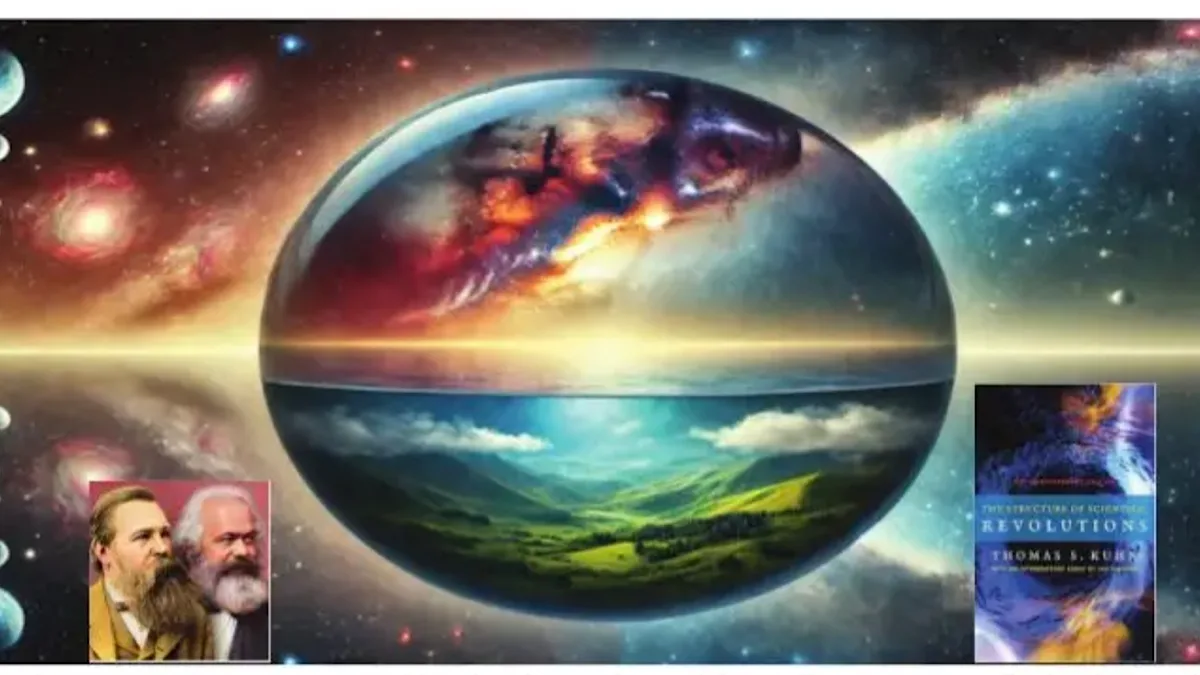
Photo:SNS
In 1848, the world was viewed through the lens of steam engines and clockwork. When Marx and Engels formulated their critique of capital, they did so within a “Newtonian” universe ~ a world of solid, “billiard-ball” atoms and predictable, mechanical forces. Today, that world has melted away. From the smartphones in our pockets to the “spooky” entanglement of atoms and subatomic particles, we live in a quantum reality. Yet, our social philosophies remain trapped in the 19th century. It is time for a “Paradigm Shift.”
It is time to define the Structure of Scientific Socialism not as a mechanical inevitability, but as an emergent property of a quantum-informed, non-dual universe. The journey begins with a method of understanding change. In the mid-19th century, Alexander Herzen dubbed Hegelian dialectics the “algebra of revolution.” Algebra provides a symbolic framework to solve for unknowns without needing immediate numerical values; similarly, the dialectic offered a method for navigating social upheaval. Dialectics in history is a method of understanding change through the conflict of opposing forces ~ Thesis, Antithesis, and Synthesis. It posits that history moves forward not linearly, but through contradictions that clash, leading to a new, higher state of development. To the classical Marxist, history moved through the conflict of the Thesis (Capitalism) clashing with its internal contradiction, the Antithesis (the Proletariat), to produce the Synthesis (Communism).
Advertisement
As John Rees explored in his 1998 work, The Algebra of Revolution, this was the “logic of change.” But this logic was grounded in a materialist world that we now know to be an incomplete approximation of reality. In 1962, a Harvard physics undergraduate turned philosopher named Thomas Kuhn changed how we view scientific progress. In The Structure of Scientific Revolutions, Kuhn argued that science does not move smoothly toward “truth.” Instead, it stays within a “Paradigm” ~ a set of established rules ~ until “anomalies” accumulate. These anomalies create an “Essential Tension” ~ a structural crisis where the old model can no longer explain reality.
Advertisement
This leads to a total collapse and a Paradigm Shift. We are currently living through such a shift. The Newtonian-Marxian “objective” world has reached its breaking point. The “essential tension” is no longer just between classes; it is between a fragmented, reductionist worldview and a holistic, quantum reality. The dialectic of course has not vanished; it has evolved. In modern condensed matter physics, the “essential tension” has a sophisticated avatar: Frustration. In social science, we focus on the tension between the “Haves” and the “Have-nots.” In physics, this tension manifests as a state where a system cannot satisfy all its internal interactions simultaneously.
This frustration arises from two primary sources: Geometric Frustration, where the very lattice arrangement of atoms in a crystalline solid prevents a simple state, and Random Competing Interactions, where conflicting forces pull the system in different directions. Whether acting alone or together, these forces prevent a system from settling into a boring, static equilibrium. This “Frustration” is the engine of Emergence, giving rise to exotic, resilient states of matter that mirror our social complexities. Spin-Glasses are systems defined by random competing interactions and “complex landscapes.” Like a society shaped by its revolutions, a spin-glass has a “memory” of its history; it cannot simply “reset” because its current identity is a product of its historical struggle. Mott Insulators are “frustrated metals.” Due to intense electron-electron repulsion, actors that should conduct and move freely are locked in place.
This is the physical mirror of social “stasis,” where internal contradictions prevent a system from functioning as its potential suggests. In Topological Quantum Materials, the “Global Structure” dictates the properties of the system, far beyond the sum of its parts. This is the ultimate physical realization of the “Synthesis” ~ a state where the “Whole” protects the “Parts.” For centuries, “reductionist philosophy” told us that if we understood the smallest bricks, we could understand the whole building. This dream was dismantled by physics Nobel Laureate Phil Anderson (Kuhn’s Harvard contemporary) in his 1972 cult-paper, “More is Different.”
Anderson posited that at each level of complexity, entirely new laws appear. You cannot predict the beauty of a symphony by studying a single note. Similarly, Socialism is not a mechanical program to be coded into law; it is an emergent property of a complex, interacting human “quantum” field. When human interactions reach a certain level of complexity and “frustration,” a new social symmetry must be born. Quantum science is no longer in its “mysterious childhood.” It is now a “restless teenager,” pervading our technology and hardware. It is the backbone of the next generation of data storage and information processing. Interestingly, the “high priests” of quantum mechanics ~ Schrödinger, Heisenberg, and Bohr – knew that Western logic was insufficient. Schrödinger in particular, looked to Advaita Vedanta (Non-Dualism) to explain the “spooky” reality of entanglement.
In this view, the “separation” between individuals is a functional illusion, or Maya. At the fundamental level ~ the quantum vacuum or the Brahman ~ the field is one. Modern science is finally correlating the microscopic (entanglement) with the macroscopic (consciousness) to confirm what the ancient Indians knew: Unity is the fundamental reality; separation is the approximation. This brings us to the most crucial part of this new manifesto. To the “Digital Natives” of Gen-Z: you must be wary of the “High Priests” of knowledge. Historically, elites have used their superior knowledge to exploit the masses. From the ancient Vedic gatekeepers to colonial administrators like Lord Macaulay, knowledge has been used to create a “class” system of the mind.
Today, “Neo-Colonists” use complex Marxian jargon and/or “mysterious” quantum hype to make these subjects look opaque. They paint ancient Indian knowledge as “mythology” while people like Diana Eck, the renowned American scholar of religious studies at Harvard, extracts the “cream” of that very knowledge for high-level theological and philosophical study. Don’t fall for the phobia of science and socialism: General mathematics is not a secret code. We treat a brilliant student who masters the textbook as something special, yet we fail to notice the primary school dropouts peddling goods in the marketplace. They perform flawless, complex mathematical calculations orally every day without any formal methodology. The logic of the universe is innate.
AI is not a monster as computers were depicted a few decades back. It is simply a natural consequence of the principle of emergence ~ a tool meant for everyone. Socialism is not a jargon-heavy theory. It is the practical realization of our fundamental unity. You do not need to spend decades in a library to understand the Oneness. The synthesis has already been prepared by Swami Vivekananda. Start with his Lectures from Colombo to Almora and his monograph My India, the India Eternal. He already did the heavy lifting of bridging the ancient soul with the scientific requirement for strength.
The Structure of Scientific Socialism is finally clear: Quantum Science + Advaita Vedanta. It is a world where the “material” is an interconnected field, and “society” is the emergent expression of our shared oneness. The algebra has been solved. The paradigm has shifted. The revolution is no longer a mechanical breakdown ~ it is a quantum leap into the realization that we are, and always have been, one.
(The writer is Distinguished Professor, RKMVERI, Belur and Visiting Professor, IIT Bombay, Powai)
Advertisement