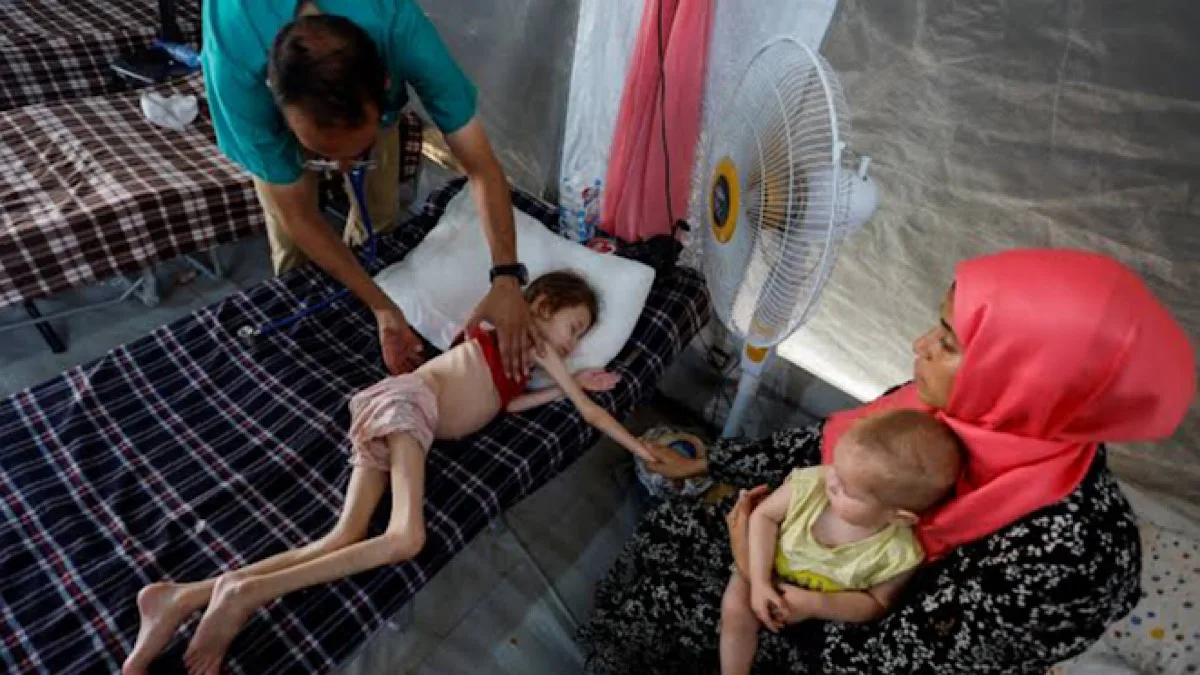
The most haunting image of war is often not its violence but its silence ~ the silence of a child’s hollow eyes, a mother’s outstretched hand, or a truck loaded with food that never arrives. Gaza, today, is not just a war zone. It is the stage of a humanitarian collapse where the denial of suffering is as deafening as the suffering itself. US President Donald Trump’s remark that children in Gaza are experiencing “real starvation stuff” pierced through months of evasive political language. While his words are rarely known for nuance, they have a rawness that resonates.
In this case, that rawness acts as a mirror reflecting the uncomfortable truth: people are starving, visibly and undeniably. And this truth is no longer confined to the domain of UN reports or human rights bulletins ~ it is visible in grainy footage, in empty bowls, in looted food trucks. What makes this more disturbing is the attempt to sanitise the crisis through rhetoric. The Israeli government’s categorical denial of starvation in Gaza, and its accusation that such claims are “boldfaced lies,” suggest a deliberate effort to shape global perception while humanitarian agencies beg for uninterrupted access. When aid trucks are looted not by militants but by ordinary civilians ~ desperate, emaciated, and starving ~ it ceases to be a question of logistics or insurgency.
Advertisement
It becomes a moral emergency. Israel’s argument that it is enabling aid, and that any shortage is due to Hamas’s interference, reflects a common tactic in modern conflict: shifting the blame to the other side while controlling the gates. Even if one assumes bad faith on the part of Hamas, it does not absolve the occupying power from its duty to prevent collective punishment. Starvation is not just a side effect of war; it becomes a weapon when access to food is manipulated, obstructed, or slowed down. UN officials, faced with impossible constraints, have admitted they cannot deliver at the required scale. Their trucks, laden with flour, have been waylaid by desperate hands before they reach distribution centres. Their drivers face real threats.
Their access is choked by bureaucracy and bullets. These are not isolated lapses ~ they are symptoms of a system where hunger has been allowed to fester while the world opts for semantics. Pauses in military action are not solutions. They are breathing spaces that often fail to resuscitate. What Gaza needs is not a pause, but a plan ~ a sustained, verifiable mechanism for aid delivery protected from both military and political sabotage. And more than that, it needs an honest reckoning from all parties involved. You can dispute statistics. You can debate policies. But you cannot look into the sunken eyes of a starving child and call it a lie. Gaza is starving. And the world is running out of excuses.