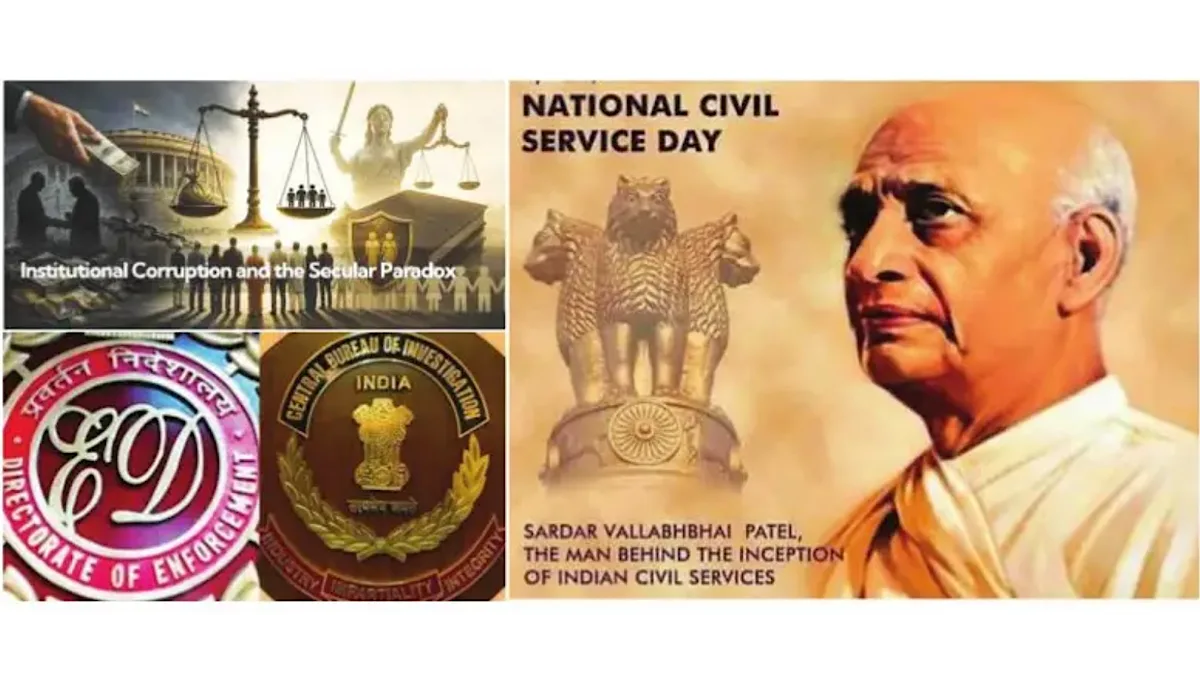
Indian administration has always had a fantastic worldwide reputation. Sardar Vallabhbhai Patel once referred to our civil services as the “steel frame” of the nation. However, the Indian civil services, which were intended to serve as an apolitical backbone for the country’s prosperity in accordance with his vision, are currently losing their identity. Institutionalised corruption is seriously undermining the fundamental pillars of public service, integrity, and honesty.
There is rising evidence that government officials are misusing their positions and authority to build unlawful fortunes worth crores of rupees on a daily basis. Armed with unlimited power, some authorities are willing to sacrifice public welfare for political and business objectives. Recent raids across the country by agencies ranging from the Central Bureau of Intelligence (CBI) and Enforcement Directorate (ED) to state Anti-Corruption Bureaus (ACBs) ~ targeting both high-ranking officials and judges ~ clearly demonstrate the cancerous spread of systematic corruption. At the Central government level, Union Minister Dr. Jitendra Singh revealed in a written response to a Rajya Sabha question in 2022 that the CBI had filed cases against 1,281 officers from various departments on bribery and corruption allegations.
Advertisement
He stated that the appropriate cadre-controlling bodies handle individual situations in accordance with applicable disciplinary procedures. Furthermore, figures show that over 150 corruption charges against IAS and IPS officers are still pending with the CBI alone. At the state level, regular raids by enforcement agencies in Telangana are exposing deep-seated, high-level corruption. A senior IAS officer’s case is a great example of administrative rot. The central government has approved an investigation against this officer for financial irregularities in organising the coveted Formula-E competition. The main accusation is the unauthorised transfer of Rs 54.88 crores of public cash to foreign business companies for a cancelled event, without cabinet clearance and in breach of central banking standards.
Around the same time, ACB searches on the residence of the Engineer-in-Chief of the Roads and Buildings Department sent shockwaves, discovering disproportionate assets of Rs 17.94 crores. More recently, ACB agents raided the home of a Multi-Zone Deputy Director of Land Records, seizing crores of rupees in cash and gold biscuits. Similar administrative malpractices have become common in Andhra Pradesh. The ACB determined that a Senior Assistant at the Kakinada Collectorate held assets worth crores of rupees and luxury automobiles that were disproportionate to his known sources of income. Meanwhile, the number of Tahsildars, Revenue Divisional Officers (RDOs), surveyors, and other revenue department officials caught red-handed continues to rise, with little regard for gender. A broader look across the country indicates that the corruption plague has spread to all states.
In Rajasthan, the ACB detained a retired IAS officer for allegedly participating in the coveted ‘Jal Jeevan Mission’ tender scam. It is said that even this critical welfare system, created to supply citizens with safe drinking water, was not spared; private corporations were permitted to gain contracts using forged certifications in exchange for enormous bribes, diverting crores of public funds. In Chhattisgarh, the Economic Offences Wing (EOW) and the Anti-Corruption Bureau (ACB) targeted a suspended IAS officer. As Director of the Department of Geology and Mining, he allegedly exploited his position to run a huge extortion mafia and money laundering network under the premise of coal taxes, causing authorities to seize commercial and residential properties worth crores.
A similar story of administrative theft played out in Bihar, where the Special Vigilance Unit uncovered a large network that collected contract commissions. Two mid-career IAS officers were suspended and are currently missing. Investigations indicated that they manipulated government tenders for infrastructure and rural livelihood projects. They accepted exorbitant bribes from contractors, including pricey electronics, a private terrace garden worth Rs 9 lakhs, and luxury holidays across Europe. The CBI arrested an IAS officer in Haryana for allegedly misappropriating Rs 504 crores in government cash. While acting as the Commissioner of the Panchkula Municipal Corporation, the officer alleg
edly collaborated with private bank officials to syphon about Rs 79.46 crores in public monies to shell businesses under the premise of fixed deposits. The Indian Police Service (IPS) is not immune to this rot. A 2009-batch IPS officer serving as the Deputy Inspector General (DIG) of the Ropar Range in Punjab fell into the CBI’s strategic trap. He was caught collecting a bribe of Rs 8 lakhs through an intermediary from a scrap dealer to resolve an old police case. Subsequent raids at his apartment found five crore rupees in unaccounted cash, 1.5 kg of gold, and unlicensed weapons.
Meanwhile, a big issue broke out in Madhya Pradesh in April 2026 when it was revealed that a group of senior IAS and IPS personnel had collectively purchased 2,000 hectares of agricultural land in a single village. Within 16 months of their purchase, the state government approved a Rs 3,200 crore highway bypass approximately 500 meters away from their land. Using their intimate knowledge to acquire these properties resulted in windfall gains of Rs 50-60 crores. Alarmingly, this cancer of corruption has infiltrated the judiciary. In Telangana, the state ACB arrested an Additional District Judge on the High Court’s directives.
Simultaneous raids in Hyderabad, Siricilla, and areas of Maharashtra revealed disproportionate assets of over three crore rupees belonging to the sitting judge. In a similar enforcement effort within the Telangana judiciary, the ACB raided the residence of the First Additional Junior Civil Judge of Jagtial, seizing unaccounted cash and arresting him. Investigations into bribery charges against a sitting judge of the Hyderabad Labour Court found illicit assets worth over Rs 3.5 crores, resulting to his suspension and incarceration.
In Delhi, a Senior Civil Judge from the Tis Hazari Court was caught in a CBI trap after requesting a bribe of Rs 20 lakhs through a court-appointed Local Commissioner to deliver a favourable judgement in a property dispute. Raids at her home reportedly resulted in Rs 94 lakhs in cash. The main reasons of this severe corruption include systemic failure, the premature conferring of huge discretionary powers on relatively young officers, and administrative arrogance based on the notion that “nobody can touch us.” Despite amendments to the Prevention of Corruption Act, the requirement to obtain political or central government sanction before prosecuting All India Services officers, combined with the states’ lack of effective control over officers appointed through the Union Public Service Commission (UPSC), has slowed legal proceedings.
This legal barrier, originally meant to protect honest officers from harassment, has sadly evolved into an impregnable fortress enabling the guilty to dodge justice. Complicating matters is the unholy alliance between local politicians and bureaucrats; cooperative personnel are rewarded with lucrative loop-hole posts and legal immunity, while honesty is punished with persistent, punitive transfers. To deconstruct this system of administrative theft, cosmetic vigilance raids and token punishments are insufficient; India demands profound, structural reforms.
Administrative data must be completely democratised by utilising blockchain technology to publicly track every single paisa of public expenditure via blockchain-based public ledger systems. Automated procurement systems powered by artificial intelligence must be implemented in government bids and public works allocations to entirely eliminate human intervention and arbitrary official discretion. To promote accountability, independent fast-track tribunals should be formed solely to prosecute corruption in the public service and judiciary. These courts must work without the constraints of political consequences and deliver rulings within a specific timetable.
Furthermore, states should be able to hire administrative officers without relying on the UPSC, and whistleblower rights should be strengthened significantly to protect them from any type of administrative reprisal. Finally, civil service training academies must shift toward a modern, ethical governance framework in order to dismantle the outdated, colonial-era bureaucratic mindset, and the process of transfers and postings must be delegated to independent boards that are completely free of political interference. Only then can honesty be properly recognised and the flow of corruption truly stemmed.
(The writer is former Senior Adviser, United Nations)