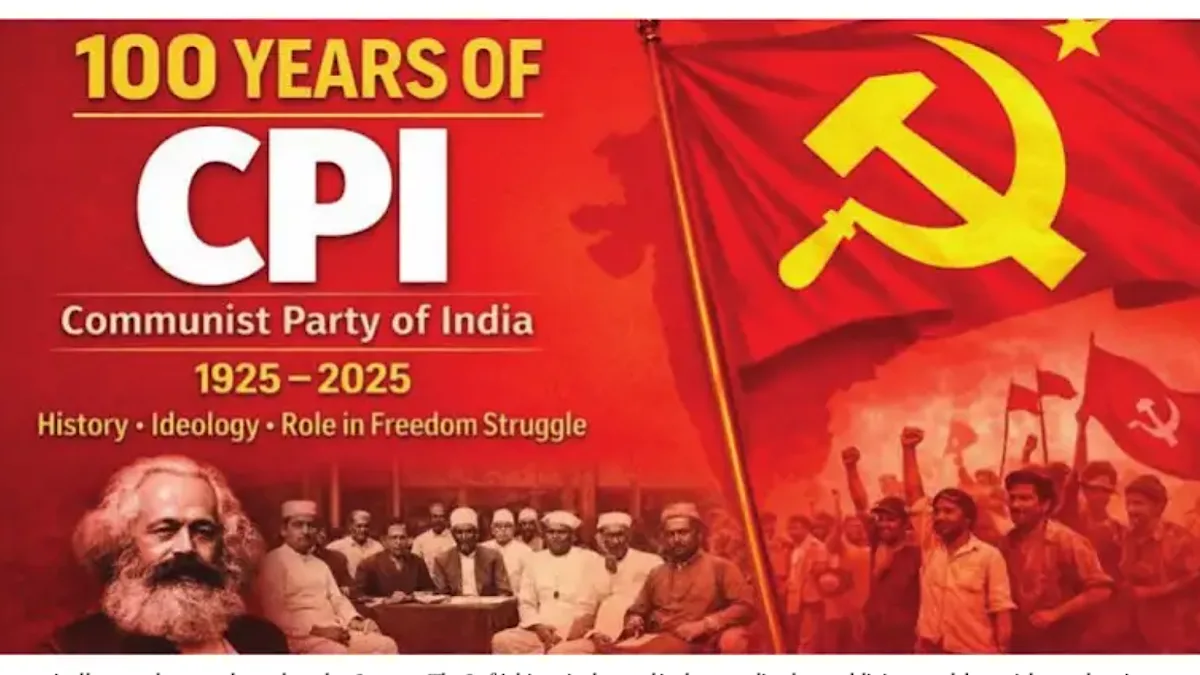
As the Communist Party of India marks its centenary ~ having been founded in December 1925 ~ the parliamentary Left in India confronts an existential crisis. Barely two decades ago, it was a formidable force in national politics: propping up the first UPA government (2004–09) and governing three states ~ West Bengal, Kerala and Tripura.
Today, it has been pushed to the margins. The Left Front’s strength in the Lok Sabha has declined sharply, from 61 seats in 2009 to just eight in 2024. In West Bengal, where the Left won seven consecutive Assembly elections between 1977 and 2006, it failed to secure even a single seat in 2021. Even in Kerala ~ its last bastion ~ where the Left Democratic Front won an unprecedented second consecutive term in 2021, the December 2025 local body elections revealed significant setbacks and growing anti-incumbency. This decline should concern anyone invested in democratic pluralism.
Advertisement
The Left remains the only mainstream political force offering a sustained critique of neoliberal economic policies and their social consequences. Yet, the prospects for revival at the national or state level appear bleak. Contemporary electoral politics is increasingly shaped by populist leaders backed by immense money power, mobilising voters through emotive appeals centered on shrill nationalism and communal and caste identities. More recently, as seen in Maharashtra and Bihar, direct cash transfers and welfare handouts have reshaped voter behaviour, pushing questions of governance into the background. In this political landscape, the Left’s clearest path to renewed relevance lies in local governments.
To rebuild its base and restore political credibility, it must renew its social contract at the grassroots – particularly through municipal corporations in India’s rapidly growing cities. Historically, the Left built its strength by mobilising peasants through land reforms and industrial workers through trade unions. However, India’s socio-political landscape has changed dramatically over the past three decades. In the 2020s, amid an expanding middle class, a youthful workforce and an already unfolding urban future, the Left must forge new social coalitions ~ and municipal politics offers the most viable route to do so. Urbanisation is a defining feature of 21st-century India.
Over a third of the population ~ more than 35 per cent ~ now lives in towns and cities, a figure projected to exceed 50 per cent within two decades. The southern states are already at an advanced stage of urbanisation. Cities are central to economic growth and livelihood aspirations, but they are also sites of deepening governance failures. Everyday life has become a struggle in India’s principal economic nodes: Delhi cannot breathe, Bengaluru cannot move and Mumbai cannot house its workforce affordably.
Cities are also becoming increasingly exclusionary. Urbanisation brings migrants, labour, ideas and innovation, yet migrants routinely bear the brunt of everyday discrimination ~ whether a lady management professional being denied rental housing or a delivery worker being barred from using lifts in multistoried buildings. Cities cannot function as economic engines if their social fabric is frayed. Re-centering these everyday urban injustices within political discourse is precisely where the Left can reconnect with citizens. Municipal governments are the tier of the state closest to everyday life. They manage water, sanitation, housing, public transport, air quality, waste management and neighbourhood safety.
Unlike state or national elections, local body contests ~ especially in large cities with educated middle classes ~ are less susceptible to emotive ideological mobilisation or cash-transfer politics. Urban voters are expected to be more outcome-oriented, judging governments by service delivery and governance performance. This creates a crucial opening for the Left to reposition itself as a party of governance. The Left’s historical record in decentralised governance remains one of its strongest assets. Kerala’s People’s Plan Movement of the 1990s expanded participatory decision-making at the local level, while the Kudumbashree programme empowered women through community-based enterprises.
The state’s humane treatment of migrant workers during the Covid-19 lockdown earned global recognition, and its performance on health, education and human development indicators remains among the best in India. In West Bengal, land reforms and the empowerment of Panchayati Raj institutions transformed agrarian relations and deepened democratic participation. Although urban governance received less sustained attention, the introduction of the Mayor-in-Council system in Kolkata created a stronger executive structure than in most Indian cities. Kolkata’s satellite township New Town (Rajarhat) ~ represents an often-overlooked model of planned urban expansion, contrasting with the real estate-driven, haphazard growth seen in Gurgaon and elsewhere.
Yet, if the Left is to become a credible urban force ~ especially among aspirational youth ~ it must confront two major challenges. First, it must undertake serious introspection about its political-economic outlook. Contemporary city systems are embedded in complex technological and financial eco-systems; it is no longer realistic to assume that the state alone can deliver all services. The Left must articulate a pragmatic social-democratic framework that engages with private capital while safeguarding public interest, labour rights and environmental sustainability. Equally important is overcoming entrenched perception biases. In cities like Kolkata, memories of industrial decline, capital flight, militant trade unionism and opposition to bank computerisation continue to reinforce the image of the Left as anti-development and hostile to private enterprise.
To counter this, the Left must actively showcase pragmatic initiatives such as Kochi’s Water Metro and Kolkata’s New Town IT cluster as evidence of its capacity for development-oriented governance. Second, the Left must articulate a new idiom of urban politics centered on decentralisation, sub-national federalism, and urban citizenship. Civic governance in India is too often reduced to infrastructure provision, while deeper questions of rights, access and accountability are neglected. Urban challenges cannot be resolved through one-size-fits-all national schemes; decisions about who gets what, and on what terms, are inherently political and must be negotiated locally.
This also requires sensitising people ~ particularly the middle classes, who frequently disengage from civic elections ~ to the importance of municipal governments. Although the 74th Constitutional Amendment of 1992 recognised municipalities as the third tier of India’s federal system, its implementation has been uneven. A 2024 audit by the Comptroller and Auditor General of India shows that cities remain constrained by limited functional devolution, restricted finances, and chronic staffing shortages, exacerbated by excessive state control.
Strengthening municipal governance is therefore not merely an administrative reform; it is a political project. If the Left is serious about reclaiming relevance in its second century, the path forward runs through city halls, ward offices and municipal councils ~ not just Parliament and state Assemblies. Only by winning trust locally can the Left hope to translate credibility into a broader national resurgence.
(The writer is an urban policy analyst and Vice Chair (International Relations), Centre for Multilevel Federalism, New Delhi. The views are his own and do not reflect those of the organization)