India, UAE agree to enhance cooperation across consular, visa and legal domain
India and the UAE agreed on further steps to enhance cooperation across the consular, visa and legal domains.
India’s latest attempt to govern online gaming marks a subtle but consequential shift in regulatory thinking.




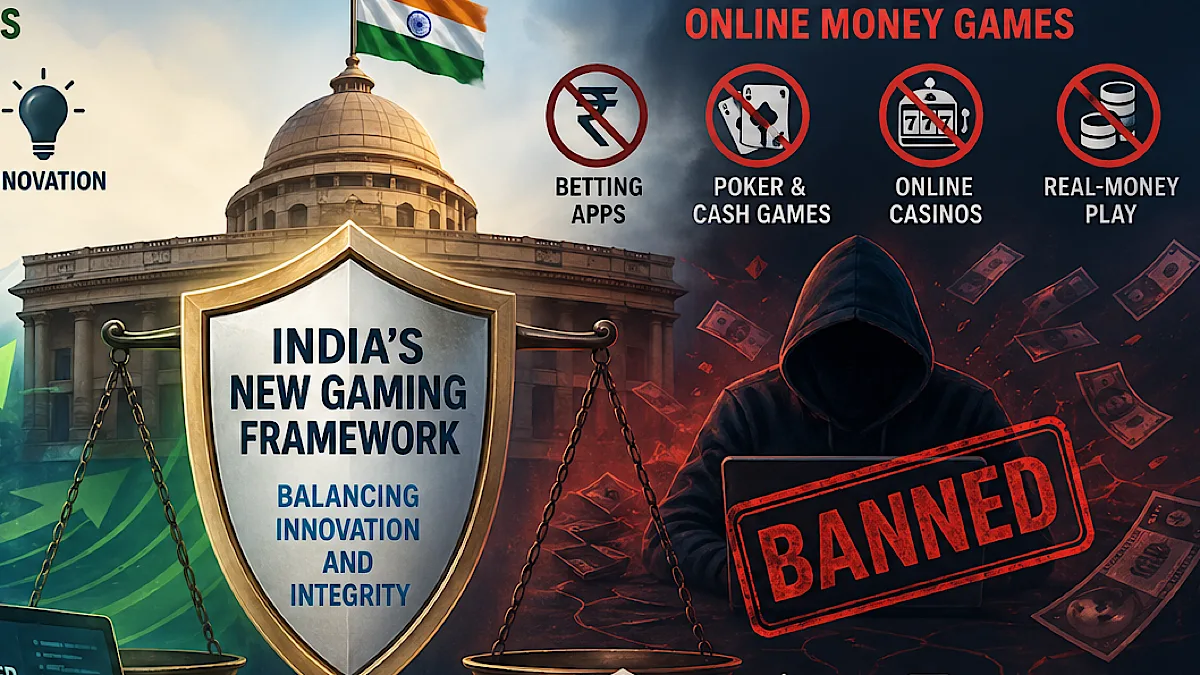
Photo:AI
India’s latest attempt to govern online gaming marks a subtle but consequential shift in regulatory thinking. Instead of casting a wide net over all digital games, the state has chosen to narrow its focus, loosening oversight for most formats while drawing a hard, unambiguous boundary around real-money gaming. This is not deregulation. It is selective control. For years, policymakers have struggled to reconcile two competing realities.
On one hand, India’s gaming ecosystem, spanning casual mobile games, fantasy sports, and competitive e-sports, has grown into a significant digital economy segment, attracting global capital and millions of users. On the other, the proliferation of betting apps, many operating offshore, has raised concerns around financial fraud, addiction, and regulatory arbitrage. Earlier regulatory drafts erred on the side of caution, proposing broad compliance burdens that risked stifling innovation.
Advertisement
The new framework appears to course-correct. By making registration largely voluntary for non-monetised games, the government is effectively signalling trust in the wider ecosystem. Developers of social and casual games are freed from intrusive oversight, allowing the sector’s creative and commercial energies to expand without bureaucratic friction. This aligns with India’s broader ambition to position itself as a digital innovation hub, where policy does not unnecessarily choke emerging industries. Yet, the permissiveness ends where money enters the equation. The outright prohibition of online money games reflects a decisive moral and economic stance: that speculative gaming, particularly in unregulated environments, poses risks too significant to tolerate. More importantly, enforcement is no longer conceived as a purely legal exercise.
Advertisement
By bringing banks, financial institutions, and cyber policing units into the compliance architecture, the state is shifting the battleground to the financial layer ~ where illegal activity is often most visible and most vulnerable. This dual approach ~ liberalisation for low-risk segments and muscular enforcement against high-risk ones ~ suggests a maturing regulatory philosophy. It recognises that digital markets cannot be governed effectively through uniform rules; they require differentiated oversight calibrated to risk. However, the framework’s success will depend less on its design than on its execution. India’s experience with financial and cyber regulation shows that enforcement capacity often lags behind legislative intent.
Offshore betting platforms, in particular, are adept at exploiting jurisdictional gaps and technological loopholes. Unless financial monitoring systems are both agile and coordinated across agencies, the ban may remain more declaratory than effective. There is also a deeper question about regulatory coherence. Gaming intersects with state-level laws on gambling, creating a layered and sometimes conflicting legal landscape. Without clearer alignment between central and state approaches, enforcement could become uneven, undermining the very clarity the new rules seek to establish. Ultimately, India’s new gaming framework is an experiment in balance. It attempts to separate play from profit, innovation from exploitation, and growth from risk. Whether it succeeds will determine not just the future of online gaming, but the credibility of India’s broader approach to governing its fast-expanding digital economy.
Advertisement

![‘Beginning of accountability’: Sonam Wangchuk reveals 3 written assurances from Centre before ending fast [VIDEO]](https://www.thestatesman.com/wp-content/uploads/2026/07/Sonam-Wangchuk-1-1-300x200.webp)
![‘Beginning of accountability’: Sonam Wangchuk reveals 3 written assurances from Centre before ending fast [VIDEO]](https://www.thestatesman.com/wp-content/uploads/2026/07/Sonam-Wangchuk-1-1.webp)