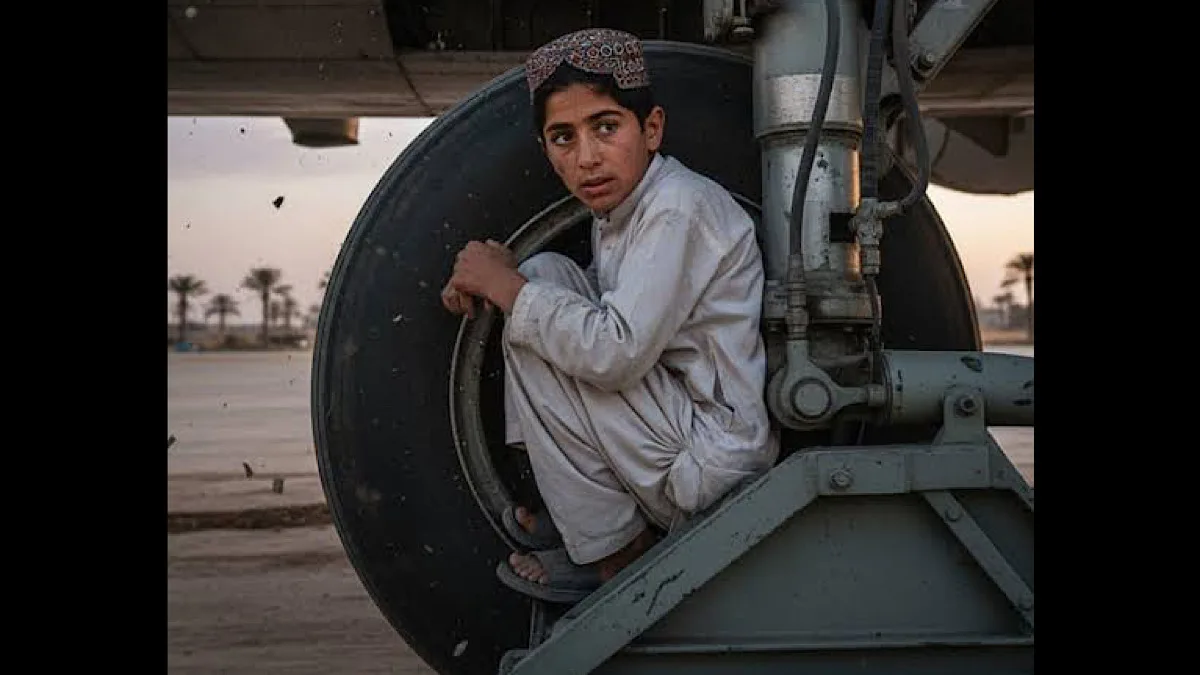
A 13-year-old Afghan boy accomplished what should have been impossible: surviving a flight from Kabul to Delhi by hiding in the landing-gear compartment of a commercial aircraft. His astonishing escape, equal parts miracle and tragedy, is not just a gripping human story. It is a piercing indictment of the world we have built ~ one where a child can risk death for the sake of escape or adventure, and where security systems meant to protect passengers can be breached by a determined teenager. The boy’s feat defies logic.
The rear wheel well of an aircraft is an unforgiving place, with temperatures plunging to sub-zero levels and oxygen levels too low to sustain consciousness. Many adults have perished in similar attempts. That a child endured the freezing cold, lack of breathable air, and the violent mechanical movements of the landing gear is nothing short of miraculous. His survival is a statistical outlier; his journey is a reminder that nature’s laws of endurance are not always absolute, but rarely are they so merciful. Yet the miracle cannot obscure the failures that enabled it. For a minor to slip past the multiple security layers of an international airport in a conflict-torn country speaks volumes about systemic lapses.
Advertisement
It also exposes the limits of aviation security at the receiving end. The fact that he was discovered only after landing should alarm both Afghan and Indian authorities. Aviation safety depends on the integrity of checkpoints, surveillance cameras, and ground staff vigilance. A single breach of this magnitude calls for a full review of procedures, training, and technology. Beyond the technical failures lies a deeper human tragedy. A boy from a war-scarred nation chose a hiding place of near-certain death. He reportedly acted “out of curiosity,” but such curiosity cannot be separated from the environment that shaped it. Afghanistan remains a landscape of poverty, repression, and limited opportunity, where the line between boredom and desperation is perilously thin. For children growing up amid conflict, danger becomes a familiar companion, and even fatal risks may appear as doors to a wider world. India’s swift decision to detain and return the boy underscores the delicate balance between security and compassion.
But merely repatriating a child who braved death is not enough. He needs psychological care, educational support, and protection from the circumstances that drove him to such extremes. His journey demands a response that goes beyond airport audits and immigration protocols. The wheel well of a plane is not a route to freedom, although it is a route attempted before. That a young teenager believed it might be should shake governments, airlines, and societies out of complacency. His survival is a gift of chance. The duty to prevent the next tragedy is a responsibility we cannot leave only to chance.