30 dead, 75 burnt: Five reasons why Bangkok pub fire was so deadly
Pub and club fires across the world have proved to be deadly, the most recent incident from India being the one from Goa.
The guns may have fallen silent along the Thai-Cambodian border, but the battle has not ended.




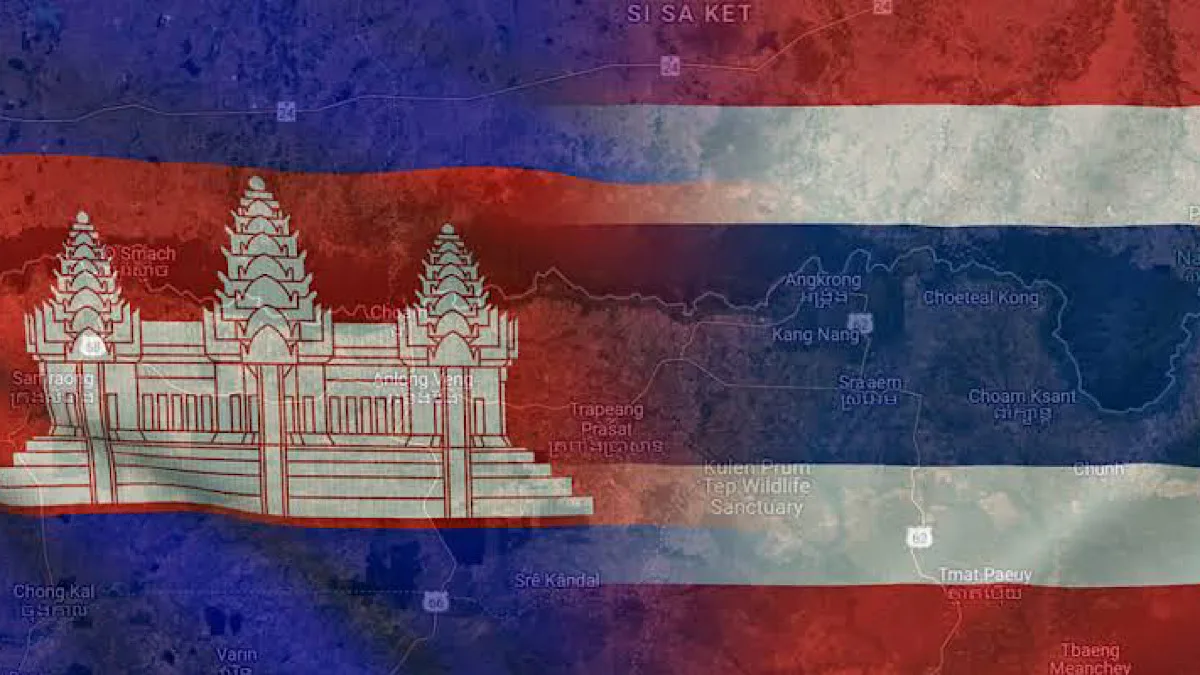
Thailand and Cambodia flags (Photo:X)
The guns may have fallen silent along the Thai-Cambodian border, but the battle has not ended. Instead, it has shifted to a different front ~ one where perception, rhetoric and propaganda are the decisive weapons. The fragile ceasefire now holds not because the two neighbors have found common ground, but because both are seeking to win the argument in the court of global opinion and in the hearts of their own citizens. In this contest, Cambodia appears to have seized the initiative. With a tightly controlled political system, centralised leadership, and a commanding voice on social media, Phnom Penh has portrayed itself as both victim and defender of sovereignty. Images, allegations and emotional appeals have flooded the information space, often regardless of factual accuracy.
What matters is not the truth of each claim but the speed and resonance with which it is delivered. Thailand, in contrast, has been on the back foot. Its government, weakened by internal political divisions and an uneasy relationship with its military, has struggled to project a coherent message. While Cambodian voices sing in unison, Thailand’s statements have been scattered across different ministries and military units, often dry and technical in tone. In an era where narratives travel faster than facts, this slow and fragmented approach has cost Bangkok dearly. At the heart of this confrontation lies history. The disputed territory is not just about lines on a map but about memories of humiliation and national pride.
Advertisement
Cambodia recalls an empire fractured and diminished by neighbours and foreign powers. Thailand remembers the concessions it made to colonial powers in the last century and still bristles at the 1962 international ruling over the Preah Vihear temple. These stories have become inseparable from questions of sovereignty, ensuring that compromise is framed as betrayal. The stakes, however, are not limited to symbols. Border clashes have displaced communities, injured soldiers, and endangered livelihoods. Landmine accusations and artillery exchanges have left scars both physical and political. Meanwhile, the mass departure of Cambodian workers from Thailand highlights how quickly nationalist fervour can spill into economic pain. What makes the present situation so perilous is the widening gap between perception and reality.
Advertisement
Cambodia has successfully internationalised the conflict, taking it to global institutions, while Thailand insists it must be resolved bilaterally. Each step deepens the stalemate, hardening nationalist positions on both sides. Ultimately, this conflict illustrates how modern wars need not be fought only with bullets and bombs. The real struggle is over legitimacy, narrative and identity. Unless leaders in Bangkok and Phnom Penh find the courage to rise above historical grievances and nationalist pressures, the ceasefire will remain fragile, the distrust will deepen, and the “silent” war of words will continue to carry the seeds of future violence.
Advertisement