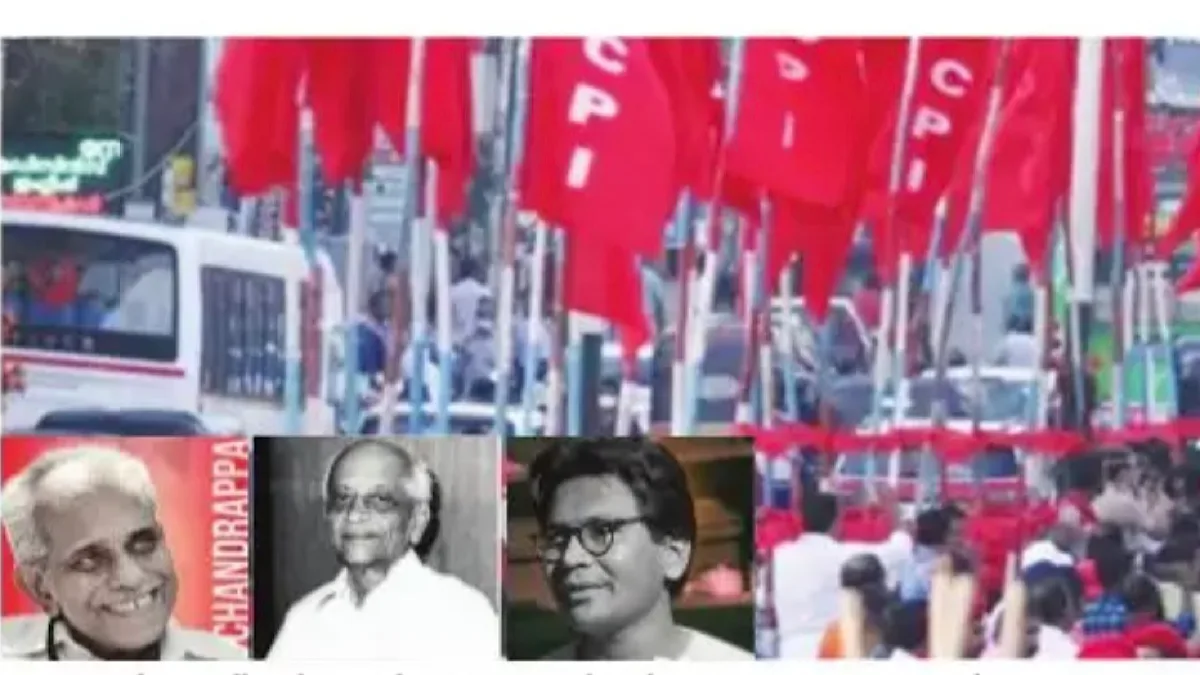
A few months before his demise in 2012, CK Chandrappan, CPI Kerala State Secretary, called me ~ I was at the time a member of the Kerala Public Service Commission ~ to the MN Memorial Building in Thiruvananthapuram to discuss an urgent matter. When I stepped into his room, he seemed to awake from deep thought.
Suddenly, he said something that startled me: “The CPI-M is going to sink!” My immediate query was: “Then, what about the CPI?” The reply came instantaneously: “What else? CPI will also sink along with it!” When Chandrappan uttered those words nearly 15 years ago, the CPI-M in Bengal had just imploded after being in power for 34 years. Not long afterwards, a similar phenomenon took place in Tripura. So, what do the results of the recently-concluded local body elections in Kerala point to, and what portents do they hold for the upcoming Assembly poll? Is not the CPI-M in Kerala on the path towards the same destination? As CP John, the Kerala Left leader told me in a private conversation, the role played by the CPI whenever it saw the Left go off-track in Kerala, was that of a bed-bug. Occasionally, it bit Pinarayi Vijayan but if he made the slightest movement, it hid itself from plain sight. At the next opportunity, it bit again and quickly disappeared from view.
Advertisement
A shift from this trend happened only recently when the PM SHRI issue cropped up. While that change of attitude has to be duly acknowledged, it alone will not be enough to keep the CPI from drowning along with the CPI-M. What is the reason for the local bodies’ poll debacle of the CPI-M in Kerala, its last outpost? Isn’t it a fact that, ideologically speaking, the party has reached a cul-de-sac? Do the CPI-M or the Indian Left have an effective strategy or national policy to confront Hindutva forces in contemporary India? The CPI-M took birth in 1964, after splitting the CPI down the middle, and identifying the Congress as its arch enemy. Today, in Kerala, the only state in which it remains electorally relevant, has it reconsidered its anti-Congress stand or dismantled its Stalinist organizational system in order to be in sync with the times? The answer is expressly not in the affirmative.
Is the CPI-M’s impending irrelevance any wonder, then? Not only the results of the latest local body elections, but the activities of the CPI-M in the last five years of its governance, as well as its organizational and policy-related changes, have shown beyond doubt that the CPI-M in Kerala is following in the footsteps of its comrades in West Bengal. The 1964 CPI split marked the beginning of the political destruction of the Left in India, but in the eyes of the CPI-M it was a sacred revolutionary act! Though differences of opinion existed within the Communist movement right from the beginning, these became intense and burst into the open in 1948, after India gained independence.
The central issue of debate then was whether India’s freedom was genuine or not. The sectarian group led by BT Ranadive trained its guns on the pioneering General Secretary and towering leader of the CPI, PC Joshi, and his policy of aligning himself with nationalism. The crucial arguments of the Calcutta Thesis, which Ranadive introduced in the 1948 party congress at Calcutta, were that the gaining of independence in 1947 was a mere case of power changing hands; Pandit Nehru was an agent of the British government, and an armed revolution had to be waged to unseat the Nehru government. There is no greater example of dogmatism to be found in the history of India’s Left movement.
The havoc it wreaked within the party and in the country was simply unimaginable. What Joshi, who gave a sense of direction to the Indian left movement for a long spell of thirteen years ~ from 1935 to 1948 ~ envisioned was a creative spirit of co-operation with the Nehru government in post-Independence India for the purpose of rebuilding our nation. But a group within the (undivided) CPI leadership saw this goal as a sin. Over the course of time, not only the sin but the “sinner” too became the object of hatred. The ingratitude and injustice that the Indian Communist movement showed towards Joshi was not just petty but self-defeating as we can now observe. Ironically, by the time the Calcutta Thesis was rejected as a flawed idea at the Madurai Party congress in 1953, Joshi had already been politically demonized and personally ostracized. The plain truth is that PC Joshi became the scapegoat for daring to take on the communist dogmas of the time and attempting to pursue solutions rooted in the Indian reality to uniquely Indian issues, albeit under a left and progressive umbrella.
Joshi, after the 1948-1953 period, spent the years till his death in 1980 pursuing his academic interests including writing the history of Indian communism, keeping up the pressure on the extremist elements of the Left through his prolific public writings, and swallowing the political slights and personal insults meted out to him by his erstwhile admirers, many of whose political- intellectual careers he had made. But the CPI-M did not end its campaign of calumny with Joshi. When the mantle of incremental, sensible, and progressive Left politics fell on SA Dange, they targeted him too. The spokespersons of the Calcutta Thesis continued to adhere to their narrow standpoints. Their fundamental arguments revolved around the class character of the Congress and the attitude to be adopted towards that party. In 1964, with China calling upon the Communist parties of Asian and African countries to initiate an “immediate revolution,” the split within the Communist Party of India became inevitable.
Dange and his supporters came to be known as “revisionists” who followed the Joshi line and were later accused of promoting “right-revisionism” within the Left, as it were! Although the CPI-M leaders went to the extent of misrepresenting Dange by portraying him as having written to the British government seeking a pardon while he was incarcerated in jail in pre-independent India, they did not succeed in destroying his spirit, like they arguably did with Joshi who, loyal to the end, refused to break ties with the CPI despite the humiliations heaped on him and the progressive forces in the Congress waiting to welcome him with open arms. Dange was perhaps less naïve than Joshi. For, in the General Election of 1957, Dange stood for and was elected as MP from the Bombay City Central constituency. That his margin of victory was higher than Nehru’s from the Phulpur parliamentary constituency is a matter of public record.
Dange became the Opposition leader in Parliament and AK Gopalan, the deputy Opposition leader. Despite his resounding electoral mandate, the CPI-M did hold Dange up to public ridicule. Obviously, intelligence goes awry when destruction is imminent. Both Joshi and Dange were always of the opinion that our nation’s greatest adversaries were: (i) Imperialism, and (ii) Extreme rightwing forces that extended cooperation to it. They also took the position that to fight these two threats, the CPI should participate in the nation-building process by cooperating with the Indian National Congress, the mainstream organization that spearheaded the freedom struggle.
What, then, does the extant political-electoral situation in contemporary times tell us against this backdrop? In present-day Kerala, the only geography where the communists as an electoral force are relevant (for now), it is clear that the CPI-M’s political stands ever since it came to power for a second time in the 2021 Assembly election are the cause of the party’s debacle in the recently held local body elections. It may be recalled that at its 1978 Bhatinda party congress, the CPI surrendered its policy of “national democratic revolution” at the feet of the CPI-M, and since then the ‘Big Brother’ has succeeded in maintaining the Left’s relevance and electability in Kerala with the support of the CPI (though the CPI-M will never concede this truth).
But the CPI-M’s doctrinaire arrogance and parochial mindset continue to remain its predominant feature. It will not be long before the CPI-M follows the “Bengal model” towards total self-destruction. Who is responsible for this impending collapse? Whoever those CPI-M leaders are, they do not deserve the support and compassion that leaders like PC Joshi and SA Dange deserved ~ then or now.
(The writer, a Left sympathizer, is former member, Kerala Public Service Commission)