At the recent 2nd All India State Water Ministers’ Conference in Udaipur, the Central Water Commission (CWC) of India unveiled two grandsounding innovations: the ET-based Quick Irrigation Performance Assessment (EQIPA) and the ET-based Detailed Irrigation Performance Assessment (EDIPA), both developed with the World Bank.
While marketed as revolutionary, these tools embody the classic case of misplaced technooptimism in a country where onground irrigation infrastructure is in shambles. Evapotranspiration (ET) – the sum of evaporation from the soil and transpiration from plants – is the equivalent of a crop’s daily water “intake.”
Advertisement
Just like a doctor might track hydration levels in a patient, ET maps theoretically help us gauge how much water crops are consuming and, in turn, where there is stress or surplus. With such information, irrigation water can, in principle, be adjusted for greater efficiency. But there’s a catch. Like using a stethoscope on a mannequin, applying ET in its current form through EQIPA and EDIPA grossly misunderstands the real patient: India’s broken irrigation system. The CWC’s fanfare ignored the fact that India already has three mature, globally validated models: SEBAL (1998, Netherlands), METRIC (2007, U.S.), and SSBoP (2013). Why then reinvent the wheel at great cost to taxpayers? EQIPA and EDIPA offer no discernible methodological innovation over these tools, but worse, they do so while ignoring India’s specific on-ground complexities.
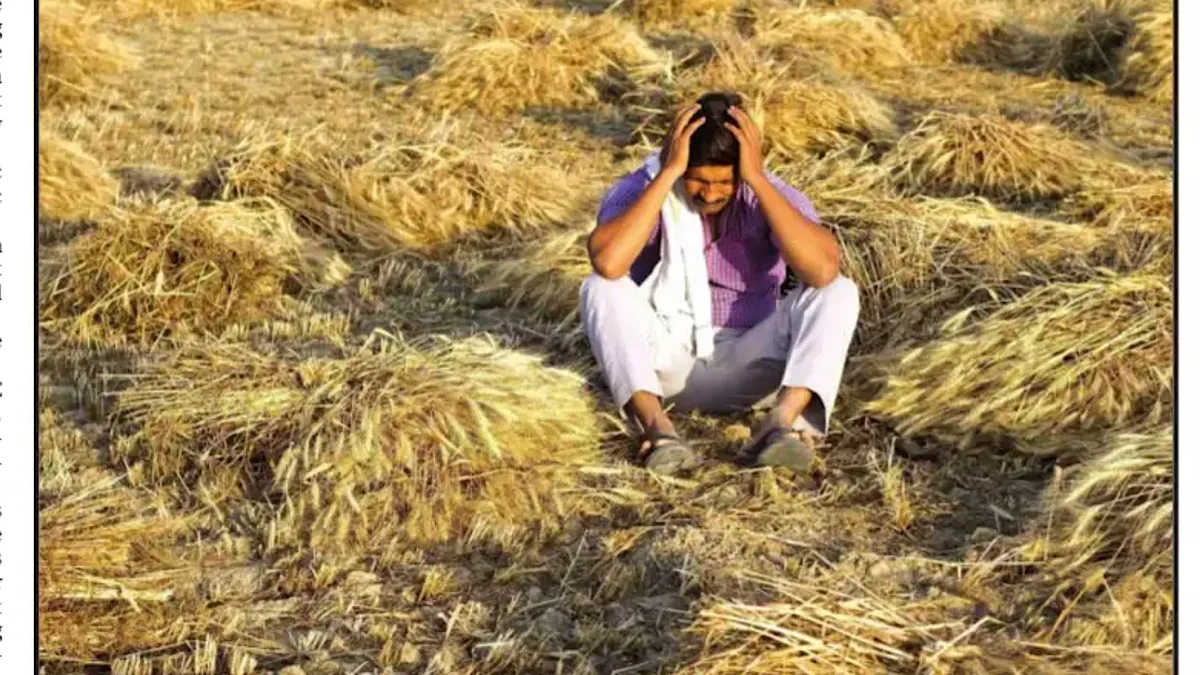
Across the country, canal networks are poorly maintained, silted, choked by weeds, or physically damaged. Command Area Development (CAD) – which is meant to ensure that water reaches the actual field channels – is mostly non-existent. As the 2018 CAG Performance Audit on the Accelerated Irrigation Benefit Programme (AIBP) points out, several declared “completed” projects were either non-functional or well below their irrigation targets. The result?
Farmers in supposed canal command areas often rely on groundwater and rainfall, not canal water. Yet EQIPA and EDIPA make no attempt to distinguish between sources of irrigation. That means the ET they calculate may have nothing to do with the canal systems they’re meant to assess. It’s like evaluating a city’s public transport system without knowing whether people arrived by bus, bike, or on foot. These tools claim scientific robustness but rely on problematic data inputs:
• Rainfall: IMD’s coarse-resolution gridded precipitation data does not capture local rainfall at the field scale (~100–200 m).
• ET data: Tools like WaPOR have built-in estimation errors.
• Land Use Data: The NRSC LULC 250K map, used for cropping extent, lacks the temporal and spatial precision needed for field-level decisions. Given that ~80% of Indian farms are 1 hectare or less, using remote sensing data with spatial resolutions of 10m (Sentinel), 30m (Landsat), or coarser is like trying to read fine print with foggy glasses.
Worse, the timing of satellite passes – critical to capturing peak crop water demand – is unspecified or ill-suited, introducing massive errors in ET estimation. Irrigation efficiency is not just about how much water is saved; it’s about how fairly (equity) and sufficiently (adequacy) it reaches the intended users. But when ET values include water from groundwater or rainfall – while the tools still report it under canal command – the resulting analysis becomes flawed. Equity is skewed because the source of water varies from farmer to farmer. Adequacy is misrepresented because canal performance is masked by supplemental sources. Thus, irrigation schedules based on these distorted ET values risk overirrigating some fields while leaving others dry. Crop stress increases, productivity drops, and farmer trust erodes. India didn’t need a new tool—it needed better adaptation of existing models:
• SEBAL, METRIC, and SSBoP are tried and tested. Their application to Indian agro-climatic conditions is overdue, not redundant.
• Multi-temporal, multi-source satellite imagery timed with crop growth stages should be the norm.
• Ground truthing should be mandatory before declaring a revolution. Promoting tools like EQIPA and EDIPA without peer-reviewed validation (none yet exists in reputed international journals) misleads stakeholders and policymakers. They offer the illusion of progress, while unleashing chaos in the underlying farm sector. ET can be a powerful ally in water governance, but only when rooted in scientific rigor, ground realities, and transparency.
Otherwise, as with EQIPA and EDIPA, it draws us deeper into the quagmire of water mismanagement. The erroneous outcomes from these tools if implemented can erode water security even as the water anarchy across farms is blindsided from the stakeholders thereby leading to a devastating impact on food security. As any wise farmer would say, “You don’t look at a single cloud and predict a monsoon”. The sooner the Central Water Commission learns and abandons faulty ET tools, the better for India’s water management.
(The writer is a retired Assistant Professor, Water and Land Management Institute, Lucknow. Views expressed are personal)