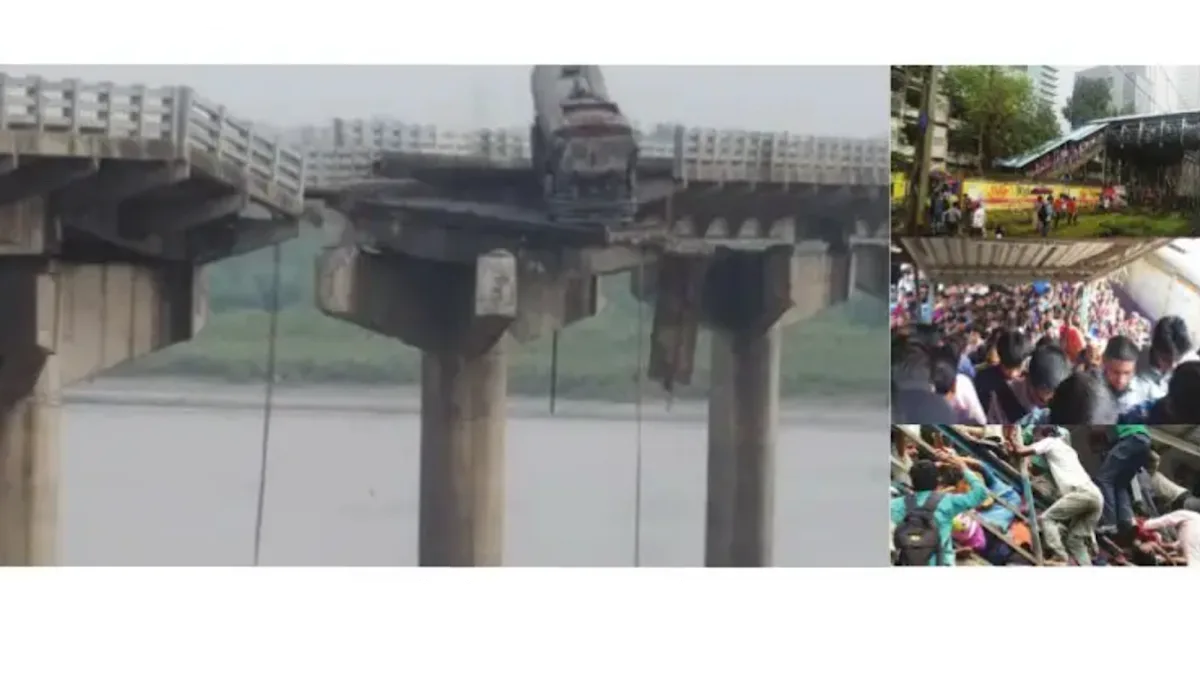
The collapse of the ill fated Gambhira Bridge, over the Mahi River in Gujarat, that caused 21 deaths, has focussed an unforgiving spotlight on the poor condition of public infrastructure in India. This is not an isolated instance; last year, in Bihar, twelve bridges collapsed in a span of seventeen days.
Recently, two weird bridges in Bhopal and Andhra Pradesh, with ninety-degree turns, and an under-construction Z-shaped bridge in Indore, puzzled newspaper readers. Then, there was the strange case of a bridge built in Bihar, in the middle of a field, with no road on either side. Nothing except venality and a brazen disregard for rules and norms is the reason for such mis conceived, expensive, and dangerous projects. Hearing a PIL about Bihar’s collapsing bridges, the Supreme Court observed that the Bihar government’s explanation of frequent incidents of bridge collapse in the State was merely a long list of “schemes, policies, etc” without giving any reason, for the collapse of multi-crore structures that endangered lives of the public.
Advertisement
The Gambhira Bridge collapse shows that no lessons were learnt by the government from the Morbi bridge collapse three years ago, which had killed 141 people. To recapitulate: startling facts emerged after the Gujarat High Court took suo motu cognisance of the Morbi tragedy. The operator’s agreement with the municipality, which authorised the operator to collect a fee of Rs.17 per person, was silent about the operator’s responsibility for safety. Rather, the agreement stated that there would be no interference by the Government or State agencies, in the maintenance or administrative tasks assigned to the contractor.
The level of negligence of authorities could be gauged from the fact that the repair of the bridge was limited only to polishing and painting the weight-bearing suspension cables and replacing the wooden flooring of the bridge by a four-layered aluminium one ~ which made the bridge significantly heavier. This gross negligence had a monetary motive ~ only Rs.12 lakh was spent on repairs, out of a sanctioned sum of Rs.2 crore. Then, at the time of collapse, more than three hundred people had been allowed on the bridge, while the bridge’s carrying capacity was only fifteen.
Before the High Court stepped in, the police fixed responsibility for the bridge collapse on two ticket booking clerks, two managers of the operator entity, two contractors and three security guards. All were duly arrested, but soon enlarged on bail. In the aftermath of the Morbi bridge collapse, the Gujarat High Court prescribed two annual inspections for all bridges ~ one before the monsoon and one after ~ and the Government issued an instruction for this purpose, but the value of such inspections could be gauged from the fact that all bridges in Gujarat, including the Gambhira bridge were certified as ‘fit and fine’ in this year’s pre-monsoon inspection.
After the Gambhira Bridge tragedy, all bridges were again inspected; this time 133 bridges were found defective, and closed to traffic. The Government had no reply when the High Court questioned them on the quality of their inspections. Bridge collapses, stampedes, and most other man-made disasters, have a background of official neglect and callousness. A classic illustration is the stampede on the foot overbridge linking Elphinstone Road (now Prabhadevi) and Parel railway stations in Mumbai in September 2017, which left 22 commuters dead and 39 injured.
It appears that because of rains, a large number of passengers had assembled on the narrow and dilapidated structure; once panic set in, order could not be restored and a stampede followed. Later on, it emerged that it was a disaster waiting to happen; much before the stampede, citizens had been constantly petitioning the Government to repair and widen the foot overbridge, and the Railway Minister had sanctioned a new foot overbridge for Elphinstone Road Railway Station. But railway officials had not carried out the Minister’s directions.
Mumbai citizens felt doubly aggrieved because the then Railway Minister, as also his predecessor, both hailed from Mumbai, and were well aware of the dilapidated condition of the Railway’s infrastructure. Moreover, the site of the tragedy was less than ten kilometres from the Western Railway headquarters, and top railway bosses could not have been unaware of what needed to be done. Mumbaikars also pointed out the injustice of spending an infinitesimal amount on public infrastructure in Mumbai, while 40 per cent of the country’s tax revenues were collected from the city.
This is a sad parallel to the Gambhira Bridge collapse; members of the public and some public representatives, had long been pressing for extensive repairs to the bridge which shook when vehicles crossed it; according to Government officials a new bridge costing Rs. 212 crore, had been sanctioned in 2024, but due to bureaucratic callousness, leave aside constructing a new bridge, even the old bridge was not closed to traffic, despite its visibly dilapidated condition. In another unsavoury parallel, after the Elphinstone Road tragedy, the Bombay High Court had ordered a structural audit of all foot overbridges, but such was the quality of audit that a foot overbridge near Chhatrapati Shivaji Maharaj Terminal (CSMT, erstwhile Victoria Terminus) collapsed in March 2019, shortly after being certified fit by the audit.
Interestingly, CSMT, which was built by the British a century and a half ago at the cost of some lakhs of rupees, houses the headquarters of Central Railway. The quality of construction of CSMT is such that it still handles almost a crore of passengers, and a thousand trains daily. Similarly, sometime before the CSMT tragedy, a road overbridge collapsed at Andheri Railway Station in Mumbai. It transpired that the railway’s bridge inspector had carried out a detailed survey of the 47-yearold bridge in April 2018 and had found large-scale corrosion along the bridge. However, no action was taken on the inspector’s report, so much so that the report was not even sent to the Brihanmumbai Municipal Corporation, the body that ‘owned’ the bridge. Strangely, recent years have also seen several under construction bridges collapsing, like the Vivekananda flyover collapse in Kolkata, or the Kota Chambal bridge in Rajasthan, both with considerable loss of lives.
Such mishaps could be squarely blamed on design faults and use of substandard materials, as there could have been no misuse or overuse. Sadly, official apathy and negligence does not pervade only the Public Works Department, but runs through all departments and enterprises ~ both public and private. The Bengaluru stampede, stampedes at Mahakumbh and New Delhi Railway Station, factory fires in Telangana and Gujarat, Harni Boat Tragedy in Baroda, TRP Zone fire in Rajkot, a couple of train accidents, crash of flight AI171, the list of recent tragedies is almost endless. The common thread running through these man-made disasters is unnecessary loss of human lives, caused by negligence of people operating infrastructure, mostly prompted by greed, callousness and an ‘I don’t give a damn’ attitude.
To rub salt into the public’s wounds, after a tragedy, it often emerges that officials had enough forewarning of what was about to happen. Thus, after a reckless driver mows down ten innocent bystanders, we learn that the driver had twenty outstanding challans to his name, or that a person accused of a serious crime, had a long history of criminal offences, and was out on bail, or that a bridge that collapsed had been shaking for some time. However, no one asks the officials concerned questions like why they had not cancelled the driving licence of the errant driver, or why they had not kept watch on the criminal, or why they had not shut down traffic on the shaking bridge. Perhaps, the Government should draft an SOP for the maintenance of all premises used by the public, which should include a compulsory annual safety audit by an independent agency.
Grievous penalties could be prescribed for the issue of a false certificate. This would be music for the ears of the public, plagued as it is by bridge collapses, stampedes at religious places, accidents involving horribly overloaded school buses driven by unlicensed drivers etc. In the long run, the only way to prevent man-made disasters is to prescribe and enforce accountability for bureaucrats and politicians. The much reviled Emergency proved that Government employees perform well, if the fear of God is put in them. The only requirement is that we discard complex administrative procedures and rid the bureaucracy of its self-perpetuating instincts, which prevent action against non-performing and/or corrupt bureaucrats.
(The writer is a retired Principal Chief Commissioner of Income-Tax)