Strategic Distance
The renewed war between the United States and Iran has again placed American and Israeli military interests on apparently common ground.
More than a month after a naval strike left them stranded, Iranian sailors are finally heading home from Sri Lanka, a delayed return that quietly marks the afterlife of a widening conflict.




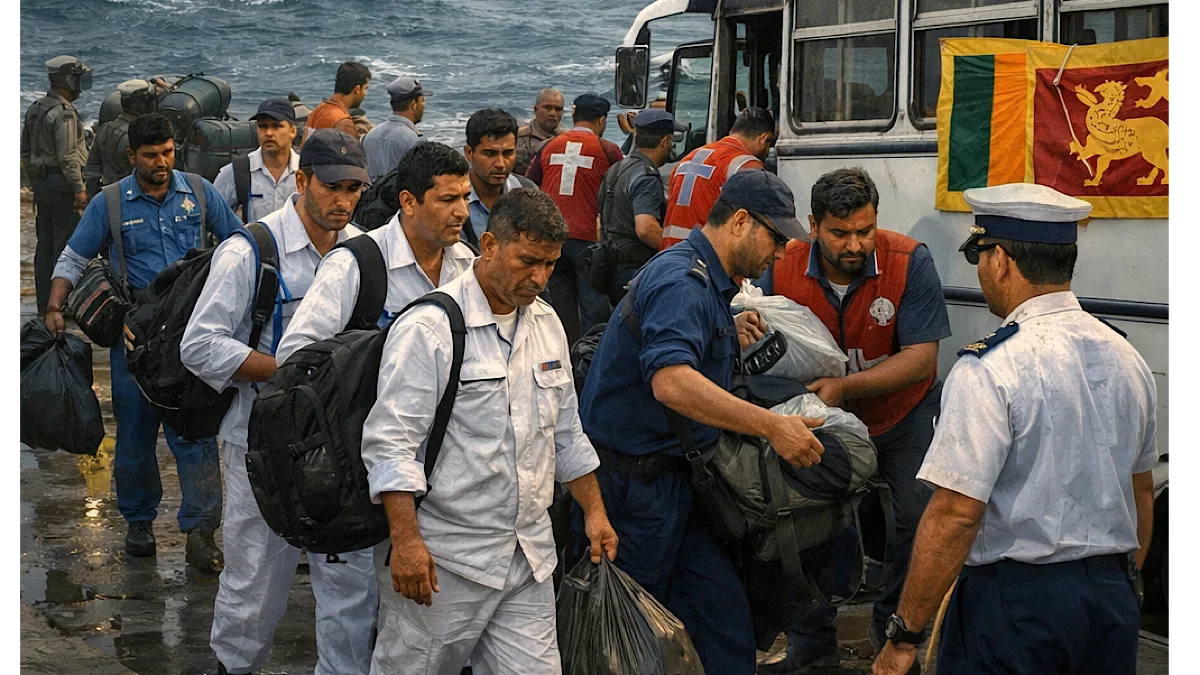
Photo:AI
More than a month after a naval strike left them stranded, Iranian sailors are finally heading home from Sri Lanka, a delayed return that quietly marks the afterlife of a widening conflict. When a naval strike reverberates thousands of kilometres from its presumed theatre, it signals more than a tactical escalation ~ it redraws the map of risk. The sinking of an Iranian warship in waters not far from Sri Lanka has done precisely that, pulling the Indian Ocean into the strategic orbit of a conflict otherwise centred in West Asia. For decades, this vast maritime expanse has functioned as a corridor of commerce rather than confrontation.
The sea lanes connecting the Strait of Hormuz to the Malacca Strait are among the busiest in the world, vital to energy flows and trade. Yet a US submarine strike on an Iranian vessel in these waters suggests that the geography of the US-Iran conflict is no longer bound by the Persian Gulf. It is mobile, fluid, and increasingly unpredictable. The humanitarian aftermath – hundreds of stranded sailors, casualties, and an emergency response by Sri Lanka – offers a quieter but equally important lesson. Colombo’s decision to house, treat, and repatriate the sailors while avoiding overt political alignment reflects a careful adherence to its long-standing non-aligned posture.
Advertisement
Since independence, Sri Lanka has balanced ties with competing powers, including India, Iran, and the United States. In this instance, it demonstrated that neutrality is not passivity but an active, calibrated stance. Yet neutrality is becoming harder to sustain. When military engagements spill into international waters near smaller states, those states are forced into roles they did not seek: first responders, logistical facilitators, and, potentially, unwilling stakeholders. The risk is not merely diplomatic discomfort but economic vulnerability. Any sustained militarisation of the Indian Ocean threatens shipping routes, insurance costs, and port activity, critical lifelines for economies like Sri Lanka’s. There is also a subtler shift at play.
Advertisement
The Indian Ocean has long been viewed as a secondary theatre in global power politics, overshadowed by flashpoints in the South China Sea or Eastern Europe. This incident challenges that assumption. It underscores how quickly peripheral spaces can become central when great-power rivalries intensify. For regional players, including India, the implication is clear: maritime security can no longer be treated as a distant concern but must be integrated into core strategic planning.
Ultimately, the episode reveals a conflict that is no longer geographically contained. It is expanding along the arteries of global trade, testing the resilience of neutral states and the stability of shared spaces. Sri Lanka’s measured response offers a template for diplomatic restraint, but it also highlights a stark reality: in an interconnected maritime world, even those who choose not to take sides may find the conflict coming to them.
Advertisement



![‘Beginning of accountability’: Sonam Wangchuk reveals 3 written assurances from Centre before ending fast [VIDEO]](https://www.thestatesman.com/wp-content/uploads/2026/07/Sonam-Wangchuk-1-1-300x200.webp)

![‘Beginning of accountability’: Sonam Wangchuk reveals 3 written assurances from Centre before ending fast [VIDEO]](https://www.thestatesman.com/wp-content/uploads/2026/07/Sonam-Wangchuk-1-1.webp)