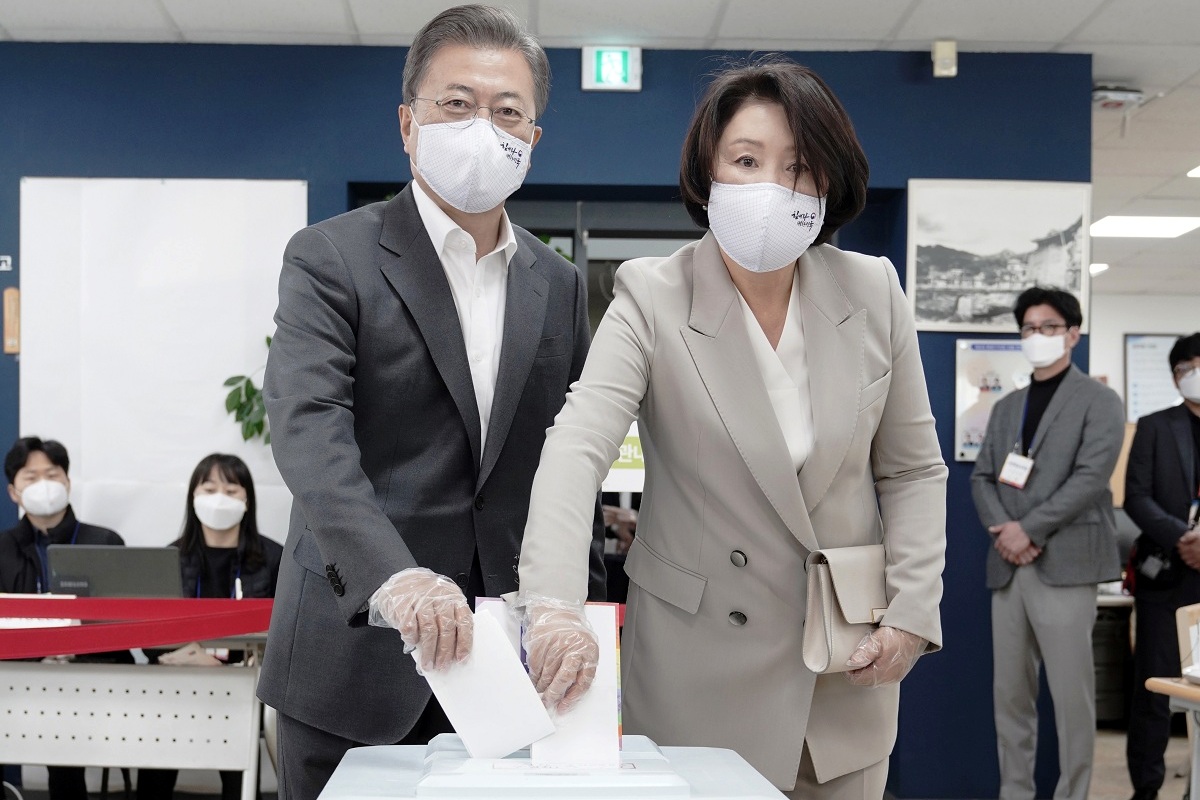
It is a heroic tryst with democracy. As one of the countries that has been acutely afflicted by the coronavirus pandemic ~ it may well be under the hat in the North ~ South Korea has ensured that the first vote is cast two days ahead of the parliamentary polls on April 15 in the midst of the fight against the virus and more than 10,000 confirmed cases.
This is the chief significance of Friday’s vote ~ democracy must survive in the moment of a catastrophe and long after Covid-19 ceases to grab the headlines. It is a measure of the inbuilt resilience of Seoul’s democracy that the safety of the voter has been accorded uppermost priority by the National Election Commission in the midst of fears that voters could be exposed to the risk of infection.
Advertisement
The short point must be that the pandemic has not disrupted the political calendar in South Korea. The tiny country has conveyed a profound message to the democratic world, notably the bedrock of the concept, pre-eminently the United States and Britain. For all the disaster that confronts humanity, the parliamentary election is proceeding with foolproof preparation and protocol in place to protect voters.
Even while it battles the scourge, the government is trying to assure its 44 million voters that it is safe to leave their homes to go to the polling booths. Concordant with the rulebook, it has urged the public to avoid large gatherings and practise social distancing. The medical certitudes are very much in place even as the country renews its tryst with democracy.
The government has, for instance, disinfected 14,000 voting stations across the country and marked waiting lines at an interval of three feet so that voters avoid standing too close. Separate areas for voting have been earmarked for those running a temperature. The voter is then sent for testing and the booth disinfected.
By all accounts, it is what they call an “epidemic- era election”. Officially, the election to South Korea’s 300-member National Assembly is scheduled to be held on Wednesday. But nearly 5 million voted on Friday and more are expected to exercise their franchise over the weekend.
The advance voting system, introduced in 2013, is integral to the plan that has been formulated for the epidemicera election. The challenge before the authorities is how to protect the suffrage of the people. In parallel, safeguards have been put in place to minimise the danger of infection that could happen during the election.
South Korea showcases a case-study of electoral compulsions in the time of a health emergency. Having endured one of the worst early outbreaks of the disease, the country is now voting under quarantine. It signifies the triumph of democracy. From the medical perspective, the precautions and testing facilities are in place. This intrinsically is the profound signal emitted by Seoul.