With the passage of time Donald Trump’s Alaska summit appears to not only have failed but also to have displayed a changing world order. Sanctions on India for procuring Russian oil and thereby funding their war machinery were aimed at pressurising India into switching alliances. India refused to budge. Trump, in his desperation to display proximity to Vladimir Putin, and hoping he would accept direct talks with Ukraine’s President Zelenskky, made European leaders wait while he spoke to him.
This too failed. Trump’s dream of a Nobel is fading. While Putin has not commented on Trump’s summit request, his foreign minister Sergei Lavrov made the Russian position clear. He debunked most of what Trump and his European allies had suggested. On security guarantees he mentioned that a group of nations, including UNSC members, should be guarantors of Ukraine’s security. These would automatically include Russia and China. He added that non-UNSC members being part of guarantors must be “neutral, non-aligned with any military bloc and non-nuclear,” implying almost no NATO role.
Advertisement
He added that NATO membership was unacceptable, and that protection for Russian speakers in Ukraine and territorial realignment need to be accepted. Finally on a Putin-Zelensky summit, Lavrov mentioned, “Putin is ready to meet with Zelenskyy when the agenda is ready for a summit, and this agenda is not ready at all.” Generally, leaders’ summits are photo-ops, with most preparations done by diplomats in advance. A meeting without pre-set agendas or approved agreements has little chance of success. Lavrov’s comments came after he met India’s EAM S Jaishankar, implying India was on board with the Russian view.
Putin, like most heads of state, would prefer issues being discussed and finalized between diplomats, with limited refinement at the summit. At Alaska, Trump went in promising a ceasefire, but ended up singing Putin’s tune of peace. Trump also made no mention of additional sanctions on Russia. What was more embarrassing was his subsequent meeting with European leaders in Washington, where he bulldozed his views on ending the conflict. However, Russia refused to play ball.
Meanwhile the war continues. Drone and missile strikes are being launched by both sides. While Russia targets new regions, Ukraine targeted a Russian nuclear power plant. The West fears a fresh Russian offensive could be disastrous for Ukraine. Trump, defending his decision on the US not funding Ukraine, mentioned that it is NATO which is procuring US armaments for delivery to Kiev, implying US companies are earning from the conflict. Leaders from Europe continue streaming into Ukraine offering support. The latest to visit Kiev or speak to Zelenskky include Canada’s PM, the NATO Secretary General, the German Vice-Chancellor and the Norwegian PM.
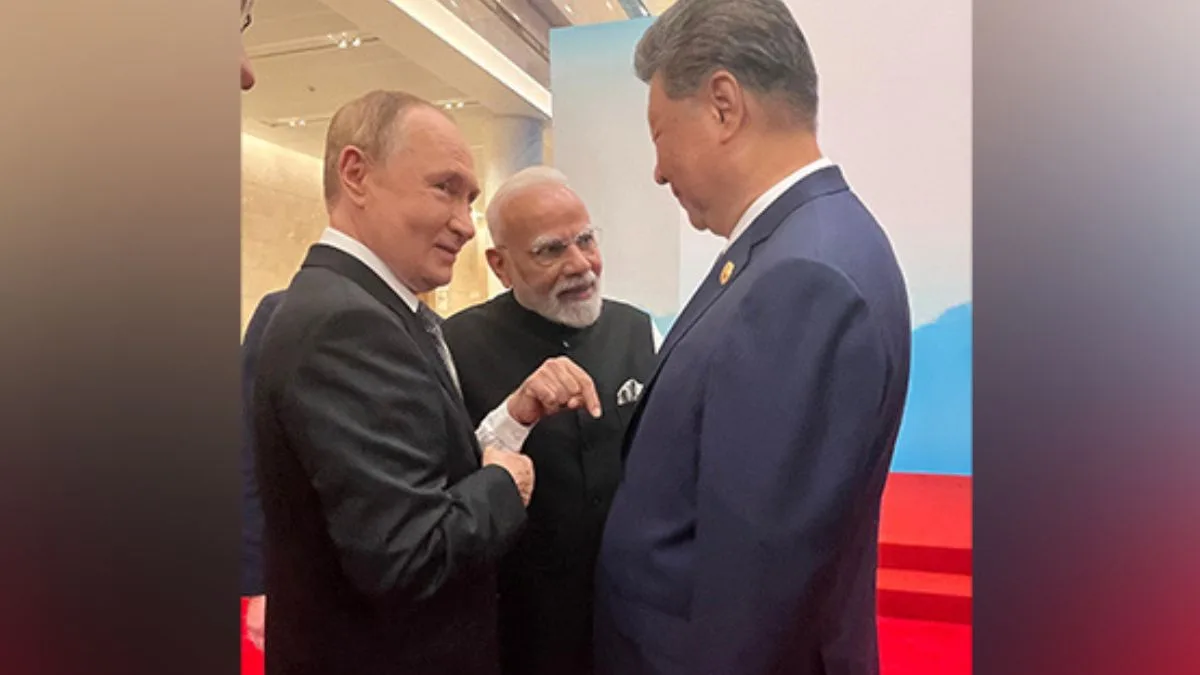
The Russian economy may be slowing down but is nowhere near levels which could compel Putin to change his stance. India, whom the US targeted with additional sanctions, has refused to bend, despite sanctions having some impact on the economy and employment. China, already under 55 per cent tariffs, remains firm. The leaders of the three nations met over the weekend on the sidelines of the SCO summit at Tianjin in China. Putin had already briefed PM Modi on the outcome of the Alaska summit. The manner in which European leaders rushed to the US to display solidarity with Ukraine and possibly project a united front turned out to be an embarrassment.
Images released by the White House displayed them being treated as errant schoolchildren by Trump. This is primarily because for decades Europe ignored its defence and remained dependent on the US for security. This has enabled Washington to override their views. Plans to increase defence spending to 5 per cent over the next decade will have limited impact for the present. Europe is no longer the power it once was. With Europe largely left to fund Ukraine and prepare for future hostile scenarios, it cannot afford to be involved in trade conflicts on America’s demands. It has thus far refused to respond to Washington’s requests to impose sanctions on India.
Talks on a free trade agreement are in an advanced stage. This benefits India. Military and economic power is rising in Asia. India and China are two major powers in the region. Russia is closely associated to both. The Russia-India-China troika can be an economic and military powerhouse in the future, provided India and China overcome their trust deficit and resolve their border issues. The recent visit of Chinese Foreign Minister Wang Yi indicated change. It is to be seen whether it will hold true. A media report in a German newspaper Frankfurter Allgemeine Zeitung mentioned that Trump had attempted to call PM Modi on a number of occasions but failed.
Though dates have not been mentioned, it is likely to be recent. Possible reasons for PM Modi avoiding conversation with Trump include his determination not to open India’s agricultural sector, refusal to stop procurement of Russian oil and to prevent Trump from exploiting the call to reiterate his claims of brokering peace. Today India is the nation to watch. It is being wooed by China with promises to resolve pending issues and by Russia which seeks that it remains a partner, while the US assumes that bullying on trade can compel India to change its position. Peter Navarro, the US trade advisor, has never given so many interviews on a single subject as he has done on US sanctions on India, nor has Trump discussed the Russo-Ukraine war as many times as brokering the Indo-Pak ceasefire.
India is willing to stand up to US bullying and the nation stands behind the government. The Trump administration’s attempts to justify sanctions may not get New Delhi to bend but rather compel it to alter its trade and financial policies to absorb a part of the losses from US sanctions. Meanwhile the US-India two plus two dialogue was held indicating that there are signs of normalization.
India will be on firmer ground provided its relations with China, which also faces high tariffs, mend. With Europe in decline and bullied by Trump, it is Asian giants and Russia standing up to it. At some stage, Trump will need to reassess his current strategy towards India if the US seeks to contain China’s rise. This may possibly flow from a summit this month on the sidelines of the UNGA session, in case PM Modi visits New York. Details have yet to be released. Till then, India will stand firm.
(The writer is a retired Major-General of the Indian Army.)