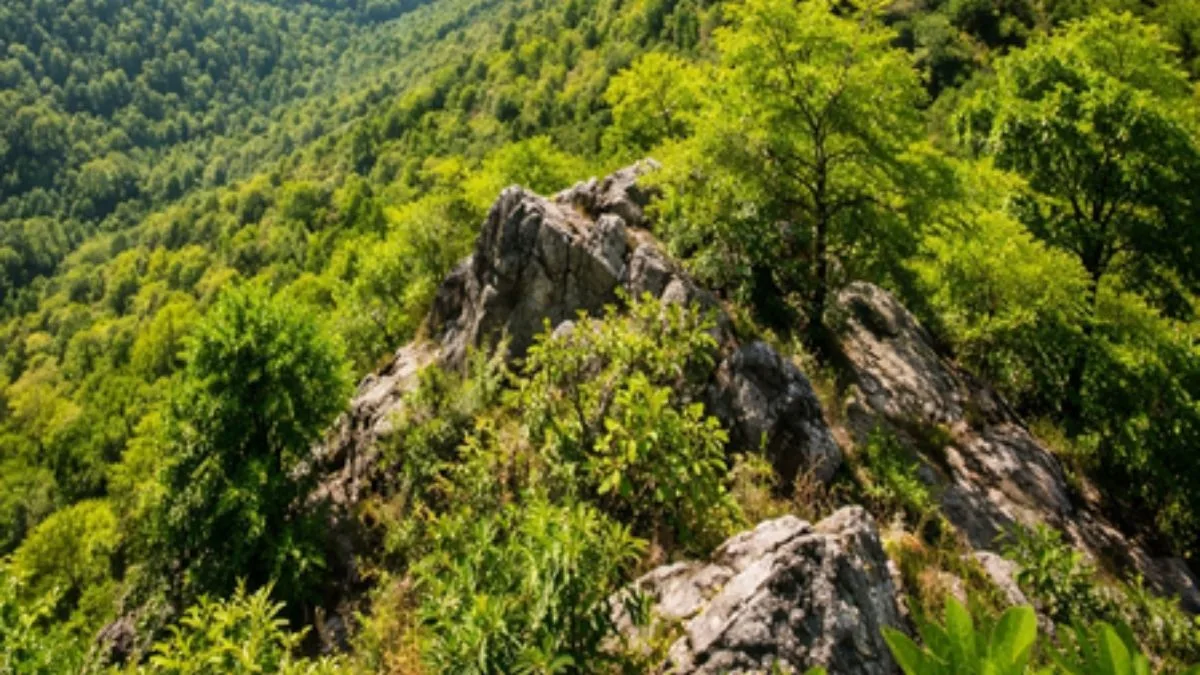
Stretching from west to east for 680 km through Gujarat, Rajasthan, Haryana and Delhi, and more than two billion years old, the Aravalli mountain ranges are natural barriers against the spread of Thar desert northwards. These hills also deflect westerlies and bring winter rains in Punjab, Haryana, Delhi and western UP and further play important roles in climate regulation, ground water recharge and biodiversity conservation. The tree covers on the hills are vital carbon sinks, which has a role in mitigating winter pollution in Delhi NCR. The Supreme Court on 5 May 2024, directed the Union Environment Ministry (MoEFCC) to constitute a panel to formulate a uniform definition of the Aravalli.
Accordingly, a panel headed by Secretary MoEFCC and comprising Forest Survey of India, Geological Survey of India and Central Empowered Committee was constituted. The minimum, maximum and average elevations of hills in each of the 34 districts across the Aravalli in four states were measured. Wide variation was found in ‘average elevation’ across the districts, indicating the challenge in making a definition uniform. Some districts have hilly terrain that do not belong to the Aravalli range while the entire geological extent of the Aravalli ranges is not uniformly hilly.
Advertisement
Thus, neither the slope nor the elevation can delineate Aravalli ranges from other land parcels of the districts. If slopes and elevations are kept as the criteria for delineation, one can include other areas or even exclude some Aravalli areas from true range. With ever increasing threat to ecology due to mining, the Supreme Court on 12 August 2025 asked the states to reason out the definition. The Rajasthan government reported that identification of Aravalli is based on Richard Murphy’s 1968 land reforms classification, which said that hills above 100 m elevation along with its supporting slope below 100 m and up to ground level bottom-most contour (local relief) and all areas encircled by it (supporting slope) is included in the hills. Gujarat and Haryana too followed the same definition. Delhi, however, added that no mining is permitted in the ridge area.
While taking note of the ecological importance of Aravalli hills, the panel headed by Secretary MoEFCC observed that the region is the crucial repository of base metals like lead, zinc, copper, as well as precious metals such as gold and tungsten, while Delhi’s Aravalli has critical and rare earth minerals like tin, graphite, molybdenum, niobium, nickel, lithium etc. needed for energy transition, high technology manufacturing and national security. The panel recommended the definition of Aravalli as landforms located in Aravalli districts having an elevation of 100 meters or more from local relief along with the supporting slopes and associated landforms irrespective of gradient. The Supreme Court approved the definition on 20 November 2025.
Amid protests and criticism of this definition, MoEFCC further announced that there would be no new mining leases until a detailed study is undertaken. Despite this the protesters have not deterred and the protests are continuing. Earlier, the Forest Survey of India – MoEFCC’s institution – had come up with slope criteria for the identification of the Aravallis. It had included all landforms with 3-degree slopes and above in it. 15 out of 18 districts of Rajasthan that qualify under the 3-degree criteria had 40,483 sq. km of area under Aravalli hills, which nearly works out to be 33 per cent of total geographical area of said 15 districts. Forest Survey of India earlier mapped 12,081 hills in these districts and only 1,048 are above 100-meter elevation.
The Supreme Court-approved definition of 100-meter elevation would exclude 90 per cent of these from Aravalli ranges. But MoEFCC told the Supreme Court that 12 out of 34 Aravalli districts are under 3-degree slope and would be excluded from definition. Either of the definitions seems to exclude a large chunk of areas identified by the other. In the circumstances, both definitions would not do justice in delineating the Aravalli hills properly. To date, neither the states nor Union government have carried out any comprehensive survey of Aravalli, to find the extent of area covered under hill ranges, total number of hills, and the hills above 100-meter elevation etc.
The Supreme Court has rightly taken suo motu cognizance of the issue and the bench on 29 December stayed its ruling on 100-meter definition and said that a committee of experts would be constituted to study the environmental impact. A final view on definition of Aravalli is yet to emerge. But the larger question remains – whether hills have been defined based on elevation and slope in any part of the country. We have no such definition for Himalayas, Satpura, Western Ghats, Eastern Ghats, Shivaliks, Vindhyas etc. SC’s own Amicus Curiae cautioned that it would open up the lower hills to incessant mining, if the definition based on elevation is accepted.
Earlier in 1996, 2004 and 2008, the SC judgements in the MC Mehta Vs Union of India case sought to preserve Aravalli and the green belt against deforestation and mining. Rajasthan has 1,230 mining leases over an extent of 17,383 ha within the Aravalli ranges. Many are under dispute and few are operating. Though the state government notified 50 new mining leases in Aravalli, the Centre’s recent ban has put them on hold. MoEFCC last year announced a green wall for nearly 1,400 km long across four states Delhi, Haryana, Rajasthan and Gujarat. It is said to connect the places from Mahatma Gandhi’s birth place in Porbandar in Gujarat to Rajghat in Delhi, where he was finally laid to rest. The wall has some natural forests and some plantations, interspersed with restored agriculture land, pasture land and water bodies.
The Ministry has proposed to reforest 1.15 million hectares’ area in these states covering foothills and buffer areas on either side of the Aravalli hills by 2027. The greening was to be taken up by planting native tree species during the monsoon season of 2025, 2026 and 2027. There is no report in public domain as to what has been achieved under the scheme during 2025 and what are the targets for 2026 and 2027? While on the one hand the government has committed to develop a green wall along the Aravalli, we are restricting it by imposing a definition favouring exclusion of areas from the range.
(The writer is former Head of Forest Force, Karnataka)