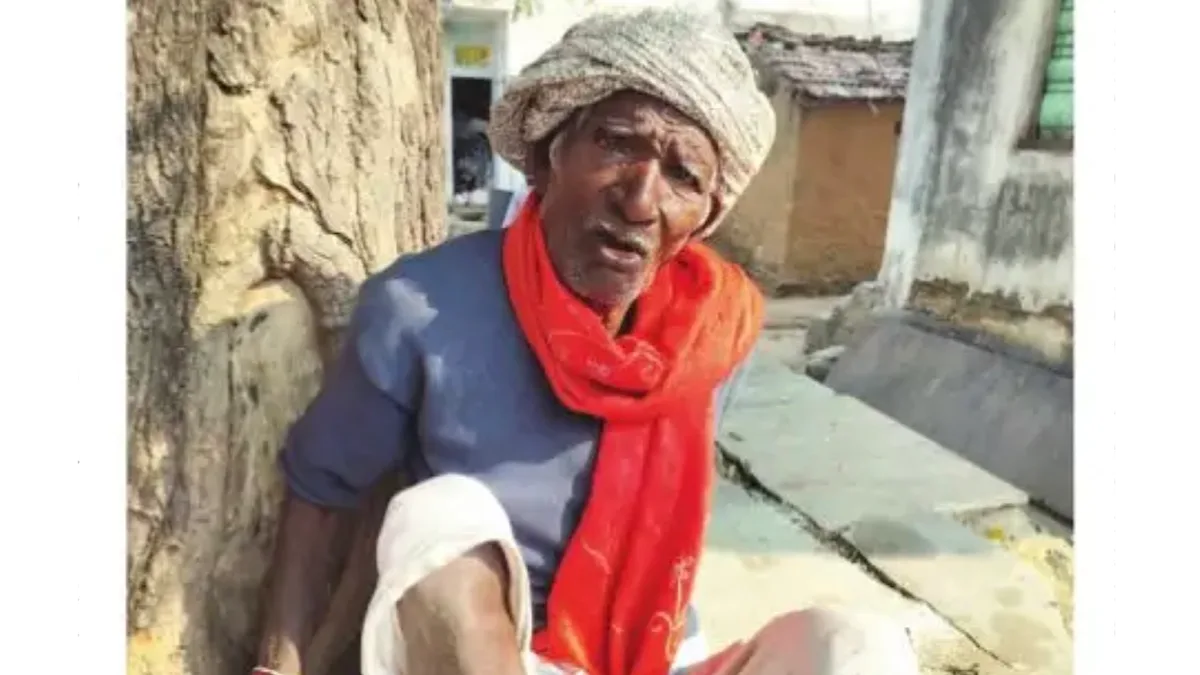
A neglected aspect of health and development initiatives in rural areas is that the needs of elderly people, particularly those from weaker sections, do not get adequate attention. The problems of elderly people can be severer in areas where dependence on migrant work is high and younger members of a family must be away for considerable periods of time. Dr. Sharad Iyengar, who leads a programme called Prabal Yatra (PY) for improved health and wellness care for elderly people in about 100 villages of south Rajasthan says that their experiences so far have confirmed the urgent need for such interventions to specially help the elderly people from weaker sections in remote villages.
Gaya Prasad Gopal, an elderly and respected social activist from Chitrakut district of Uttar Pradesh has been closely observing the changes in rural poor households. He says that sometimes due to compulsion and sometimes due to neglect, increasingly there is a tendency on the part of younger members to not fulfill their responsibilities towards elders in their families satisfactorily. In such conditions, government policies need to give more attention to meeting the needs of older people in rural areas. For evolving the most appropriate policies it is important to collect information on priority needs and the wider social conditions in which these needs can be met based on constant interactions with the elderly as well as the wider rural community.
Advertisement
An initiative like Prabal Yatra thus helps at two levels. On the one hand it contributes directly to the wellness of older people in villages where it works. On the other hand, sensitive community workers get valuable insights which can be helpful for need-based and evidence-based policy. Each village of this work area in south Rajasthan has a Prabal Yatra Manch or a membership-based platform of older people. They come together in meetings to take up physical exercises, mental simulation games, and conversations on their welfare. At the same time, with the help of PY community workers, elderly people can resolve problems and questions relating to benefits from government schemes.
The PY program is being implemented by a voluntary organization Action Research and Training for Health (ARTH) which is known for the strength of its health programmes. Hence health, nutrition, safety, and overall wellness have been emphasized more in PY. Broadly these interventions are in keeping with the World Health Organization’s approach called Integrated Care for Older People or ICOPE. This approach emphasizes that six intrinsic capacities are essential for healthy ageing. These include mobility, nutrition, vision, cognition, hearing, and mood related matters. An assessment of 2,386 older persons revealed that 90 per cent have at least one diminished capacity and 79 per cent have two or more. Thus, PY has been involved in extensive efforts to provide glasses, cataract surgeries and walking aids. Hundreds of those suffering from serious illness have been helped in getting medical care, with many being accompanied to health facilities.
To improve nutrition, raised bed vegetable gardens have been provided to several households. In addition, the fact that the elderly people can meet and discuss their issues in meetings has been a step forward for them and they look forward to such interactions. Recently I attended one such meeting. One of the issues that we discussed related to the increasing tendency for older people to live separately which in the case of death of one partner means that several older persons are living entirely alone. In the cases of some women like Jumli Bai, too old and weak to cook her own meal, this means that daily food needs now depend precariously on what a neighbour may agree to provide. I also visited a family in which a middle ground appeared to have been found. Here the older people were living separately but very close to their children.
In such a situation, it appeared more likely that the essential needs of old people would be noticed and taken care of. Such situations also indicate that apart from health and nutrition issues, wider social issues are also integral to finding satisfactory conditions for the care of elderly people. In the meeting we also discussed the factors that lead to neglect of the needs of elderly people. Those assembled agreed that where alcohol consumption is a problem for younger persons, the needs of the elderly people tend to be neglected more. According to a Nanalal Gayari, an experienced social worker of this area, there is a clear tendency in these villages for the care of elderly people not to get adequate attention, at least among those weaker sections with which he is familiar.
This is a worrying trend for anyone working for better overall care and wellness of elderly people. At the same time there is no denying that various communities have rich traditions of respecting the elderly and taking good care of them. These good traditions however can come under pressure in difficult conditions or under the influence of the expansion of some harmful trends. Can we work to revive some of these good traditions, generally and in the specific context of various communities which can lead to better care of the elderly people? Thus, a combination of health and social interventions are needed for improved health care of older people. Programmes like PY can make a helpful contribution to various communities among whom they work. The insights gained in the course of this work can also contribute to framing better policies for older people.
(The writer is Honorary Convener, Campaign to Save Earth Now. His recent books include Protecting Earth for Children, Man over Machine and A Day in 2071.)