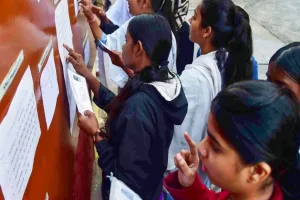
NEET-UG 2026 results declared; Punjab’s Aryan Gupta, Himachal’s Panshul Bansal joint toppers
Punjab's Aryan Gupta and Himachal Pradesh's Panshul Bansal jointly obtained the highest score of 715 out of 720 in the NEET-UG 2026 examination.
India’s medical entrance examination crisis is no longer about one leaked paper, one compromised centre or one criminal network.





India’s medical entrance examination crisis is no longer about one leaked paper, one compromised centre or one criminal network. It is about the collapse of institutional credibility in a system that millions of families still treat as the country’s last remaining ladder of meritocratic mobility. The cancellation of NEET-UG 2026, after allegations that a large number of questions matched a pre-circulated “guess paper”, has revived memories of the 2024 controversy that had already shaken public faith in the examination system. What makes the latest scandal politically and institutionally damaging is not merely that another alleged leak has surfaced.
It is that this has happened after two years of investigations, reform committees, court hearings, and official assurances that the system had been secured. The National Testing Agency was originally conceived as a technocratic solution to India’s chaotic entrance examination culture. Centralised testing, standardisation, and digital oversight were projected to reduce manipulation and restore trust. Instead, the NTA has increasingly come to symbolise opacity, defensive bureaucracy, and reactive governance. Each controversy has followed a familiar pattern: denial, outrage, partial admission, arrests, political firefighting, and eventual promises of reform. The deeper problem lies with the high-stakes competitive examinations in India. NEET is not simply an exam.
Advertisement
For many middle-class and lower-middle-class families, it is the defining economic gamble of a lifetime. Students spend years inside the country’s vast coaching industry, often sacrificing social life, mental health and family stability in pursuit of a rank that may determine their future social mobility. In such an environment, even a limited leak damages the legitimacy of the entire process. That is why the government’s defence in 2024 ~ that the irregularities were “localised” and did not justify cancelling the entire examination ~ failed to fully calm public anger. A rank-based system depends not only on fairness, but on the perception of fairness.
Advertisement
Once students begin believing that organised networks can purchase access to question papers while honest candidates rely only on hard work, the examination ceases to function as a moral contract between the state and the citizen. Equally troubling is the inability of investigative agencies to conclusively dismantle the alleged leak networks. The CBI probe into the 2024 scandal led to arrests and evidence recovery, yet reports that investigators could not prosecute the alleged mastermind have reinforced suspicions that the system catches intermediaries more easily than the deeper structures enabling such operations.
India’s examination economy has grown too large, too commercialised, and too politically sensitive to be managed through periodic damage control. A country that conducts some of the world’s largest competitive tests cannot continue relying on institutional improvisation after every scandal. The real cost of repeated NEET controversies is not administrative embarrassment. It is the erosion of belief that effort alone still matters. Once that faith weakens, the consequences extend far beyond a single examination hall.
Advertisement