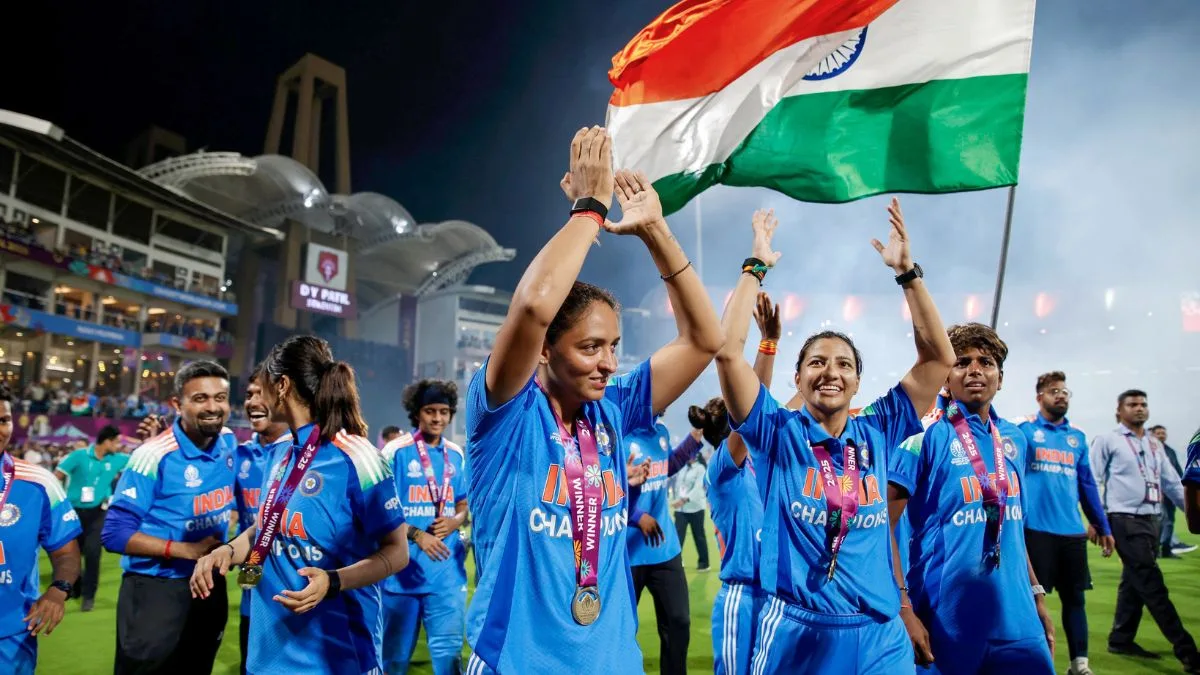
India’s first Women’s World Cup victory was not just a sporting milestone ~ it was the crystallisation of decades of perseverance, family faith, and the quiet revolution of ambition taking root in small-town India. The women who lifted the trophy did more than win a tournament; they redrew the map of Indian aspiration. Each player’s story speaks of a personal odyssey through scarcity and scepticism.
Their journeys began in narrow lanes, on uneven fields, with second-hand bats and dreams often dismissed as unworthy. What makes this victory historic is not only that India are world champions, but that the champions themselves emerged from the very corners of the country where opportunity is still rationed by gender, geography and class. Their victory is not just an athletic achievement but cultural renewal ~ a reminder that gender equality advances most powerfully when success is earned, not granted, and when excellence forces recognition over tokenism. Captain Harmanpreet Kaur’s embrace of her father after the final captured more than joy ~ it carried the weight of countless families who chose belief over convention.
Advertisement
Her father’s quiet defiance of social ridicule in Punjab’s Moga town for letting his daughter play cricket reminds us that social progress in India often begins not in legislatures but in living rooms, when parents refuse to accept limits for their daughters. Amanjot Kaur’s composure under pressure, whether catching under a swirling sky or playing a critical innings, mirrors the patient resilience of a family that built her future from a carpentry workshop. The hands that carved her first bat made her victory possible, a powerful metaphor for India’s working-class families who invest in dreams before they can afford to. Radha Yadav’s story ~ from a pavement stall in Mumbai’s Kandivali to the world podium ~ belongs to the annals of modern India’s self-made generation.
Her father’s milk and vegetable stall financed a dream that returned, in triumph, to the same lane as a family-run shop named after her. It is a full circle not just for one family, but for a country learning that social mobility can be a team sport too. And in Renuka Singh Thakur’s disciplined spell ~ tight, unfussy, unshowy ~ lies the story of India’s silent achievers. Her late father’s memory and her mother’s endurance were the unseen scaffolds of a career that has now shaped national history. The women’s victory should also serve as a policy cue. Investment in women’s sport is not charity; it is nation-building. Infrastructure and scouting must expand beyond metros, because talent clearly has. The triumph at DY Patil Stadium was more than a scoreboard result. It was the sound of India’s small towns finding their voice, the echo of mothers who refused to give up, and the promise of a nation that can no longer afford to overlook its daughters