Can Bengal lead again?
In May 1826, a seventeen-year-old youth, Henry Louis Vivian Derozio, joined the ten-year-old Hindu College as a teacher and revolutionised the character of the institution.
Artificial Intelligence in the classroom In a country with a varied demography like India , new measures and components constantly reshape the education landscape. Most recently the affordable and accessible artificial intelligence-driven tools have made their foray into the academic classroom.




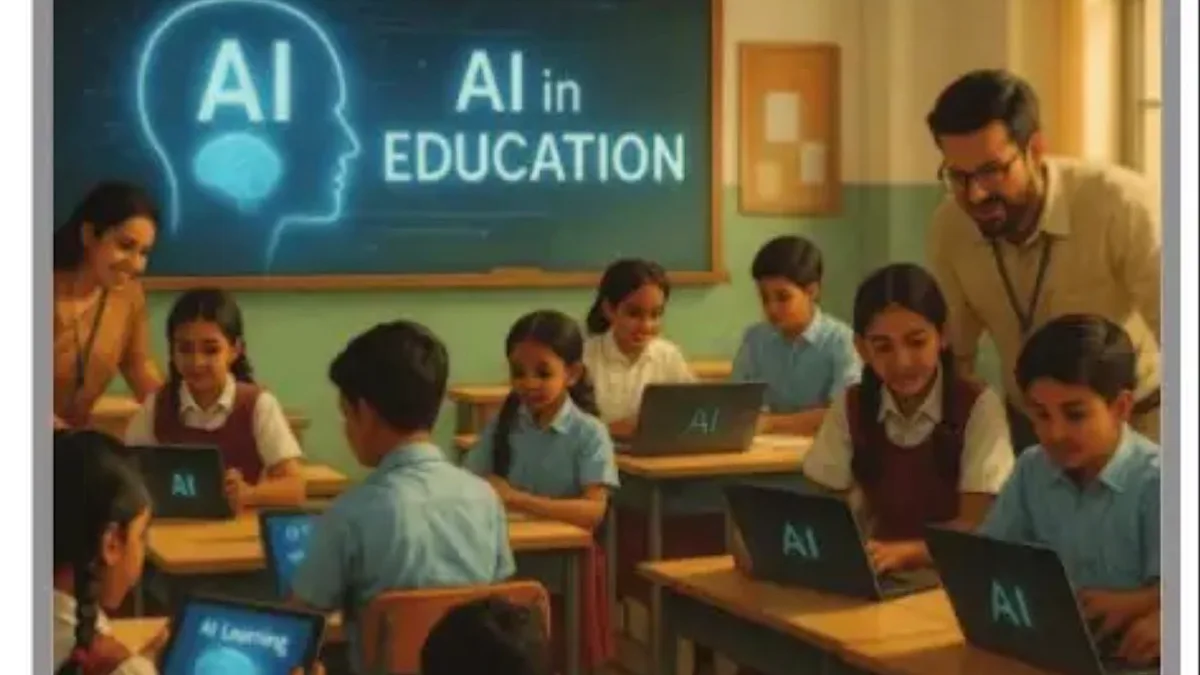
Photo:AI
Artificial Intelligence in the classroom In a country with a varied demography like India , new measures and components constantly reshape the education landscape. Most recently the affordable and accessible artificial intelligence-driven tools have made their foray into the academic classroom. Teachers have begun experimenting with the different uses to engage the learners, enhance the quality of aids and seek alternative engaging practices. Contemporary learners have found a more vibrant alternative to brick and mortar schools. The Classroom Today Modern classrooms are inclusive, dynamic and driven.
Both learners and teachers have different convergent interests. Teacher centric learning has gradually given way to need and interest based skill development. However, one component has remained as important as the lighthouse on the seashore. That is, the teachers. You may call them facilitators, concept architects, designers, specialists or even learners. But they drive the ideas and ideologies home with experience and experiments. In the post COVID era, when teachers have become acclimatized to the use of various technological tools, artificial intelligence has come as a reprieve and a collaborative agent providing the professionals with alternative perspectives and multifaceted solutions.
Advertisement
But, is it really advantageous? Does it truly compromise creativity and critical thinking? Are people becoming over dependent? According to a 2023 survey on AI, “63% of teachers reported that tech has significantly streamlined their work, freeing up time to support students better–and themselves” (Browner, 2023, “AI to Revolutionize” section). Teachers use AI to design visually appealing presentations and multi-modal lesson plans, create compelling images, seek mind maps, design games and set questions. Interestingly, students have also picked up usage of AI.
Advertisement
From structuring projects, to rectifying linguistic errors; from drawing graphs to illustrating posters for co-curricular events; from researching for academics to revising concepts – the choices are multiple. Learners with varying needs, objectives and styles have begun to benefit from personalized, self paced feedback oriented tools. Fundamentals are easier to understand. Yet, we cannot overcome the apprehension that AI is overshadowing the importance of teachers in the classroom. With independent learning formats, learners too are growing isolated and introverted. Concerns arise. Excessive screen adaptation is harming cognitive functions too. Yet, like all technologies the application of AI based tools should be tempered with discretion by all alike.
(THE WRITER IS COORDINATOR, MAHADEVI BIRLA SHISHU VIHAR, SERIES EDITOR OF ICSE COURSE BOOKS AND MEMBER OF IPPL. SHE IS ALSO A POET)
Advertisement