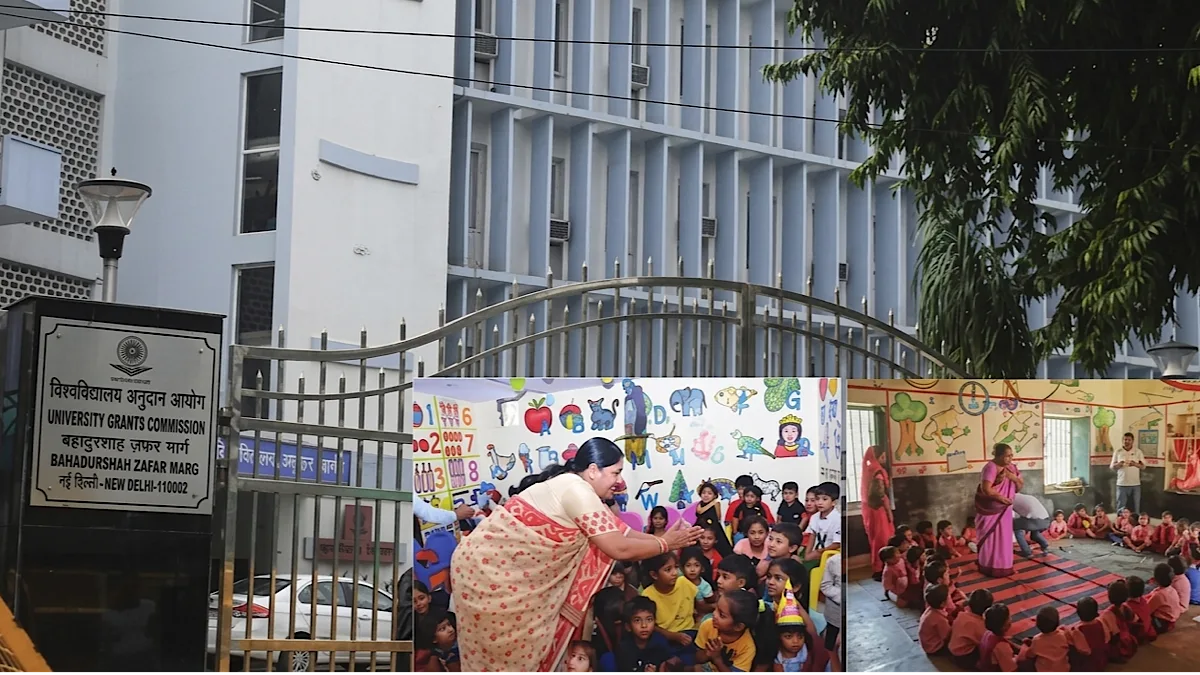
Debates have begun on a directive of the University Grants Commission in which colleges and universities are urged to adopt at least five to six Anganwadi centres to monitor child care and early education of children. Academics, union leaders, and activists have all criticised the directive, arguing that it sheds the responsibility of the government and shifts it on to the shoulders of higher educational institutions. The Congress-backed All India Trade Union Congress (AITUC) has strongly opposed the decision, saying the move is “deeply regressive and illustrative of a dangerous drift in the union government’s commitment to welfare.”
The secretary of AITUC, Amarjeet Kaur, has said, “This move of the union government is effectively abdicating its constitutional and moral responsibility. The welfare of children and mothers cannot be left to the vagaries of voluntary or institutional charity. The higher education centres are institutions that are neither equipped nor mandated to run such welfare programmes. Essential services like Anganwadis require stable public funding, a trained workforce, and systematic state monitoring.” Former Delhi University executive council member Rajesh Jha has also harped on the same tune, saying, “If the government is serious about Anganwadis, it must provide training to Anganwadi workers and improve facilities in these centres.”
Advertisement
While concerns like these do have merit, it must also be accepted that the UGC’s new directive can transform the insular universities and colleges into socially committed institutions contributing significantly to community development. History proves that worldwide universities and colleges have contributed significantly to the development of society. In India, the very ethos of our constitutional values enshrines the societal mission of universities: equity, justice, and the common good. The National Education Policy (NEP) 2020 also explicitly calls for “holistic and multidisciplinary education” that is “grounded in the Indian ethos and rooted in community engagement”.
Unfortunately, Indian universities and colleges by and large have failed to fulfil the expectations of society and the state in this regard. Often courses are designed which are not grounded in reality, and PhD theses remain confined to the stacks of the libraries. By adopting anganwadi centres, higher educational institutions of our country can significantly contribute to community development. Anganwadi centres can act as living libraries for students and researchers, providing them with the scope for testing their knowledge in praxis. Disciplines such as education, social work, nutrition, public health, child development, psychology, and social welfare stand to benefit immensely. Engagement with anganwadi centres will also equip students and researchers with experience of learning empathy and the power of critical thinking.
An exposure to the ground reality will also convert them into responsible citizens by fostering a deeper understanding of societal issues and encouraging active participation in community service. They will also start respecting the dignity of labour. Critics of this move of the Union government have expressed their concern that this directive of the UGC is a disguised way of replacing anganwadi centres by higher educational institutions. This, however, does not seem to be the objective of the government. The letter that Anil Malik, the secretary in the ministry of women and child development, wrote to higher education secretary Vineet Joshi clearly spells out responsibilities of the universities and colleges: “It was suggested that universities & colleges should be encouraged to ‘adopt’ 5 to 6 local Anganwadis for sustained mentorship and social service initiative.
In this context, authorities of colleges and universities, particularly from disciplines such as education, social work, nutrition, public health, child development, psychology and social welfare, should integrate structured Anganwadi engagement into the fieldwork, internships, dissertations, or community outreach programmes of their students.” The letter does not suggest that the students of universities and colleges will be discharging the duties of the anganwadi workers. It also does not suggest the shedding of the responsibilities of the government towards these centres.
It is true that the Union government does not always perform its duties to the anganwadi centres ~ lack of funding, workers and infrastructure is markedly visible. The core services of the anganwadi centres ~ feeding, immunisation, and health referrals ~ must be delivered by the anganwadi workers and cannot be compromised. But the functioning of the centres can significantly improve with support from higher educational institutions of our country. For instance, students and researchers of the education department can suggest new ways of teaching children by using games and plays. They can even conduct workshops if needed. Students of the psychology department can map the mental growth of children and can also counsel them if required.
Similarly, the students of the nutrition department can help the anganwadi workers prepare healthy and balanced diet charts for children. These students will also benefit from anganwadi centres. Their projects and theses will carry the smell of the soil. So, the UGC’s directive should not be considered as an attempt to replace the anganwadi centres by higher educational institutions of the country. It is only suggesting that the role of the government must be supplemented by the societal role of the higher education institutes of our country. Both anganwadi centres and higher educational institutes of our country will benefit from the move that the Union government is taking through the UGC.
In fact, the fear that the involvement of the higher educational institutions in the activities of the anganwadi centres will weaken the state’s responsibilities towards these centres seems to be based on imagination rather than logic. The involvement of the higher educational institutions in the activities of the anganwadi centres will, on the contrary, act as a means of surveillance on the activities of the government, contributing to transparency, community participation, and advocacy. Rabindranath Tagore had actually implemented what the UGC is now suggesting long ago. In 1917, Tagore, in the then Madras, delivered his first speech in English in the country. This speech, titled ‘The Centre of Indian Culture’, is considered to contain Tagore’s ideas of an ideal Indian university and his vision of Visva-Bharati.
In that speech he said, “Our education should be in full touch with our complete life, economical, intellectual, aesthetic, social and spiritual; and our educational institutions should be in the very heart of our society, connected with it by the living bonds of varied co-operations. For true education is to realise at every step how our training and knowledge have organic connections with our surroundings.” Our higher educational institutions indeed have long been on the fringe of our society. Now the time has come that they should be at its centre.
(The writer is Professor, Department of English and Culture Studies, and Director, Centre for Australian Studies, University of Burdwan)