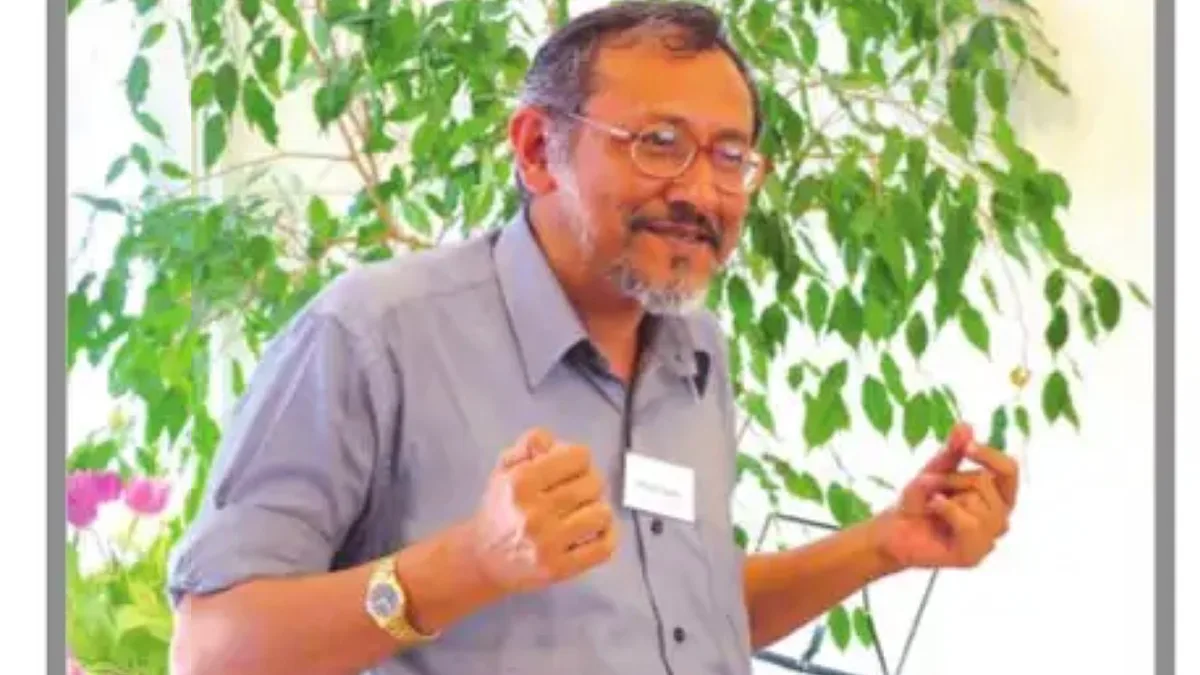
It was on 1 June 2026, in the little Scottish village of Dirleton, a few hours away from the home of the Nobel Prize-nominated Esperanto poet, William Auld, that I received news of the untimely passing of the celebrated linguist, Esperantist and polymath, Probal Dasgupta. Professor Dasgupta had been fond of joking about most everything and I had initially believed that this too was some sort of joke.
For someone who had spent most of his life studying constructed languages, the idea of constructing his own death would certainly have amused him. The flood of social media posts and the exchange of messages among Esperantists and linguists from across the world soon confirmed that this was no joke. Probal Dasgupta passed away in his sleep in the early hours of June 1, at the age of 72, leaving behind unfinished conversations with those who loved and admired him. Born in Calcutta in 1953 to academic parents, Probal Dasgupta’s earliest years were spent in Ithaca, New York.
Advertisement
His father, the late Arun Kumar Dasgupta, was a historian, primarily of the Dutch colonial world and had taught history at Presidency College, Calcutta and at Burdwan University. In 1957, he began his doctoral study at Cornell University’s Faculty of History. His partner, the social psychologist Manashi Dasgupta, and their five-year-old son (then called Mukur, who was later to change his own name to Probal in consultation with his parents) followed him to Cornell. In 1962, Arun Kumar Dasgupta submitted a thesis entitled ‘Acheh in Indonesian Trade and Politics: 1600–1641,’ which studied the altering political attitudes of western Indonesian kings in response to the arrival of the English and Dutch to early 17th Century Indonesia.
Advertisement
Probal Babu’s own memories of this time were filled with wonder at his father’s ability to decipher the characteristic handwriting of 17th Century Dutchmen — a feat beyond the standard printed Dutch that he also learned at this time — in order to consult letters sent to the Netherlands by Dutch sailors from Indonesia and preserved at the Hague. While he was admiring of his historian father, much of Probal Babu’s time in Ithaca was spent in the company of his mother, Manashi Dasgupta.
Her own doctoral thesis at Cornell, ‘Some Determinants of the Judgement of Interestingness’ focused on intended and received aspects of human communication and desirability. In Probal Babu’s words, Manashi proposed ‘that we imagine narratives about people we meet; perceiving a half-story that leaves us intrigued – and interested in the protagonist’. This belief in the ability of language to create different selves poised for different kinds of communication would be reflected in Manashi’s later Indian Council of Philosophical Research-funded research on an intrinsically production-based need that guided most friendships.
Manashi’s understanding of psychology as a communication-based discipline, as well as her knowledge of the international language Esperanto inspired young Mukur. Many years later, he would narrate to me the events of a day in Ithaca in 1960 on which his mother’s frustrated use of the Bengali word ‘baari’- meaning both house and a physical blow – had caused the seven-year-old Mukur to burst into peals of laughter at the image of his mother trying to hit her head with a big house. It is difficult to be surprised that he later became a linguist.
After a B.A. in linguistics from Sanskrit College, University of Calcutta in 1974 and an M.A. from Deccan College, Pune in 1977, he returned to New York for a PhD on ‘Questions and Relative and Complement Clauses in a Bangla Grammar’ at New York University, supervised by Lewis Levine and Ray C. Dougherty. His subsequent academic career in the United States, Australia and India combined rigorous scholarship with meticulous, hands- on student mentoring. His 1993 monograph The Otherness of English: India’s Auntie Tongue Syndrome brought him international acclaim.
In it he argued that Indian usage of English was not unlike the universal and particular usage of appellatives like ‘masi’ (maternal aunt by blood) or ‘mami’ (maternal aunt by marriage). In the same way that these endearments were both reserved for bona fide relatives and simultaneously used indiscriminately as honorifics for women of certain age groups that one encountered in passing, English in postcolonial India remained both affectionately intimate and dispassionately alien when juxtaposed against immovable ‘mother’ tongues.
His After Etymology: Towards a Substantivist Linguistics, co-authored in 2000 with Alan Ford and Rajendra Singh, questioned the usefulness of seeking linguistic meaning in a search for origin-myths, which were often born of a Victorian obsession with racial anthropology. Beyond the historical origins of elements of language lay a need to question the structures that constituted it in real time. Language, for Probal Babu, was thus very much a question of the here and now.
The ingenuity of his scholarship came with the ability to bring an existing structural reality into conversation with a hopeful future. It is this sustained hopefulness that guided his lifelong passion and interest in the international language Esperanto. Created in 1887, by the Lithuanian Jewish ophthalmologist L.L. Zamenhof in an imperial Russian, riven by anti-semitism, Esperanto (literally ‘the language of hope’) and its practitioners believed in international unity through a common language for the people of the world.
The hopeful origins of the language would give way to countless thematic organisations — for vegetarians, Boy Scouts, philately, police forces and pacifists—before the creation of two major organisations, the Universala Esperanto-Asocio (Universal Esperanto Association, U.E.A. with national membership, in 1908), and Sennacieca Asocio Tutmonda (World Annational Association, S.A.T. in 1921). Probal Babu, who had learnt the language as a child, would go on to serve as the President of the UEA. from 2007 to 2013. It was in his capacity as the foremost Esperantist in what is now called the ‘global south’ that I first met him, in 2020.
Amidst a global pandemic that confined many of us to our homes, under Probal Babu’s guidance, I learned Esperanto and began serious work on a MA dissertation that focused on the life of the Indian Esperantist, engineer, musical enthusiast and playwright, Lakshmiswar Sinha. Based in Shantiniketan, Sinha himself had learnt Esperanto on a study trip to Sweden in 1929, encouraged by Rabindranath Tagore. Probal Babu had known Sinha well. What had begun as a request for an interview, led to the creation of a study group around the translation of Sinha’s Esperanto memoir ‘Jaroj Sur Tero’ (My Years on Earth), a group that included the Professor of Russian Sajal Dey and the musical polymath and then-graduate student Moushumi Bhowmik.
Probal Babu also introduced to me to comrades from around the world, who ‘toil’d, and wrought, and thought with me’. My PhD on Esperanto’s history in South Asia completed earlier this year was, in many ways, an extended conversation with him. Our conversations did not always end in agreement. Probal babu, a linguist with an encyclopaedic knowledge of Esperanto’s histories, was not always interested in the meandering paths taken by historical questions.
Yet, he was always interested in taking individual trajectories seriously, and in inspiring others to not throw away the self in favour of a durable collective. His generosity towards the most banal of interrogations and capability to gauge potential was astounding to witness in action. In December of 2020, I remember receiving a calm phone call from him, requesting me to look at some ‘old letters in Esperanto between an American and Siberian’. It turned out that these ‘old letters’ were written by someone who had known Nadezhda Krupskaya, wife of Vladimir Lenin, whose family had been participants in an Esperanto publishing firm set up by Leo Tolstoy.
When I told him of these astounding connections, he simply said ‘Yes, Esperanto letters often reveal connections at this level’. That he will not be able to read the final products of these labours is a sadness that seems unbearable now. Obituaries are meant for the living; not the dead. In this function, they carry the burden and joy of re-telling facts and stories of the once living without attempting to betray confidences. Perhaps in the re-telling of stories and facts, we attempt to detach ourselves from the movement of a person who is to the stagnancy of a person who was, in effect killing this person twice.
In this case, the ability to tell a few stories of Probal Babu forces me to accept that he is no longer merely a message away. In one of his own dystopian Esperanto stories, a character named after me appears in the year 2047 as a singer in the Rock quartet Mola Kulteno (Soft Culture), consistently producing music that subtly alludes to the forgotten Iron Curtain. His last piece, beginning with a re-telling of the significance of the Dreyfus Affair to the Esperanto movement, sent to me on the day before he passed, still lies in my inbox, unopened. To say that I shall miss him is inadequate. He was my teacher and mentor, my best reader, my dearest friend. His humour, brilliance and love for science fiction, green curry and mixed metaphors will keep me company in these dark times in memory of a world in which hope does not die.
(The writer is the Joseph Bell Writer in Residence at the Royal College of Edinburgh Surgeons and the University of St. Andrews.)
Advertisement