Teddy Day 2026: Every February 10, ahead of Valentine’s Day, people around the world celebrate Teddy Day. This is a day to give soft, cuddly teddy bears to loved ones. Soft and sweet, teddy bears tell stories of history, childhood, comfort, connection. But how did these fuzzy creatures travel from a moment in political history to living rooms?
Let’s take a stroll through time and understand the journey of teddy bear from its origin to its emotional significance in modern life. Also, happy Teddy Day!
Advertisement
Also Read: Chocolate Day: Why singles are skipping emotional labour and choosing chocolate on February 9
How the teddy bear was born
The story of the teddy bear doesn’t start with toy maker. It starts with a US president and a bear hunt.
Advertisement
In November 1902, President Theodore Roosevelt was on a bear hunting trip in Mississippi. After other hunters caught a bear cub and tied it for him to shoot, Roosevelt refused to kill it, calling the act unsportsmanlike.
A political cartoonist named Clifford Berryman drew this moment and published it in the Washington Post, and unintentionally created a cultural icon.
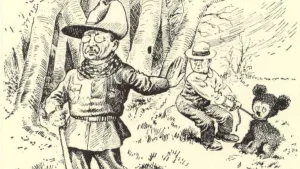
A shop owner in Brooklyn named Morris Michtom saw the cartoon and got an idea. Along with his wife Rose, he made a soft, stuffed bear and displayed it in their candy store with the sign “Teddy’s bear” after the president’s nickname.
The creation became an instant hit, and soon the Michtoms were mass producing the toy, eventually founding the Ideal Toy Company to sell more bears.
At almost the same time in Germany, Margarete Steiff’s company led by her nephew Richard developed a plush bear with movable limbs, based on real bears seen at the zoo. These bears also found success especially in the United States and Europe.
So from the very start, teddy bear was born from unexpected places. A politician, a cartoon, and creativity of everyday toymakers.
Early 20th century: Childhood, holiday gifts, collectibles
By the 1910s and 1920s, teddy bears had become must-have toy for children. They were given as gifts on birthdays and holidays.
The design of teddy bears changed over time. Early bears were made with mohair. This is a wool from goats. They had button eyes. Over time, materials shifted toward softer plush fabrics and safer designs especially for children.
Companies like JK Farnell in Britain joined the trend. They produced some of the first British teddy bears in the early 1900s. They went on to influence characters like Winnie-the-Pooh.
By mid-20th century, teddy bears were everywhere. In nurseries, under Christmas trees, and in arms of children around the world.
Teddy bears in pop culture and war
Teddy bears didn’t just stay in playrooms. They became part of stories, culture, and even history.
In 1921, English author AA Milne created Winnie-the-Pooh, perhaps the most famous teddy bear ever. The stories of Pooh and his friends Christopher Robin, Piglet, Eeyore brought the bear into literature and families’ hearts worldwide.
View this post on Instagram
Teddy bears also appeared in movie culture. In 1957, Elvis Presley performed “(Let Me Be Your) Teddy Bear,” and fans sent him thousands of teddy bears as gifts.
Even difficult times saw teddy bears playing a role. During both World Wars, soldiers often carried small bears with them as reminders of home and comfort.
Why we love teddy bears more than just stuffed toys
A teddy bear is soft, cute, and huggable. But there’s more to it than that.
Scientists call objects like teddy bears “transitional objects”. They help people, especially children, feel secure when separated from loved ones. They bridge the gap between dependence and independence offering comfort when caregivers are not around.
Research from a collaboration of universities in France found that emotional attachment (not size, shape, or fabric) is the most important factor in how comforting a teddy bear is to a person. In experiments involving thousands of participants from ages 3 to 72, attachment mattered more than any physical trait.
Another study published in Discover Magazine notes that characteristics like bigger size and softer fur can enhance comfort, but it’s the emotional bond; the memories, feelings, and personal meaning, that makes a bear comforting.
So when a child hugs a teddy before bed, it’s a source of security and calm. And when an adult holds an old teddy, it’s a memory capsule.
Teddy bears & adults: Nostalgia and emotional well-being
Teddy bears are often seen as children’s toys, but research and surveys show that many adults keep them too.
According to a popular online survey shared by users, as many as 44% of adults have held onto their childhood teddies and soft toys, and around 34% still sleep with them. These numbers reflect not just nostalgia. There’s real emotional comfort that bears provide even to grown-ups.
Psychologically adults may keep teddy bears as emotional anchors. In moments of stress, uncertainty, change, holding something familiar and soft can reduce anxiety. This is much like what security blanket does for a child.
Though the emotional bonds can be strong, mental health professionals regard such attachments as normal and often beneficial. Not something to be ashamed of.
In fact, many adults collect teddy bears too not just as sentimental items but as hobbies. Vintage and rare teddy bears can be valuable. For example, a 1906 Steiff teddy sold for around £10,500 (about $12,746) at auction. A designer teddy bear created with luxury fashion elements sold in 2000 for over $182,000. This is the record for the most expensive teddy bear ever sold.
Teddy bears in today’s world
Today teddy bears live in a world dominated by screens, apps, digital games. So why do they still matter?
Teddy bears offer something digital objects cannot. Tactile comfort. Softness, weight, physical presence of a bear engages our senses in ways screen never can. For many adults, hugging teddy can lower stress, calm nerves, provide sense of grounding.
Meanwhile children still use their bears in imaginative play that develops social skills, empathy, creativity.
Modern teddy bears may also have interactive elements. Sound chips, motion sensors, stories embedded in digital companions. But the core appeal remains the same. Comfort and emotional attachment.
Teddy Day: A celebration of connection
So on Teddy Day, what are we really celebrating?
We’re celebrating innocence, memory, comfort, connection. Be it a small bear on a keychain, a giant plush on a sofa, or a cherished childhood bear passed down through generations, these soft companions are here to tell us that love, comfort, connection matter. Still.
Happy Teddy Day. May your day be soft, warm, and full of connection.
Advertisement