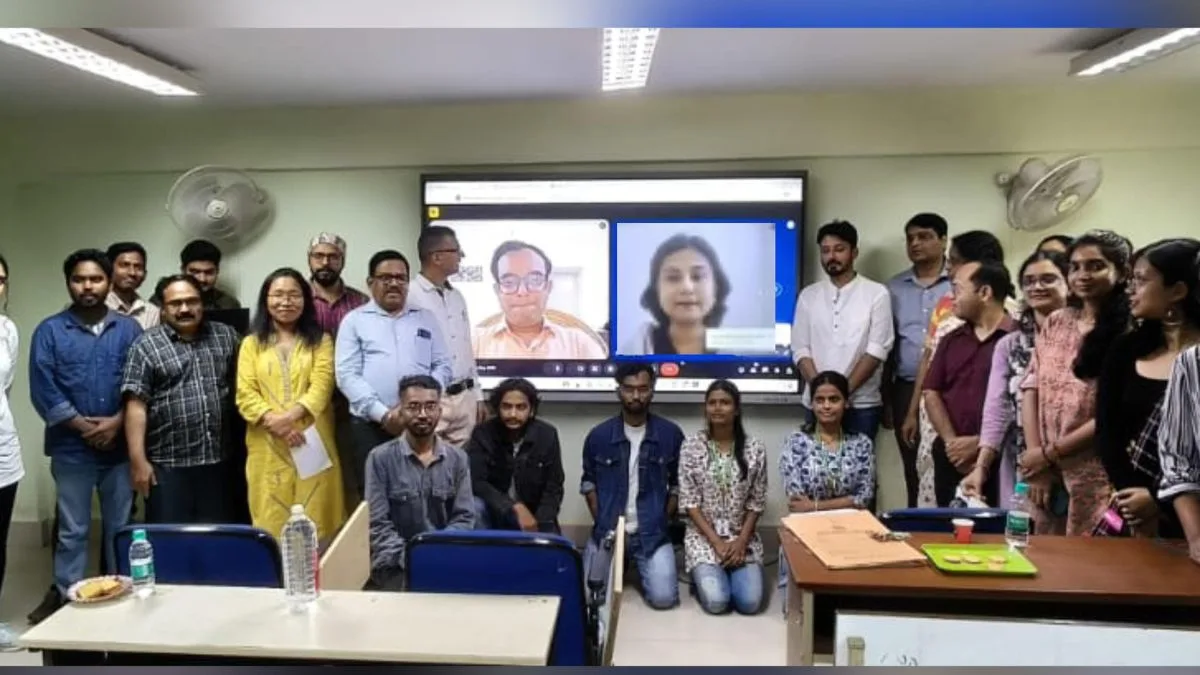
The Central University of Jharkhand (CUJ) marked World Folklore Day with a series of engaging lectures organised by the Department of Anthropology and Tribal Studies (DATS). By combining academic rigour, global perspective, and participatory approaches, the World Folklore Day observance at CUJ offered a platform to reflect on cultural preservation, historical memory, and the engagement of youth in shaping the state’s rich heritage for future generations.
The event featured Dr. Subhra Devi of Tezpur University and Pankaj Protim Bordoloi, Deputy Director of the Rashtrapati Bhavan Museum and Art Collection, New Delhi, who addressed issues of intangible cultural heritage and the role of folk history in contemporary society.
Advertisement
Dr Devi’s lecture, Safeguarding Intangible Cultural Heritage: Key Issues in the Indian Context, highlighted how ethnic communities’ cultural expressions are intertwined with nature and sustainable living. She discussed the challenges of documenting rituals, oral traditions, and performance forms, emphasising the need for approaches that respect both academic standards and community custodianship. Her talk encouraged reflection on solutions to preserve intangible heritage while engaging with local contexts across India.
Bordoloi’s lecture, Exploring Folk Histories, Narratives, Memory and Belonging in Museums and Alternative Spaces, contrasted official history with folk history. “Traditional history tells the story of victors; folk history gives voice to the marginalised,” he noted. Using global examples like the Apartheid Museum in South Africa and the Topography of Terror in Germany, alongside Indian cases such as the Partition Museum and Uttarayan in Assam, he illustrated how museums and alternative spaces can democratise memory and enable participatory storytelling.
He emphasised that community archives, cultural centers, art institutions, and digital platforms allow stories to emerge outside institutional confines. “Public history is not for the people but by the people,” Bordoloi remarked, highlighting the transformative potential of such spaces for critical historical understanding.
The lectures drew participation from faculty, researchers, and students, inspiring young scholars to engage actively with living traditions rather than viewing them merely as artifacts. The event was supported by the Anthropological Survey of India’s Regional Centre, the Centre for Endangered Languages, the Centre for Indigenous Knowledge and Sustainable Development, and CUJ’s National Cadet Corps and Equal Opportunity Cell.
Vice-Chancellor Prof Kshiti Bhushan Das praised the department’s initiative, noting CUJ’s unique position in Jharkhand to foster dialogue around indigenous traditions and public history.