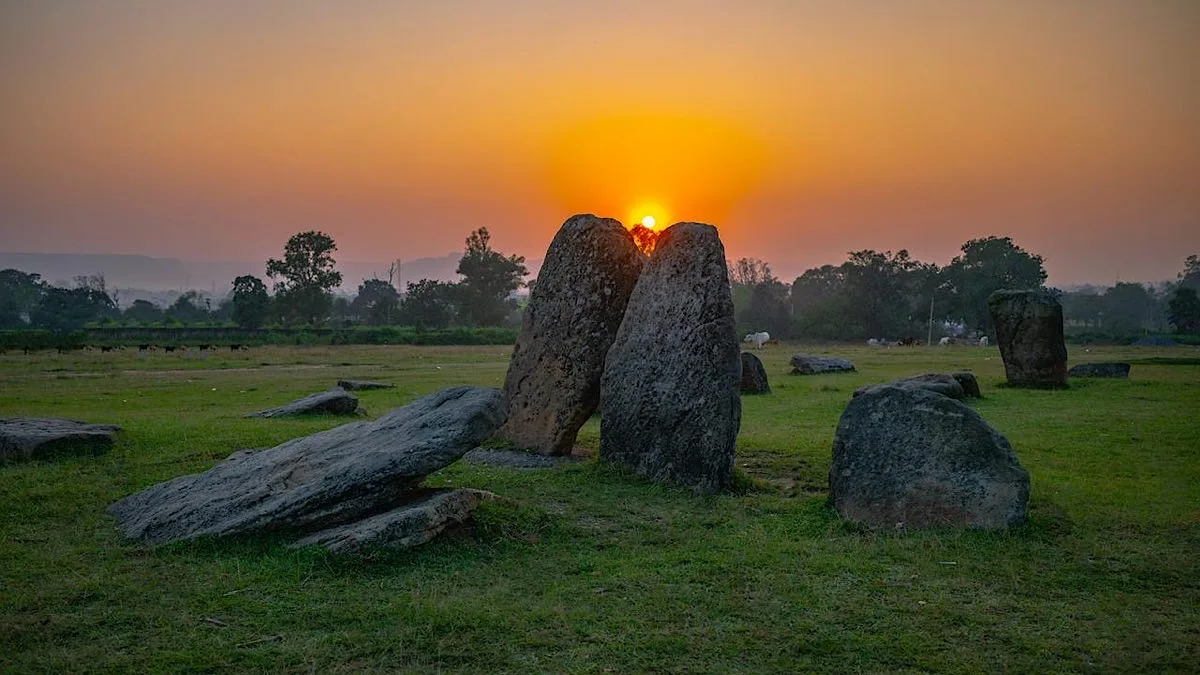
On the morning of March 21, as the first light of dawn touches the earth, something quietly extraordinary will unfold in a small corner of Jharkhand. At around 5:51 am, the rising sun will align with a set of ancient stones at Pankri Barwadih in Barkagaon, marking the vernal equinox, the moment when day and night stand in near-perfect balance.
For most, it is just another sunrise. For a handful of observers, it is a reminder that the sky has always been a clock, and the earth, a carefully observed text.
Advertisement
At Pankri Barwadih, the sun does not simply rise. It passes, almost ceremonially, through a V-shaped arrangement of megaliths, stones placed long before the language of modern astronomy existed. Here, the equinox is not just a calculation. It is an alignment, visible, physical, and deeply rooted in memory.
Shubhashish Das, the researcher who identified the site over two decades ago, has spent years returning to this quiet field, watching the same patterns repeat with a precision that defies time. According to him, the site allows observation of four key solar events through the year: the two equinoxes in March and September, and the solstices in June and December.
It suggests something profound—that long before telescopes and satellites, communities carefully tracked the sun’s journey with care, patience, and understanding. The stones, in their silent geometry, carry traces of that knowledge.
Across the world, places like Stonehenge in England or Newgrange in Ireland draw thousands to witness similar alignments. They are protected, studied, and celebrated. Pankri Barwadih, by contrast, remains largely unknown beyond a small circle of researchers and enthusiasts.
Yet, the parallels are hard to ignore. The same sky. The same sun. The same human impulse to measure time and meaning through light.
There is also a cultural layer beneath the science. For local communities, these stones are not just instruments. They are part of a lived landscape, connected to belief, rhythm, and continuity. The idea that such astronomical awareness may date back to prehistoric tribal traditions adds another dimension to the site’s significance.
But the story is not without its unease. Many of Jharkhand’s megalithic sites have already been lost or damaged over time. Others, like Pankri Barwadih, have faced neglect, even vandalism. Despite sporadic attention, including a visit by state officials and discussions around developing an equinox park, sustained conservation efforts remain limited.
Das and others who have studied the site argue that what stands here is not merely a cluster of stones, but a rare intersection of science, heritage, and identity. Its preservation, they say, is not just about protecting the past, but about recognising a tradition of knowledge that predates modern institutions.
As the equinox arrives, the moment itself will be brief. The sun will rise, align, and move on. The balance of day and night will hold, and then gradually tilt again.
But for those who stand at Pankri Barwadih at dawn, watching light pass through stone, it offers something more enduring. A sense that time, knowledge, and memory are not always written in books. Sometimes, they are etched in the earth itself, waiting quietly to be seen. And perhaps, to be understood again.