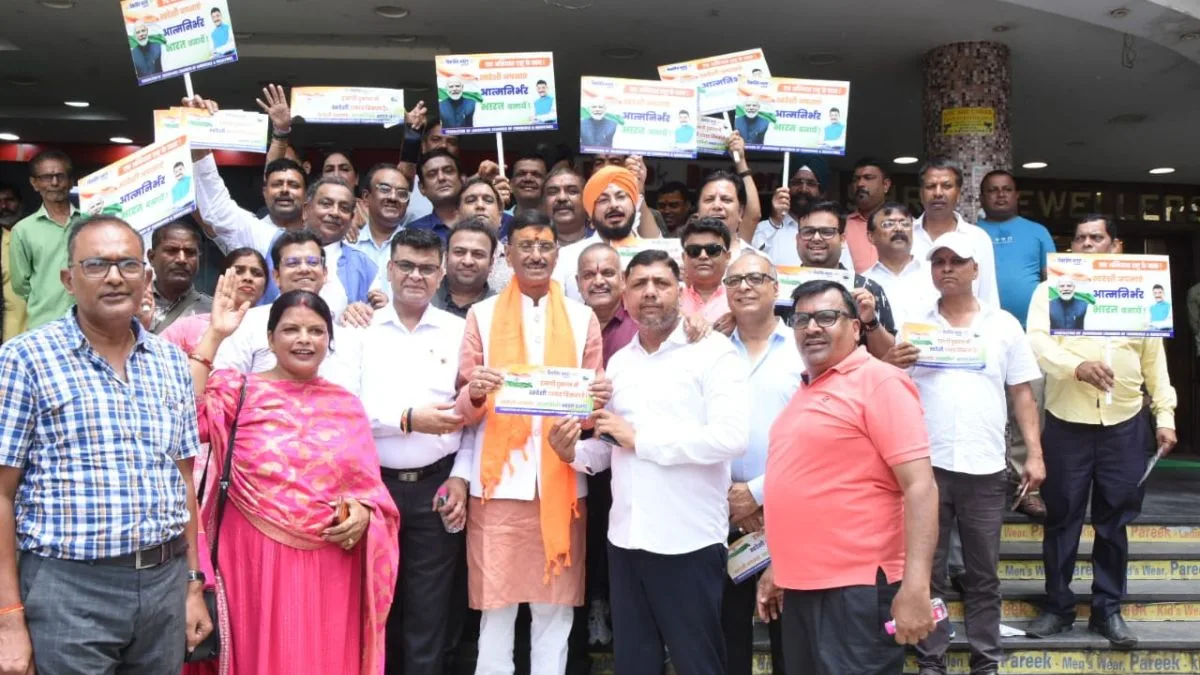
The Federation of Jharkhand Chamber of Commerce and Industries on Wednesday launched a campaign urging traders to promote indigenous goods under the banner “Swadeshi Apnao, Atmanirbhar Bharat Banao” (Adopt Swadeshi, Build a Self-Reliant India). The drive was inaugurated in Ranchi by Union Minister of State for Defence, Sanjay Seth, who joined traders in pasting stickers on shop fronts declaring “Hamari Dukaan Mein Swadeshi Utpaad Bikta Hai” (Our shop sells indigenous products).
The Chamber described the campaign as an effort to link everyday trade with the larger goal of self-reliance. President Paresh Gattani said the initiative aims at energising Jharkhand’s economy by creating more space for local producers in the market. Secretary General Aditya Malhotra added that the trading community had historically contributed in times of national need and would again form the backbone of economic self-reliance.
Advertisement
The launch route, from Kali Mandir Chowk to Gandhi Chowk, was chosen to combine cultural identity with economic choice. Shopkeepers along the stretch were urged to prioritise swadeshi products, while consumers were reminded that their purchase decisions carry social and economic consequences. Programme coordinator Ram Bangad called the campaign a joint inspiration for both traders and consumers to strengthen local industries and realise the vision of Atmanirbhar Bharat.
Chamber leaders said the drive would not remain confined to Ranchi. District chambers across Jharkhand have agreed to carry the message forward, with the Singhbhum Chamber set to host the next programme in Jamshedpur on August 30. Seth is scheduled to participate in that event as well. Organisers said the intention is to create statewide mobilisation, making swadeshi goods a central part of trade practices.
Addressing traders, Seth said that if every citizen took one step, the country would collectively move 140 crore steps ahead. He appealed to business bodies, social organisations, and religious groups to participate in the effort.
The campaign has drawn attention for its symbolism, but its long-term impact will depend on whether consumer behaviour shifts in favour of local goods and whether Jharkhand’s small industries are equipped to meet higher demand in terms of quality and supply. Economists note that without sustained capacity-building for producers, symbolic drives may have limited economic effect.