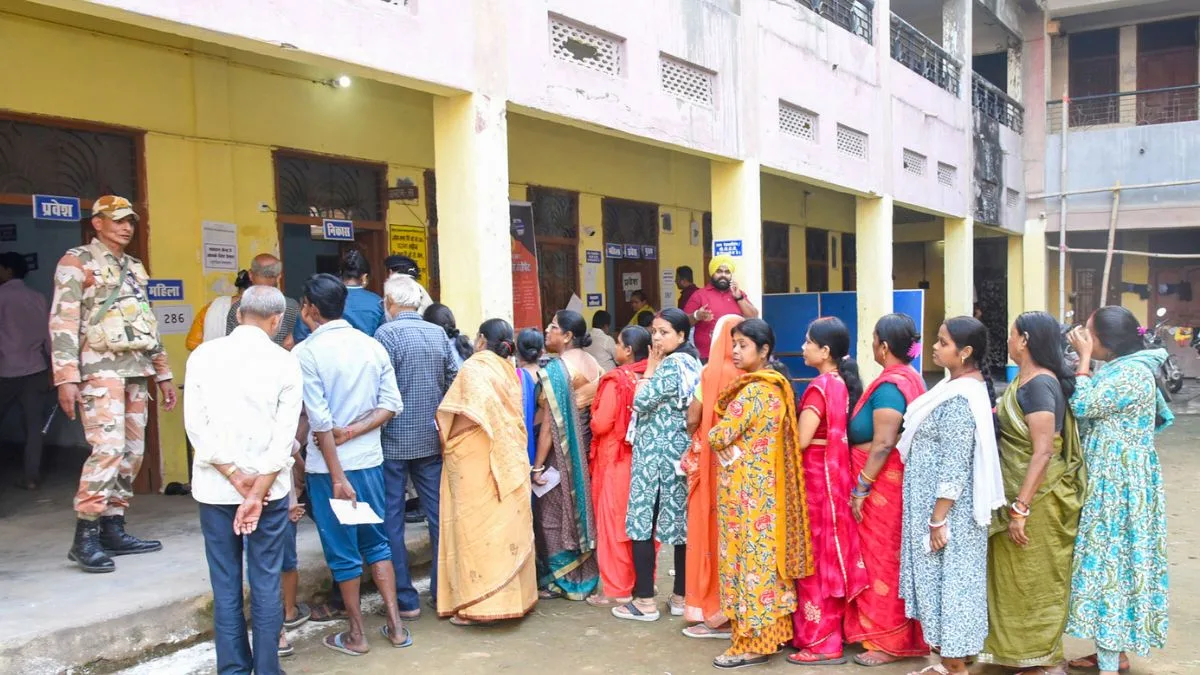
Till late afternoon on Thursday, Assam, Kerala and Puducherry continued their robust turnout trend, with political pundits beginning to debate who would benefit from high voting percentages in the two states and one Union Territory — the ruling side or its challengers. By around 5 pm, Assam had reportedly recorded 84.42% turnout, Puducherry 86.92%, and Kerala 75.01%.
A turnout of about 65–70% and above is generally considered high, while voting figures in the 55–60% range are seen as average; turnouts below 50% are described as low.
Advertisement
The three regions also recorded a higher-than-average turnout in the last assembly elections in 2021, underlining strong democratic participation by their people. In both Assam and Puducherry, the turnout was more than 82 per cent, and in Kerala around 75 per cent, reflecting robust voter engagement in the last elections. Despite COVID pandemic-related constraints, voters turned out in large numbers, underlining the resilience of the democratic process and the citizens’ determination and enthusiasm.
Normally, high voter turnout is believed to be a sign of anti-incumbency against the ruling party — in other words, a positive sign for opposition parties. Some political pundits believe that anger against the ruling party encourages people to come out and vote in larger numbers. However, there is also a counterview — that high voter turnout may also reflect support for the party in power, and hence an expression of approval — something that was demonstrated by Assam and Kerala, both of which repeated their respective ruling parties in 2021.
The fact is that there is no conclusive evidence either way, especially in a multi-party Westminster-style democracy like India, where many factors come into play — poll promises and freebies, personalities, ideologies, candidates’ individual appeal and, of course, issues like development — all adding multiple dimensions to the issue of voting percentage. In other words, a high turnout signals engagement and intensity, not direction. It tells you people care, but not necessarily who they are voting for.
Some analysts also believe that the definition of anti-incumbency is also debatable. For example, several parties tend to change candidates to counter anti-incumbency, so are votes in favour of a party with a sitting MLA but a new candidate votes for or against anti-incumbency? And what if the MLA is from the Opposition side — will the definition still hold?
In the Indian political scenario, of late there is an additional driving factor — Prime Minister Narendra Modi.
Observers say it is hard to establish a clear relationship between turnout and anti-incumbency at the national level, where multiple factors are at play. Some relationship may exist between the two at the state level, but mostly speculative.
The belief that increased voter turnout hurts incumbents has been a central part of the argument by a majority of analysts. But an increase in turnout, relative to the previous election, also has no statistically meaningful relationship with an incumbent government’s electoral performance.
“The bottom line is that higher turnouts are not necessarily associated with anti-incumbency. But again, things can change depending on the situation. When elections are stretched over a long period, people lose interest, so typically turnout is higher when elections are held in one or two phases. When elections are spread over a long time, it is expected that those with greater economic and power resources can gain,” they add.