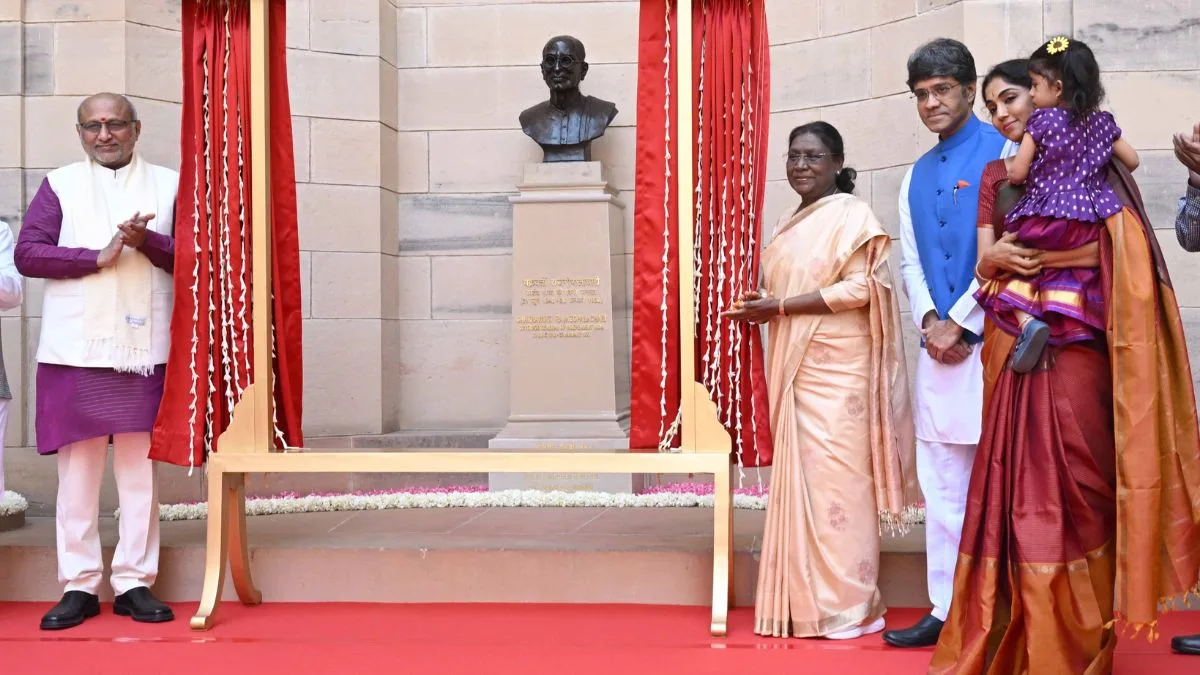
Prime Minister Narendra Modi on Monday welcomed the installation of a bust of C Rajagopalachari at Rashtrapati Bhavan, describing it as a “commendable effort” that reflects India’s determination to honour its national icons and move away from colonial-era imprints.
In a post on X, the Prime Minister said the initiative highlights the country’s resolve “to honour those who shaped our destiny and to shed remnants of a colonial mindset.”
“Rajaji was a towering scholar, freedom fighter, thinker and administrator. His life embodied integrity, intellect and unwavering commitment to the nation,” Modi said, recalling the legacy of Chakravarti Rajagopalachari, popularly known as Rajaji, who served as independent India’s first and only Indian Governor-General.
Advertisement
President Droupadi Murmu today unveiled the bust at the Grand Open Staircase near Ashok Mandap within Rashtrapati Bhavan. The sculpture replaces the bust of British architect Edwin Lutyens, who had designed much of imperial New Delhi, including the Viceroy’s House—now Rashtrapati Bhavan.
Advertisement
Officials said the decision forms part of a broader series of measures aimed at shedding vestiges of a colonial mindset while celebrating India’s civilisational ethos and the contributions of leaders who served the nation with distinction.
The Prime Minister also praised “Rajaji Utsav,” calling it “a wonderful initiative” that showcases various dimensions of Rajaji’s contributions to national life. “Rajaji Utsav is a wonderful initiative, which brings out different aspects of Rajaji’s rich contribution to our nation. I urge you all to visit it and get inspired!” he said.
Born in 1878, Rajaji was a close associate of Mahatma Gandhi and a prominent figure in India’s freedom movement. After Independence, he became the last Governor-General of India (1948-1950), the only Indian to hold the office. Over the course of his public career, he also served as Premier of the Madras Presidency, Union Home Minister, and later as Chief Minister of Madras State. A respected intellectual and statesman, he went on to found the Swatantra Party and remained an influential voice in India’s political discourse.
The replacement of Lutyens’ bust with Rajaji’s at a key ceremonial location is seen as symbolically significant. While Lutyens played a central role in designing the British imperial capital, the installation of Rajaji’s bust in the same space signals what officials describe as a conscious shift from colonial commemoration to the celebration of Indian statesmanship.
Observers say the move aligns with the government’s broader efforts to reinterpret national symbols and public spaces in keeping with indigenous heritage and post-colonial identity.
With Rajaji’s bust now occupying a prominent place in one of India’s most important constitutional landmarks, the government has sought to blend remembrance with renewal—paying tribute to a leader whose life, as the Prime Minister noted, “embodied integrity, intellect and unwavering commitment to the nation.”
Advertisement