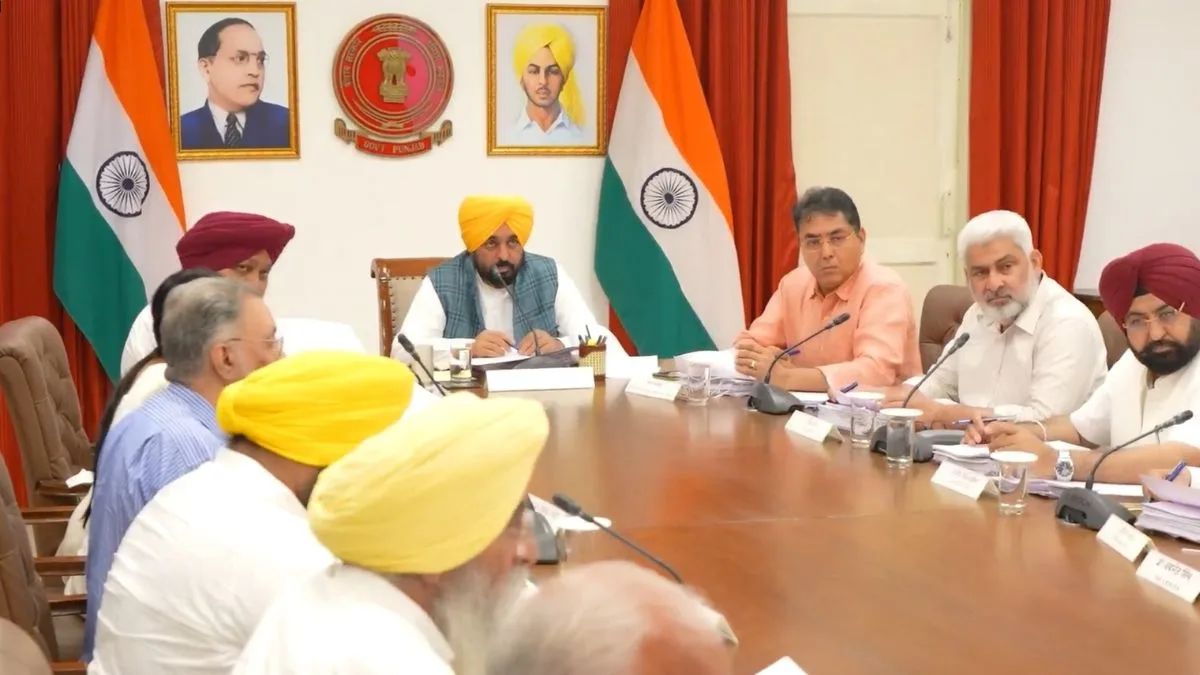
Bhagwant Mann-led Punjab Cabinet has approved several key decisions aimed at providing major relief to students set to appear in the NEET (UG)-2026 re-examination on June 21.
The decisions, taken during a meeting of the Council of Ministers chaired by Mann on Wednesday, included free bus travel for NEET aspirants and one attendant, recruitment of 1,013 lecturers and 156 Junior Engineers (JE), establishment of wet waste-based compressed biogas projects in Patiala and Jalandhar, and key amendments to the Industrial & Business Development Policy, 2026 to boost investment and industrial growth in Punjab, read a statement.
Advertisement
“The Cabinet has approved a number of important decisions relating to student welfare, education, employment generation, infrastructure development, renewable energy, administrative reforms and industrial growth, reaffirming the Punjab Government’s commitment to public welfare and economic progress,” the Chief Minister’s Office said.
The Punjab Cabinet has approved free bus travel for candidates and one attendant travelling to examination centres in Punjab and Chandigarh. Notably, the NEET exam scheduled for May 3 was cancelled and has now been rescheduled for June 21.
To facilitate students and their attendants, Punjab Roadways, PUNBUS and PRTC buses will provide free travel to and from examination centres in Punjab and Chandigarh on June 20, 21 and 22. Students will be required to show their admit cards to avail the facility and no fare will be charged from them.
The financial liability of the free travel facility will be borne by the Transport Department and reimbursed by the Finance Department, the statement added.
1,013 Lecturer Cadre posts to be filled
The Cabinet has approved the filling of 1,013 sanctioned vacant posts, including backlog and newly created vacancies, in the Lecturer Cadre (Group-B) through the Education Recruitment Directorate. Also, it granted a one-time relaxation of five years in the upper age limit for candidates applying for Lecturer Cadre posts in the School Education Department. This is aimed at creating employment opportunities for youth and further strengthening the quality of education in government schools.
156 JE posts approved in Public Works Department
Further, the state government has approved the recruitment of 156 Junior Engineers in the Public Works Department, including 127 posts of Junior Engineer (Civil) and 29 posts of Junior Engineer (Electrical). The recruitment is expected to further streamline the functioning of the department by ensuring effective planning, supervision and quality execution of works. All posts will be filled through direct recruitment by the Punjab Subordinate Services Selection Board (PSSSB).
Patiala, Jalandhar to get wet waste-based CBG projects
To promote sustainable waste management and renewable energy generation, the Cabinet has approved the award of Wet Waste Based Compressed Biogas (CBG) projects of 100 TPD capacity each at Municipal Corporation Patiala and Municipal Corporation Jalandhar to HPCL Renewable and Green Energy Limited (HPRGE) on a nomination basis.
As per the official statement, the state generates nearly 4,000 tonnes per day of municipal solid waste across 166 urban local bodies. The projects will facilitate scientific processing of wet waste, reduce landfill burden, improve urban sanitation and public health, generate renewable energy and organic manure, reduce methane emissions and promote a circular economy.
Punjab Civil Services Rules amended
The Cabinet also approved an amendment to Rule 8 of the Punjab Civil Services (General and Common Conditions of Service) Rules, 1994. The amendment addresses situations where candidates securing the same merit also have the same date of birth. In such cases, inter se seniority will now be determined on the basis of merit, including final grading or percentage obtained in the minimum educational qualification prescribed for the concerned post.
Industrial & Business Development Policy, 2026 amended
Moreover, the Cabinet has approved amendments to the Industrial & Business Development Policy, 2026 and various sectoral policies under the Punjab Udyog Kranti initiative.
The amendments provide that fiscal incentives will apply to existing industrial units instead of only existing MSMEs. They also strengthen provisions relating to industrial clusters, research and development facilities and environment-friendly technologies. A one-time incentive of ₹10 lakh for the first 50 eligible units will now include industries achieving minimum Gold Level ZED Certification or higher, while provisions relating to overall incentive caps in sectoral policies will be treated as indicative and non-statutory.