Uttar Pradesh Chief Minister Yogi Adityanath on Saturday said that India is an agrarian country, and prosperity cannot be achieved without the well-being of its farmers.
Agriculture and livestock have always been closely interlinked in India. A farming household is never complete without livestock, and vice versa, he said.
Advertisement
He added, “In this context, the steps taken over the last 11 years under the leadership of Prime Minister Narendra Modi to ensure farmers’ prosperity are highly commendable. Drawing inspiration from the PM, Uttar Pradesh has also made significant strides in this area. Benefiting from the energy of the double-engine government, the state now ranks first in the country in milk production.”
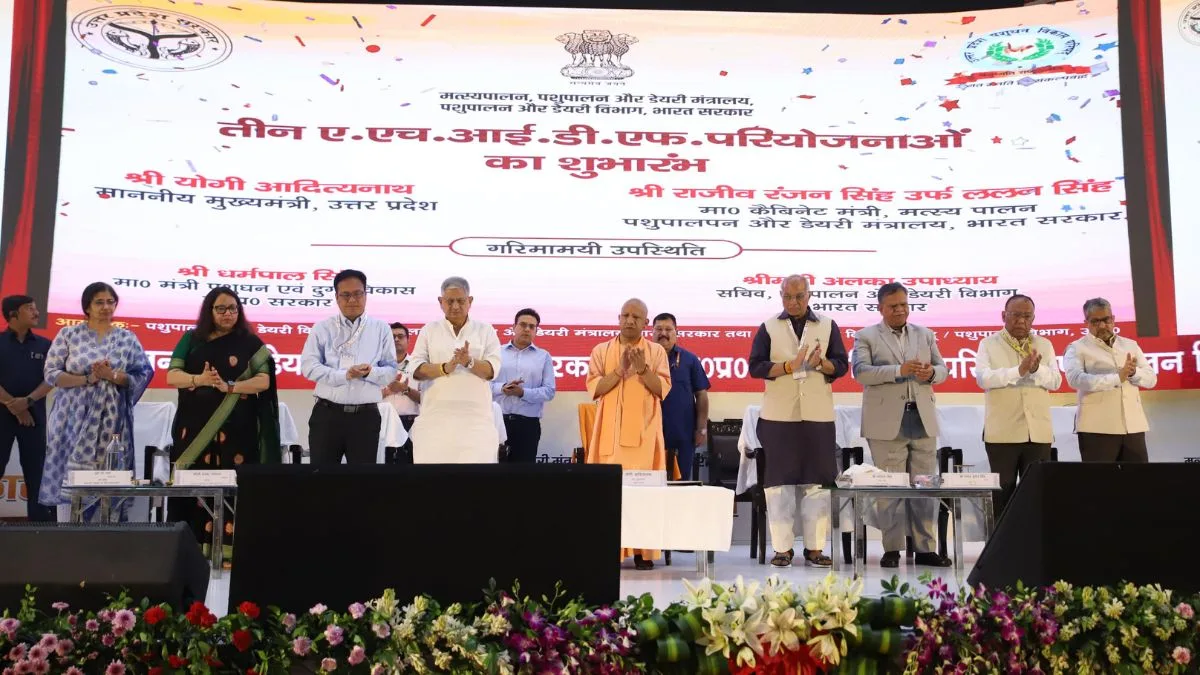
CM Yogi made these remarks while inaugurating the national workshop on ‘Development of Animal Breeds in India’ here.
On the occasion, he also launched the Artificial Insemination Training Institute in Gorakhpur and three infrastructure projects under the Animal Husbandry Infrastructure Development Fund in Amethi, Bareilly, and Mathura. A booklet was also released during the event.
Highlighting the challenge of Foot and Mouth Disease (FMD), CM Yogi said vaccination programmes had begun but were temporarily halted. Now, under the direction of the Union Minister, efforts are being renewed to achieve saturation coverage. The state government, he assured, will fully contribute to making livestock FMD-free and thereby improve the livelihoods of livestock farmers.
CM Yogi pointed out that livestock quality is influenced by climatic conditions, local management practices, and breeding efforts. While some regions of Uttar Pradesh have succeeded in improving breeds through indigenous methods, others have lagged behind. Several local breeds today face extinction. Focused efforts in breed development can create a sustainable source of income for livestock farmers.
Thanking the Government of India, the CM noted that five milk producer companies are currently operational in Uttar Pradesh—in Balini (Jhansi), Gorakhpur, Agra, and Kashi, among others. These initiatives have empowered lakhs of women, who now engage in milk collection through cooperative societies. These women are not only becoming self-reliant but also contributing to breed improvement and value addition in dairy production, thereby transforming rural livelihoods. CM Yogi also shared inspiring success stories of farmers from Gorakhpur and Kashi.
Reflecting on the situation before 2017, the CM said that the state faced major challenges due to the lack of timely breed improvement. Stray cattle frequently roamed roads, farmlands, and even reached slaughterhouses, leading to accidents and distress for farmers. In response, the government launched a comprehensive plan in 2017 and began implementing shelter homes for stray cattle in 2018.
CM Yogi shared that more than 14 lakh cattle are being cared for either in government-run shelters or by livestock owners supported by the government. He mentioned three key schemes aimed at strengthening cattle conservation and development in the state. First, nearly 12 lakh animals are being housed in government cow shelters. Second, under the Sahbhagita Yojana, livestock owners receive up to four animals along with Rs 1,500 per animal per month for their care—benefiting over 1.25 lakh farmers with more than 2 lakh animals. The third initiative provides lactating cows from shelters to malnourished families, with each of the over 10,000 families receiving one cow and Rs 1,500 monthly support for care.
The Chief Minister stated that the Gosewa Aayog in Uttar Pradesh has been entrusted with key responsibilities—ensuring the smooth functioning of stray cattle shelters, launching breed improvement campaigns, and training farmers. He added that efforts are also being made to integrate these shelters with natural farming initiatives.
CM Yogi raised serious concerns over the increasing use of chemicals, pesticides, and fertilisers in agriculture, stating that this is giving rise to new health challenges. He linked the growing cases of cancer, kidney, and liver disorders to excessive chemical usage. Emphasising the need for solutions, he advocated for a return to a natural lifestyle, highlighting that natural farming—particularly cow-based farming—can play a crucial role. Indigenous cattle breeds, he said, can be instrumental in this approach.
The Chief Minister said that 27 districts in Uttar Pradesh lie along the banks of the Ganga, and it was Prime Minister Narendra Modi’s efforts through the Namami Gange project that breathed new life into the river. The improved flow and cleanliness of the Ganga made it possible for over 66 crore devotees to participate in the Prayagraj Mahakumbh. He highlighted that this transformation would not have been possible had the river not been clean and uninterrupted. Notably, the ₹100 crore that PM Modi received from various institutions as a token of appreciation was donated entirely to the Namami Gange project.
CM Yogi further warned that chemicals and pesticides used in farming eventually flow into rivers during rainfall, polluting water sources and causing serious health issues. The adoption of a natural lifestyle, he asserted, is the only viable solution.
CM Yogi informed that a focused campaign is being run across 27 districts to promote natural farming, with all seven districts of Bundelkhand being given special attention. Initiatives are underway to popularise cow-based farming as a sustainable and profitable model. These efforts, he said, will not only boost farmers’ income but also accelerate India’s journey towards becoming a self-reliant and developed nation.
The Chief Minister noted that further steps have been taken to strengthen livestock farming in the state. Despite being landlocked, Uttar Pradesh has emerged as one of the leading states in fisheries production—a feat considered unthinkable just 10 years ago. The state has also made notable progress in egg and poultry production.
CM Yogi shared that the National Dairy Development Board (NDDB) has signed an MoU with the state government and taken over three dairies—Gorakhpur, Kanpur, and Kannauj—as well as the fodder production centre in Ambedkar Nagar. This will help ensure quality fodder for livestock farmers across the state.