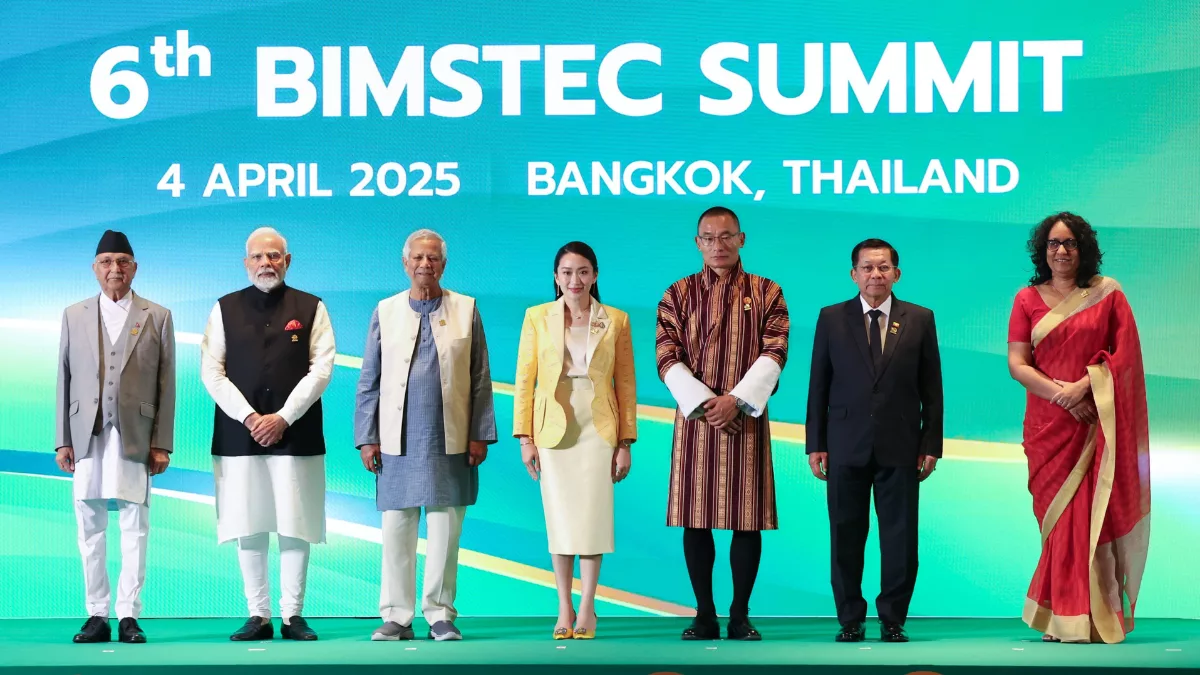
Underlining that a free, open, secure, and safe Indian Ocean is the shared priority of BIMSTEC nations, Prime Minister Narendra Modi on Friday proposed a 21-point action plan covering different aspects of cooperation among members of the seven-nation grouping.
Addressing the 6th BIMSTEC Summit in Bangkok, he proposed, among other things, establishing connectivity between India’s Unified Payments Interface (UPI) and the payment systems of BIMSTEC member states. Such integration, he said, would bring substantial benefits across trade, industry, and tourism, enhancing economic activity at all levels.
Advertisement
BIMSTEC (Bay of Bengal Initiative for Multi-sectoral Technical and Economic Cooperation), the seven-nation grouping, brings together five Asian nations–India, Bhutan, Bangladesh, Nepal and Sri Lanka–and two Southeast Asian nations–Thailand and Myanmar.
In another significant announcement, the PM said India will extend support for training and capacity-building in cancer care across BIMSTEC countries.
Noting that BIMSTEC serves as a vital bridge between South and Southeast Asia, he observed that the grouping is emerging as a powerful platform for advancing regional connectivity, cooperation, and shared prosperity.
He was of the view that to further strengthen BIMSTEC, the member-nations must continue to expand the grouping’s scope and enhance its institutional capacities.
”It is encouraging to note that the Home Ministers’ mechanism is being institutionalised. This forum can play a major role in the fight against cybercrime, cybersecurity threats, terrorism, drug trafficking, and human trafficking. In this regard, I propose that India host the first meeting of this mechanism later this year,” Mr Modi said.
He said trade and business connectivity are vital to the collective progress of the BIMSTEC nations. To strengthen collaboration and coordination among business communities, he proposed the establishment of a BIMSTEC Chamber of Commerce. Additionally, an annual BIMSTEC Business Summit, he said, will be organised to foster greater economic engagement. He also suggested conducting a feasibility study to explore the potential for trade in local currencies within the BIMSTEC region.
”The Maritime Transport Agreement concluded (among BIMSTEC nations) today will strengthen cooperation in merchant shipping and cargo transport, giving a significant boost to trade across the region,” the PM said.
He also proposed the establishment of a Sustainable Maritime Transport Centre. This Centre will focus on capacity building, research, innovation, and fostering greater coordination in maritime policy. It will also serve as a catalyst for enhancing our cooperation in maritime security across the region.
The PM said the recent earthquake, which shook Myanmar and Thailand, has been a stark reminder of how vulnerable the BIMSTEC region remains to natural disasters.
”India has always stood by its friends as a first responder in times of crisis. We consider it a privilege to have been able to deliver timely relief to the people of Myanmar. While natural disasters may be unavoidable, our preparedness and ability to respond swiftly must always remain unwavering,” he added.
In this context, he proposed the establishment of a BIMSTEC Centre of Excellence for Disaster Management in India. This Centre will facilitate cooperation in disaster preparedness, relief, and rehabilitation efforts. Additionally, the fourth joint exercise among the BIMSTEC Disaster Management Authorities will be held in India later this year.
Noting that public health is a vital pillar of the collective social development of the BIMSTEC nations, he announced that India will extend support for training and capacity-building in cancer care across BIMSTEC countries. ”In line with our holistic approach to health, a Centre of Excellence will also be established to promote research and dissemination of traditional medicine,” he added.
Hailing the strides made by Indian scientists in the field of space, he said India is ready to share their expertise and experience with all BIMSTEC member states. ”In this regard, I propose the establishment of a ground station for manpower training, the development and launch of nano-satellites, and the use of remote sensing data for the BIMSTEC countries,” he added.