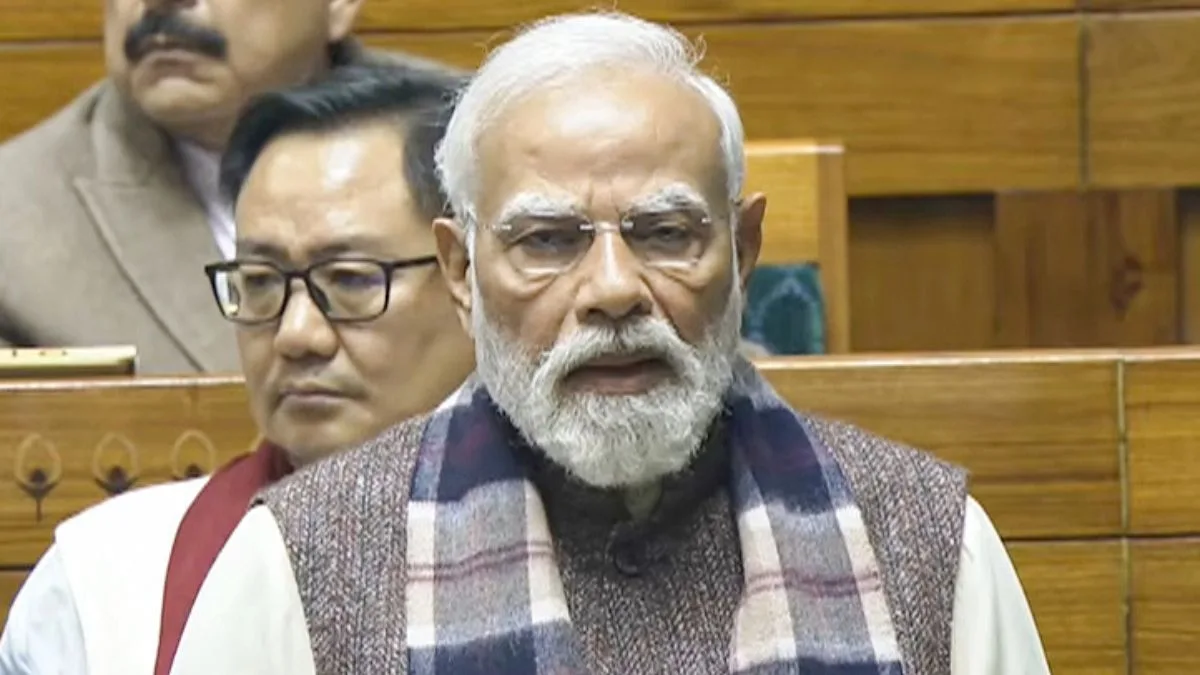
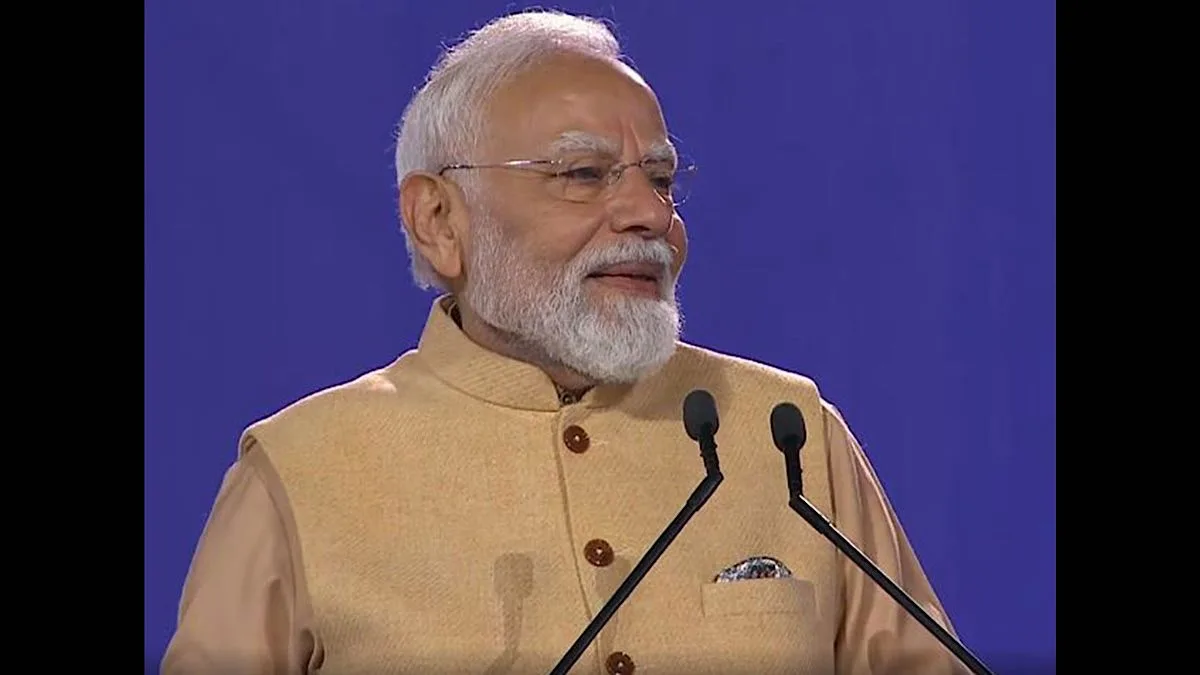
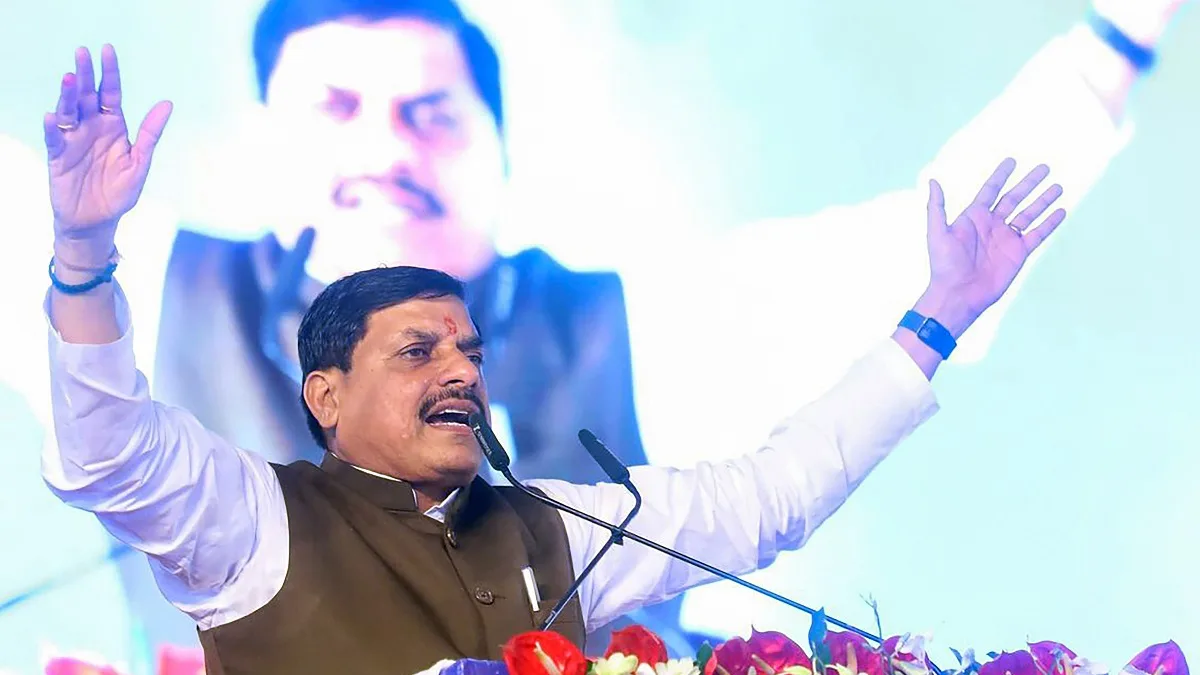
Prime Minister Narendra Modi on Monday set the tone for a politically charged Winter Session as he opened a special discussion in the Lok Sabha to mark 150 years of Vande Mataram. The Prime Minister said the debate was far more than a commemorative formality; it was a moment to revisit a hymn that shaped India’s imagination of freedom and collective identity.
Entering the House to loud chants of Vande Mataram by BJP MPs, Modi said those occupying seats in Parliament today were “here because lakhs before us chanted this mantra and fought for Independence”. Calling the national song a “sacred war cry”, he said its power lay in the way it inspired entire communities to stand up to colonial authority.
Advertisement
“It is a matter of pride that we are witnessing the 150th year of Vande Mataram,” he told MPs, adding that the song’s journey, from its 50th year under colonial rule to its centenary during the Emergency, reflected the resilience with which it endured across shifting political eras.
PM takes Nehru’s name in every debate
PM Modi’s remarks against former Prime Minister Jawaharlal Nehru during the debate on Vande Mataram prompted a strong response from the Congress party, with its Deputy Leader in Lok Sabha, Gaurav Gogoi, alleging that it has become a habit of PM Modi to target Nehru in every debate.
“Congress supported Vande Mataram. Congress gave importance to Vande Mataram to make it the national song of India. PM Modi takes Nehru Ji’s name and Congress’ name in every debate. Operation Sindoor – Pandit Nehru Ji’s name 14 times and Congress’s name 50 times, 75th anniversary of the Constitution – Pandit Nehru Ji’s name 10 times and Congress’s name 26 times, President’s Address in 2022 – Pandit Nehru Ji’s name 15 times, President’s Address in 2020 – Pandit Nehru Ji’s name 20 times. I want to say with utmost humility to Narendra Modi Ji and his entire system, no matter how hard you try – you won’t be able to put even a single black mark on Pandit Nehru Ji’s contributions,” Gogoi said.
Revisiting Bankim Chandra’s work and British response
PM Modi used the debate to trace the cultural climate in which Bankim Chandra Chattopadhyay first published Vande Mataram in 1875 in Bangadarshan. He said the decades after 1857 saw the British determined to tighten control, introducing ‘God Save the Queen’ into Indian households and using Bengal as “the testing ground for divide-and-rule”.
He noted that dismissing Indian heritage had become fashionable during those years, and Bankim Chandra’s work pushed back against that trend by giving people a cultural anchor. The PM said Bengal’s response to the 1905 partition, where Vande Mataram became the rallying cry from “street to street”, marked one of the earliest moments when the song transformed into a mass assertion of unity.
Quoting Mahatma Gandhi’s 1905 writing in Indian Opinion, he reminded the House that Gandhi called the hymn “our national anthem” and described it as more melodious than the songs of other nations.
PM intensifies political attack on Congress
The political temperature rose sharply when PM Modi returned to a contention he had raised before, that Congress had, in 1937, curtailed the hymn under pressure from the Muslim League.
He said new generations must “know the truth”. According to him, Congress “yielded to the Muslim League’s objections and split the hymn”, a decision he described as the beginning of an appeasement mindset.
The PM said that the objections first surfaced when Mohammed Ali Jinnah raised concerns in 1937. Jawaharlal Nehru, he added, wrote to Subhas Chandra Bose warning that the background of the song could provoke anger among Muslims. Following this, Congress held internal deliberations in Kolkata, and despite protests across the country, restricted the hymn to its first two stanzas.
“History shows that Congress knelt before the Muslim League,” Modi said. “Because it bowed before the division of Vande Mataram, it later bowed before the division of India.” He added that this pattern of decision-making “continues even today”.
A hymn carried by revolutionaries, women, and children
The Prime Minister also dwelt on how Vande Mataram travelled across movements and regions despite official prohibitions. He recalled stories of women in Sindh and Barisal, including Sarojini Bose, who refused to wear bangles until the ban on the hymn was lifted, and of schoolchildren who faced beatings for chanting it.
He invoked revolutionaries who carried the song to their final moments, such as Ashfaqullah Khan, Madanlal Dhingra, Khudiram Bose, Roshan Singh and Rajendra Nath Lahiri. He also mentioned Master Surya Sen, whose poem echoed the hymn before his execution in 1934.
PM Modi drew attention to its international reach: Veer Savarkar singing it at India House in London, Bipin Chandra Pal naming his publication after it, and Madam Bhikaji Cama disseminating it abroad despite restrictions.
The Prime Minister also pointed out that Vande Mataram became an emblem of Swadeshi, even appearing on ships constructed by PO Chidambaram Pillai in 1907. Tamil poet Subramania Bharati, he added, celebrated it in his writings as a call to collective awakening.
Debate to continue across both Houses
The NDA has been allotted three of the 10 hours for the Lok Sabha discussion. With the Winter Session running until December 19, the theme is expected to reverberate through the coming days.
In the Rajya Sabha, Union Home Minister Amit Shah will open a parallel discussion on Tuesday.