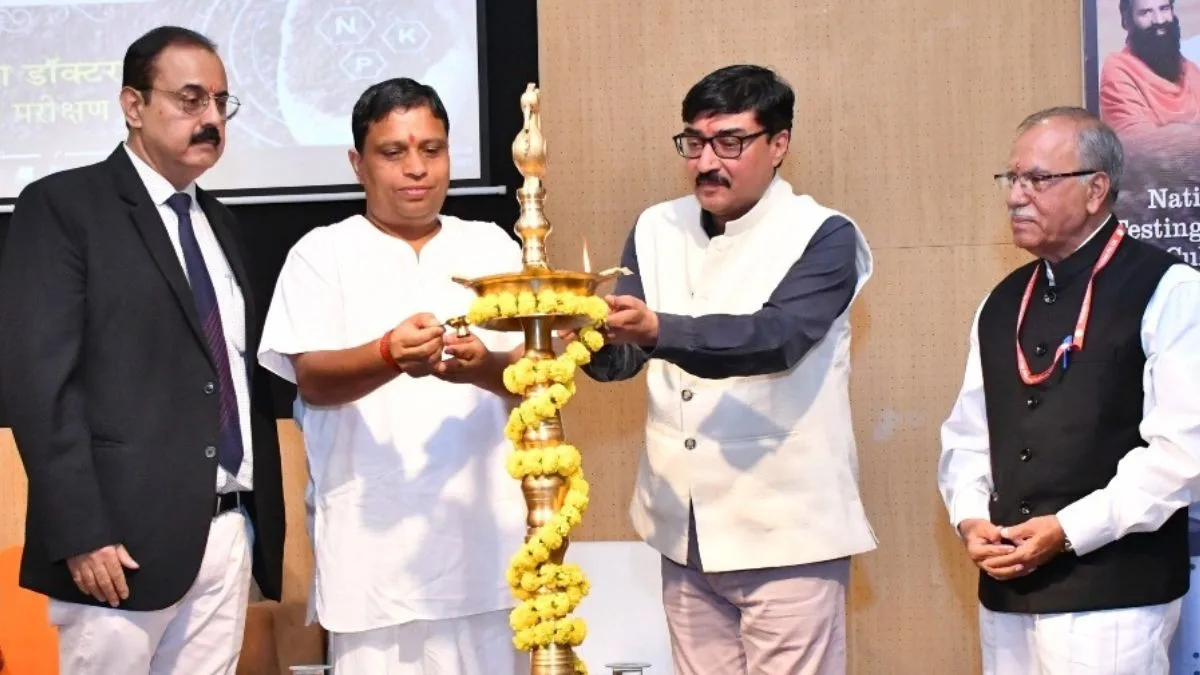
Under the aegis of the Ministry of AYUSH, Yoga Guru Baba Ramdev’s Patanjali Organic Research Institute (PORI) organised a two-day workshop on “Sustainable Cultivation of Medicinal and Aromatic Plants through Soil Health Assessment and Management”.
The conference was held at Patanjali Research Foundation and Patanjali University, Haridwar in collaboration with the National Bank for Agriculture and Rural Development (NABARD) and Bharuwa Agriscience.
The objective of the program was to promote a healthy planet, sustainable agriculture, long-term food security, and to strengthen these goals at the global level. The workshop brought together national and regional scientists, researchers, agricultural experts, and technologists who shared insights on soil health management and soil fertility improvement techniques.
The event began with a lamp-lighting ceremony, followed by the theme song of “Swasth Dhara” and a welcome address by Dr. A.K. Mehta, Director (Technical), Horticulture, Patanjali Organic Research Institute. The chief guest, Revered Acharya Balkrishna Ji Maharaj, Vice-Chancellor of Patanjali University, was warmly felicitated with flowers, a shawl, and a memento.
In his inspiring remarks, Baba Ramdev said that soil is truly useful and pure only when it is managed using sustainable techniques that ensure long-term productivity and profitability.
Healthy soil, he said, can produce higher yields at lower costs, while biodiversity forms the cornerstone of agricultural success, ensuring soil health, cost control, and profitability.
He emphasized that in the current era, it is essential to develop agro-technological models for the cultivation of medicinal and aromatic plants. He added that the scientific and technological contribution of agricultural experts is crucial in promoting sustainable and eco-friendly farming systems.
In his keynote speech, Acharya Balkrishna highlighted that yoga, Ayurveda, and the Green Revolution are deeply connected to sustainable life and healthy soil. He said that overuse of chemical fertilizers and pesticides is causing severe damage to the earth, which will eventually affect future generations.
He urged farmers to shift from chemical to organic and natural farming, emphasizing that Patanjali has been working toward this mission for years. He informed that India processes only 10% of its total agricultural produce, of which Patanjali’s share is nearly 8%. The organization leads the country in the production of amla, aloe vera, cereals, and oil-based products.
He added that digital platforms have transformed soil testing, crop planning, irrigation, and pest management, helping farmers make quicker and more accurate decisions.
Acharya Balkrishna said Patanjali’s automated soil testing machine “DKD” has shown remarkable success in improving crop yields. He emphasized that healthy soil ensures higher productivity at lower cost, and that biodiversity plays a vital role in maintaining agricultural profitability and ecological balance.
He also stressed that in the current context, advancing agricultural technologies for medicinal plants is of paramount importance.