A rustic “Homestay” facility, under the joint initiative of local forest dwellers and the forest department, has been launched in Dhodrokusum village, ensconced along the foothills of Odisha’s Debrigarh wildlife sanctuary, adjoining Hirakud wetland.
This is the first “Homestay” facility in Odisha managed by the Forest Department through local forest-dependent communities for providing them economic benefits, making them stewards for forest and wildlife conservation, and exploring the ecotourism potential of these landscapes, said Anshu Pragyan Das, Divisional Forest Officer, Hirakud Wildlife Division (Debrigarh Sanctuary).
Advertisement
The homestay amidst the warmth of nature highlights immersive ways to connect with nature responsibly while supporting livelihood.
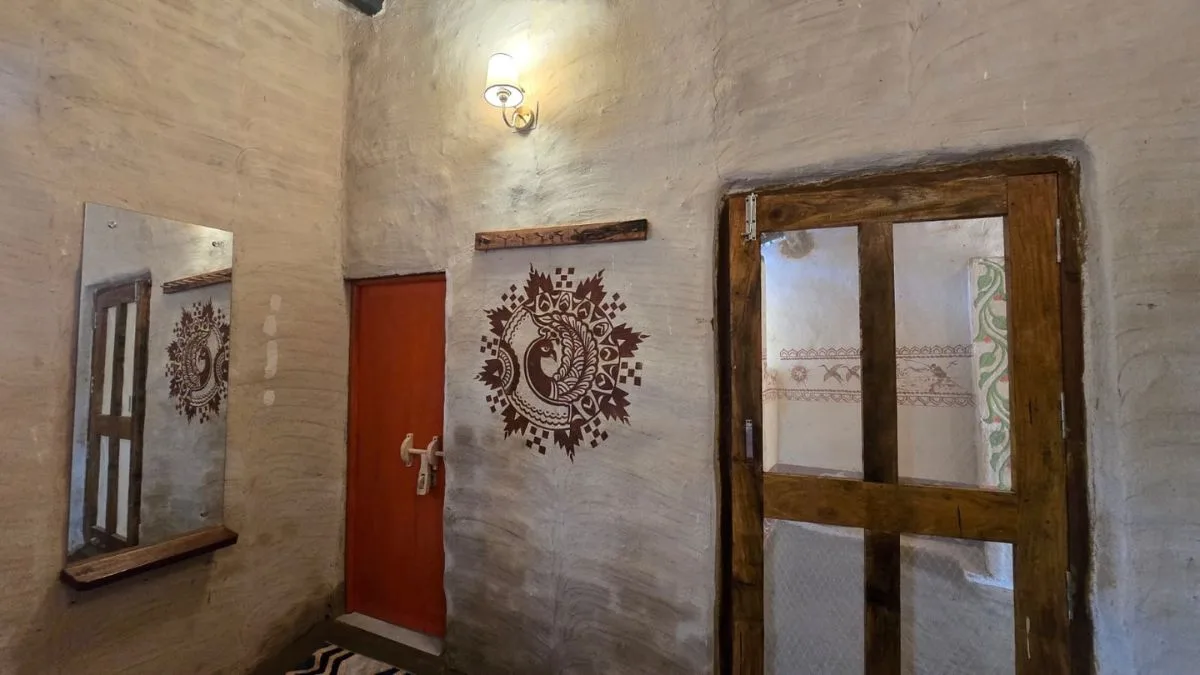
All five Homestay rooms are uniquely made from natural clay, mud, cow dung & husk, and modern toilets and houses with modern classy furnishings for a warm & authentic experience. Every article is crafted by local village artisans with a Sambalpuri touch, Das said.
Each room has a solid base of brick & mud, hence ensuring safety. All five rooms have attached bathrooms. Water and electricity backup are also available. An outdoor fireplace and children’s play area are available, she added.
The sustainable homestay facility at Dhodrokusum is a model that combines wildlife conservation with local culture and tradition. It is a well-thought-out conservation intervention, as local communities are navigating through human-animal conflicts daily.
It is a sustained grassroots action for driving conversation through community partnership in the coexistence zone and eco-sensitive zone of Debrigarh, where local stewardship is important in achieving long-term conservation goals.
As local economy and wildlife conservation are directly proportional, homestays in the long run will boost the rural economy in a stronger way, side by side with educating people more about nature and wildlife. Recently, the Supreme Court of India has also directed the encouragement of the promotion of homestays in wildlife areas and Eco-Sensitive Zone (ESZ) for benefiting both the local communities and nature as a whole.
In Odisha, around 80 per cent of the population is rural, and the majority of them are dependent on forests. “To strengthen both tourism and the rural economy, the concept of homestay is the best way forward,” added the senior forest officer.