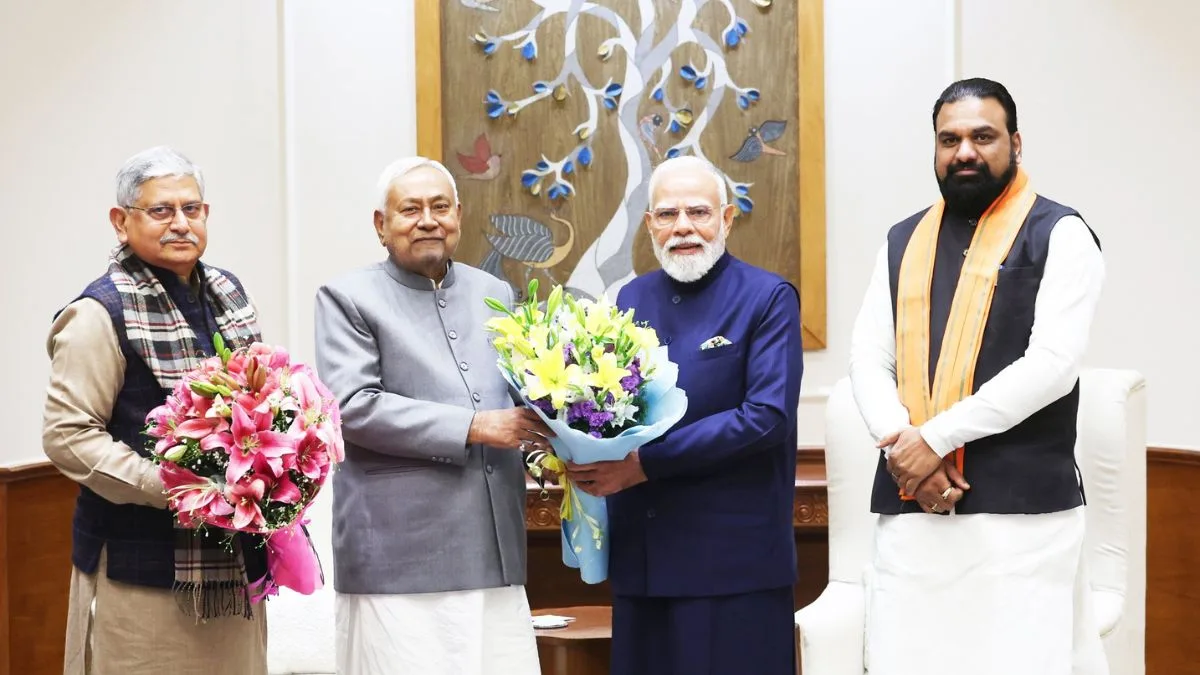
In his first visit to the national capital following a decisive win in the 2025 Bihar Assembly elections, Chief Minister Nitish Kumar called on Prime Minister Narendra Modi at his residence in New Delhi on Monday.
The meeting that lasted around 30 minutes was described by the Prime Minister’s Office (PMO) as a significant step toward aligning the “Double-Engine” government’s development roadmap for Bihar over the next five years. Bihar’s Deputy Chief Minister Samrat Choudhary and Union Minister Lalan Singh accompanied Kumar.
Advertisement
According to sources, the discussions primarily focused on implementing “Saat Nischay 3.0” (Seven Resolves 3.0), Bihar’s ambitious development plan for 2025-2030. The initiative aims to transform the state into a developed region by emphasizing “Double Employment–Double Income,” infrastructure growth, and agricultural advancement.
Bihar Minister Ashok Choudhary, speaking in Patna, termed the meeting a courtesy call and said detailed talks were held on how the Central government can further support Bihar’s development journey.
The meeting also coincided with other pressing issues for the Bihar NDA government, including an anticipated cabinet expansion after Makar Sankranti, strategies for upcoming Rajya Sabha and Legislative Council elections in 2026, and plans to fill the vacancy left by Nitin Nabin’s recent resignation from the state cabinet.
Prime Minister Modi acknowledged the meeting on social media, reinforcing the strong partnership between the Centre and Bihar. PM Modi had earlier attended Nitish Kumar’s swearing-in ceremony on November 20, 2025, marking the Chief Minister’s record tenth oath-taking.
According to sources, Nitish Kumar also met Union Home Minister Amit Shah to discuss Bihar’s internal security and law and order roadmap.
Deputy Chief Minister Samrat Choudhary, echoing sentiments from the recent election campaign, said, “The people of Bihar have trusted the leadership of PM Modi and Nitish Kumar once again. Our focus is now entirely on delivering good governance and stability.”