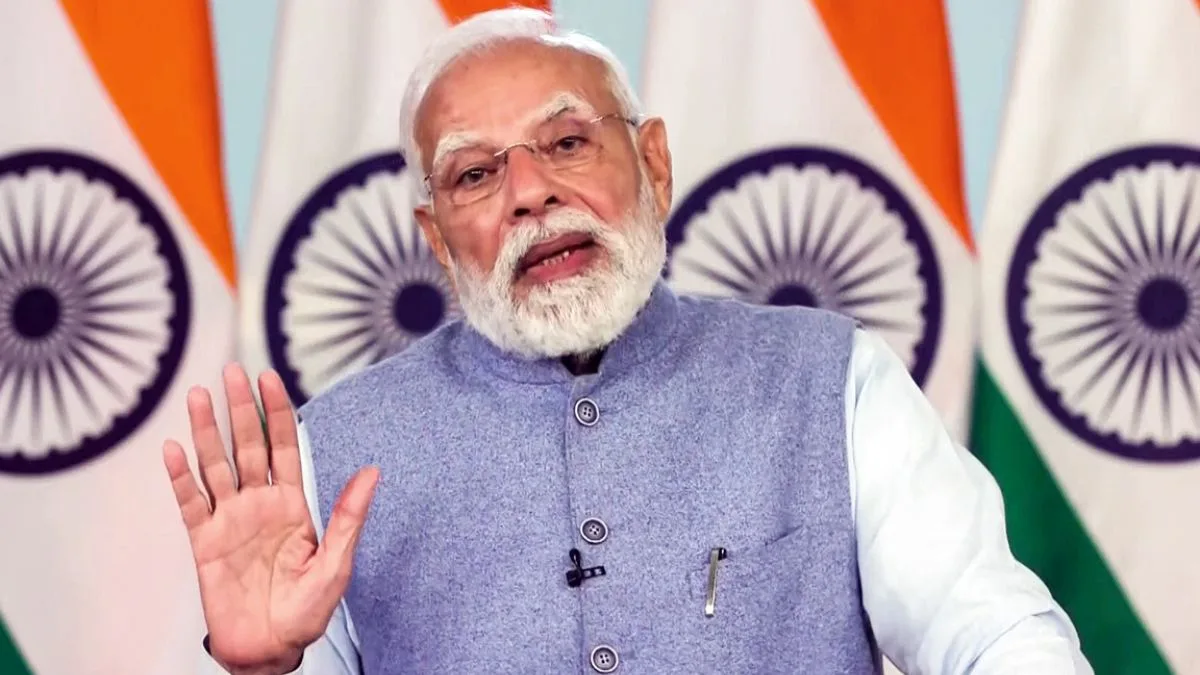
Prime Minister Narendra Modi on Wednesday inaugurated the Safran Aircraft Engine Services India (SAESI) facility at the GMR Aerospace and Industrial Park – SEZ, Rajiv Gandhi International Airport, Hyderabad, via video‑conference.
In his address, the Prime Minister described the state‑of‑the‑art Maintenance, Repair and Overhaul (MRO) hub for LEAP engines — which power the Airbus A320neo and Boeing 737 MAX — as a “new flight” for India’s rapidly expanding aviation industry.
Advertisement
“From today, India’s aviation sector is set to take a new flight. Safran’s new facility will help establish India as a global MRO hub,” PM Modi said, highlighting that the plant will create high‑tech opportunities for youth and position India as a key player in the global aerospace supply chain.
The SAESI facility spans 45,000 sq m with an initial investment of about Rs 1,300 crore. Designed to service up to 300 LEAP engines annually, it will employ over 1,000 highly skilled Indian engineers and technicians when it reaches full capacity by 2035. The plant features advanced process equipment to deliver world‑class engine maintenance and repair services.
“India’s aviation sector has advanced at an unprecedented pace — today we are among the fastest‑growing domestic aviation markets in the world and the third‑largest globally,” PM Modi noted, adding that the domestic market’s rapid growth — with airlines ordering more than 1,500 new aircraft — has heightened the need for MRO capabilities.
He pointed out that nearly 85 percent of India’s MRO work was previously carried out abroad, leading to higher costs and prolonged aircraft grounding — a situation “not suitable for a vast aviation market like India.”
The Prime Minister underlined that the new facility marks the first time a global engine original‑equipment‑manufacturer (OEM) has set up deep‑level servicing operations in India.
“Safran’s global training, knowledge transfer and partnership with Indian institutions will create a workforce that will give new momentum to the entire MRO ecosystem,” he said, noting that the project will generate numerous jobs for youth in South India and support the “Aatmanirbhar Bharat” (self‑reliant India) goal.
PM Modi also highlighted broader policy reforms that have enabled such investments: 100 percent FDI allowed through automatic routes in most sectors, 74 percent FDI opened in defence, liberalised space‑sector policies, GST reforms (2024), MRO Guidelines (2021) and the National Civil Aviation Policy (2016).
“These steps have sent a clear message to the world — India welcomes investments, India welcomes innovation,” he added.
Speaking of the larger vision, PM Modi stated, “India is not only dreaming big but also taking bold decisions and achieving even greater accomplishments. We are dreaming big, doing bigger and delivering best.”
He urged Safran to explore “Design in India” possibilities for aircraft‑engine components, leveraging India’s vast MSME network and youthful talent pool.
“For those investing in India, the country considers them not merely as investors but as co‑creators, stakeholders in the journey of a developed India,” he emphasized.
Congratulating “Team Safran” and all stakeholders, the Prime Minister said, “India is proving that betting on India is the smartest business decision of this decade.”
Chief Minister of Telangana Revanth Reddy, Union Minister K Ram Mohan Naidu and other dignitaries attended the virtual ceremony.
Safran Aircraft Engine Services India (SAESI) is Safran’s dedicated MRO facility for LEAP engines powering Airbus A320neo and Boeing 737 MAX aircraft. It is one of the largest global aircraft‑engine MRO sites and the first instance of a global engine OEM establishing an MRO operation in India.
The facility, built with an initial investment of around Rs 1,300 crore, will service up to 300 engines per year and employ over 1,000 skilled Indian technicians by 2035.
Government policies — including GST reforms, MRO Guidelines 2021 and the National Civil Aviation Policy 2016 — have simplified operations for MRO providers by rationalising tax structures and reducing royalty burdens.